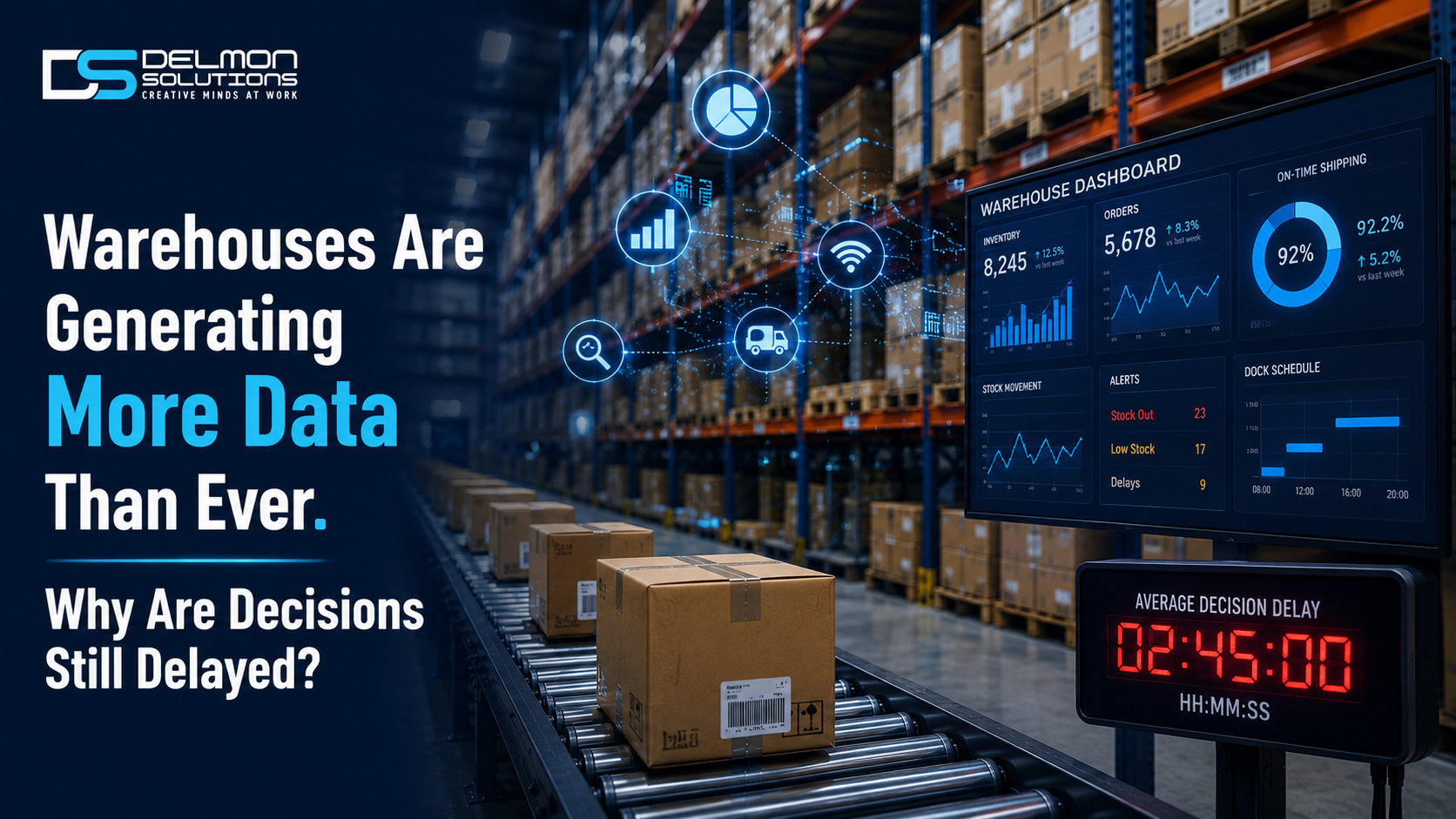
The global warehousing industry is entering a new operational phase, one defined not by storage capacity, but by data intensity.
According to multiple industry estimates, the global warehouse automation market is projected to exceed $50 billion by the end of the decade, driven by e-commerce growth, rising labor costs, and increasing demand for real-time fulfillment capabilities. Meanwhile, the Warehouse Management System (WMS) market continues to expand steadily as enterprises accelerate investments in digital supply chain infrastructure.
The numbers are unsurprising.
Modern warehouses now process millions of operational events daily:
- inventory scans,
- RFID reads,
- dock movements,
- forklift telemetry,
- pick confirmations,
- shipment validations, and
- continuous inventory adjustments.
“Warehouses have become some of the most data-rich environments in modern industry,” notes a recent supply chain technology report.
Yet beneath this acceleration lies a growing contradiction.
Despite unprecedented operational visibility, many warehouse decisions remain delayed, fragmented, and reactive.
Inventory discrepancies are often identified after fulfillment impact. Replenishment decisions still rely heavily on manual intervention. Congestion at receiving and dispatch zones is escalated only after throughput slows. Warehouse managers continue spending significant time consolidating fragmented operational views across disconnected systems.
In other words, the warehouse is generating real-time data, but the decision-making architecture surrounding it often is not operating in real time.
And increasingly, that gap is becoming a strategic concern for logistics leaders. Over the past decade, warehousing economics have changed fundamentally.
Global e-commerce expansion has compressed fulfillment timelines from days to hours. SKU proliferation has increased inventory complexity across industries ranging from retail and pharmaceuticals to manufacturing and automotive supply chains.
At the same time, customer expectations around delivery speed and inventory accuracy continue rising.
According to industry analysts, fulfillment operations are now under pressure to simultaneously improve:
- throughput,
- inventory visibility,
- labor productivity, and
- order accuracy.
Historically, Warehouse Management Systems were designed primarily to support transactional efficiency:
- receiving,
- put-away,
- inventory allocation,
- picking,
- packing, and
- dispatch coordination.
That model worked effectively in predictable supply chain environments. But modern logistics networks no longer operate predictably.
Today’s warehouse is a continuously shifting operational ecosystem where inventory velocity, demand patterns, transportation schedules, and labor allocation change dynamically throughout the day.
“The challenge is no longer capturing warehouse data,” says a senior logistics consultant at a global supply chain advisory firm. “The challenge is converting operational signals into operational decisions fast enough to influence outcomes.”
That distinction is critical.
Because visibility alone does not create responsiveness.
Many enterprises have already invested heavily in:
- RFID infrastructure,
- industrial mobility devices,
- IoT-enabled tracking systems,
barcode ecosystems, and - cloud-connected WMS environments.
However, in many facilities, operational intelligence still remains retrospective rather than predictive The result is decision latency inside environments that increasingly demand continuous responsiveness.
This is precisely why the role of Warehouse Management Software is beginning to evolve.
Enterprises are no longer evaluating WMS platforms solely on workflow management capabilities. Increasingly, the conversation is shifting toward operational intelligence.
The next generation of warehouse systems is expected to support:
- real-time visibility,
- predictive analytics,
- AI-assisted orchestration,
- continuous anomaly detection, and
- event-driven operational decision-making.
In practical terms, warehouse systems are moving from systems of record toward systems of intelligence.
That transition is being accelerated by the convergence of AI, RFID ecosystems, industrial IoT infrastructure, and edge-based operational analytics.
RFID, in particular, is emerging as more than an inventory tracking technology.
Its strategic value lies in compressing the time between operational movement and operational visibility.
The faster inventory movement becomes visible, the faster warehouse systems can identify anomalies, validate workflows, detect bottlenecks, and initiate corrective actions.
“Speed of visibility is becoming a competitive metric in logistics,” remarked an executive at a global warehouse automation conference earlier this year. “The companies that reduce decision latency will outperform those simply collecting more operational data.”
That observation reflects a broader market reality.
As supply chains become increasingly interconnected, delays inside warehouse decision cycles create cascading operational consequences across transportation, fulfillment, inventory planning, and customer experience.
This is where AI-enabled Warehouse Management Systems are beginning to gain strategic attention.
Rather than functioning solely as transactional platforms, intelligent warehouse systems are increasingly being designed to interpret operational behavior dynamically.
This includes identifying:
- inventory anomalies,
- pick path inefficiencies,
- dock congestion risks,
- replenishment gaps,
- throughput slowdowns before they materially impact operations.
The strategic advantage is not automation for its own sake. It is operational responsiveness.
And in modern logistics environments, responsiveness is rapidly becoming a defining competitive differentiator.

The warehouses emerging as industry leaders are not necessarily those deploying the largest automation budgets.
They are the organizations building the shortest distance between operational signal and operational action.
That distinction will likely define the next phase of warehouse transformation.
Because the future warehouse will not compete solely on storage density or fulfillment capacity.
It will compete on the speed, accuracy, and intelligence of its operational decision-making infrastructure.
Warehouses already possess the data.
The next competitive frontier lies in how quickly enterprises can transform that data into decisive operational outcomes.
The next phase of warehouse transformation will not be defined by how much data enterprises collect, but by how effectively they convert operational data into real-time decisions.
Building responsive warehouse environments requires more than software alone. It requires tightly integrated AIDC infrastructure spanning RFID, barcode systems, industrial mobility, real-time visibility platforms, and intelligent operational workflows.
As a leading AIDC solutions provider in India, Delmon Solutions enables logistics, manufacturing, warehousing, retail, and industrial enterprises to modernize supply chain operations through end-to-end identification and data capture solutions.
From RFID-enabled warehouse ecosystems and industrial handhelds to intelligent inventory visibility and warehouse mobility infrastructure, we help businesses reduce operational bottlenecks and improve decision responsiveness across the supply chain.
Connect with Delmon Solutions to build smarter, faster, and more intelligent warehouse operations.