For decades, Optical Character Recognition (OCR) had one primary job: converting images of text into machine-readable text. While revolutionary at the time, traditional OCR had significant limitations. It worked well with clean, printed documents but struggled with poor-quality scans, handwritten notes, and complex layouts.
Today, Artificial Intelligence has completely transformed OCR technology.
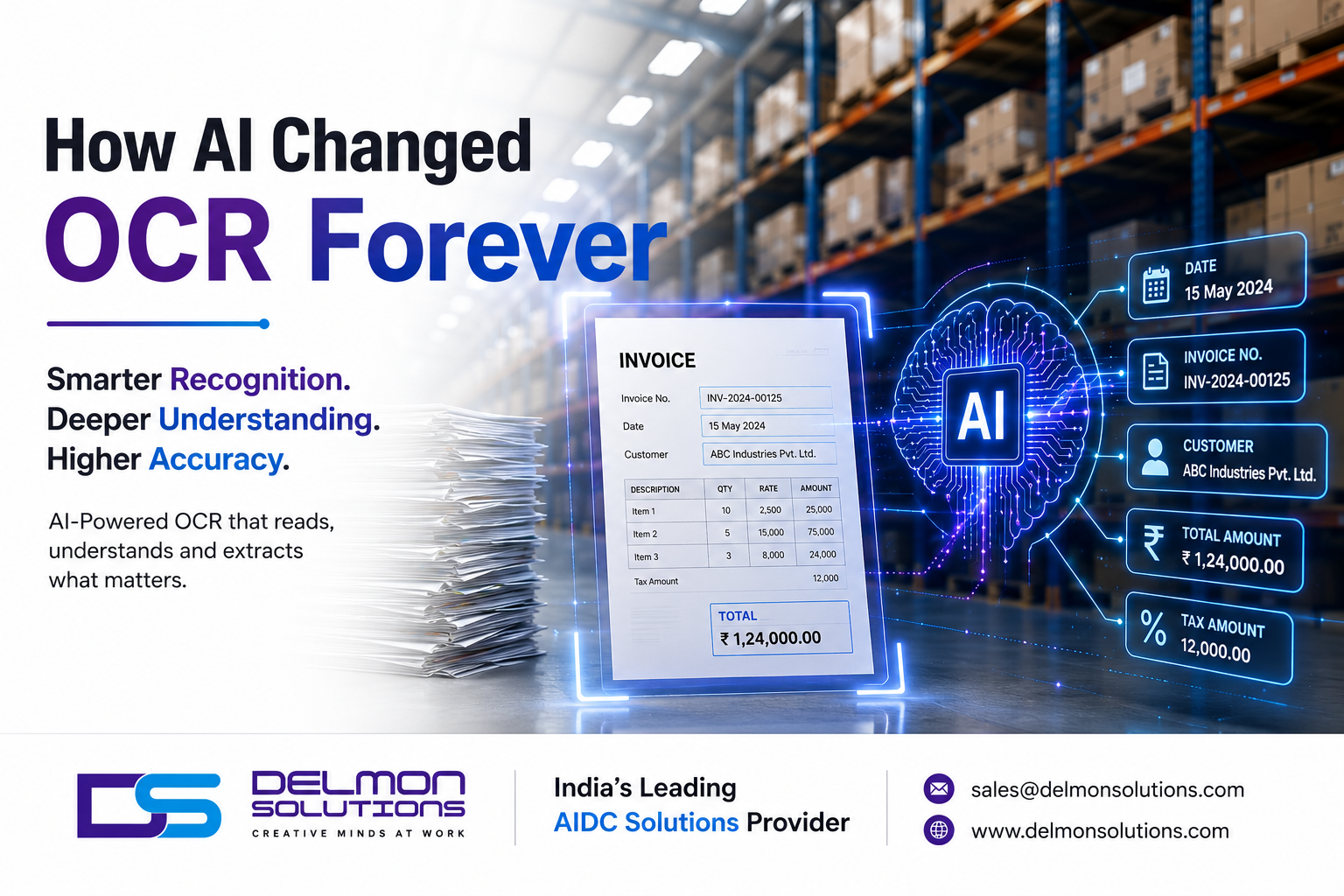
Modern Smart OCR solutions do much more than recognize text. They understand documents, identify key information, validate extracted data, and automate entire document workflows. This evolution has made AI-powered OCR an essential technology for businesses looking to eliminate manual data entry and accelerate digital transformation.
The Evolution of Traditional OCR
Traditional OCR technology relied on pattern matching.
It scanned an image, compared detected characters against a predefined character library, and converted those patterns into digital text.
For accurate results, it required:
- Clean scanned documents
- Standard fonts
- Fixed document layouts
- High-resolution images
Under ideal conditions, traditional OCR software performed well. It helped digitize books, archives, invoices, and printed forms.
However, it lacked one critical capability:
It couldn’t understand what it was reading.
An invoice number looked no different from a phone number. A total amount wasn’t recognized as a financial value. OCR simply converted images into text without understanding context.
Why Traditional OCR Failed in Real-World Scenarios
As businesses began processing diverse document types, traditional OCR quickly showed its limitations.
Poor Quality Documents: Faded invoices, skewed scans, low-resolution images, or documents with stains often produced inaccurate outputs.
Fixed Templates: Traditional OCR expected documents to follow predefined layouts. Even minor design changes significantly reduced recognition accuracy.
Handwritten Documents: Handwritten forms, signatures, and cursive text were extremely difficult for legacy OCR systems to recognize.
No Context Awareness: Traditional OCR extracted text but couldn’t determine whether the extracted values were correct or even meaningful.
Manual Verification: Businesses still spent considerable time reviewing, correcting, and validating extracted information.
Instead of eliminating manual work, traditional OCR often shifted the effort from typing to proofreading.
How AI Changed OCR Forever
Artificial Intelligence fundamentally changed how OCR works.
Instead of matching characters against fixed templates, AI-powered OCR learns from millions of real-world documents.
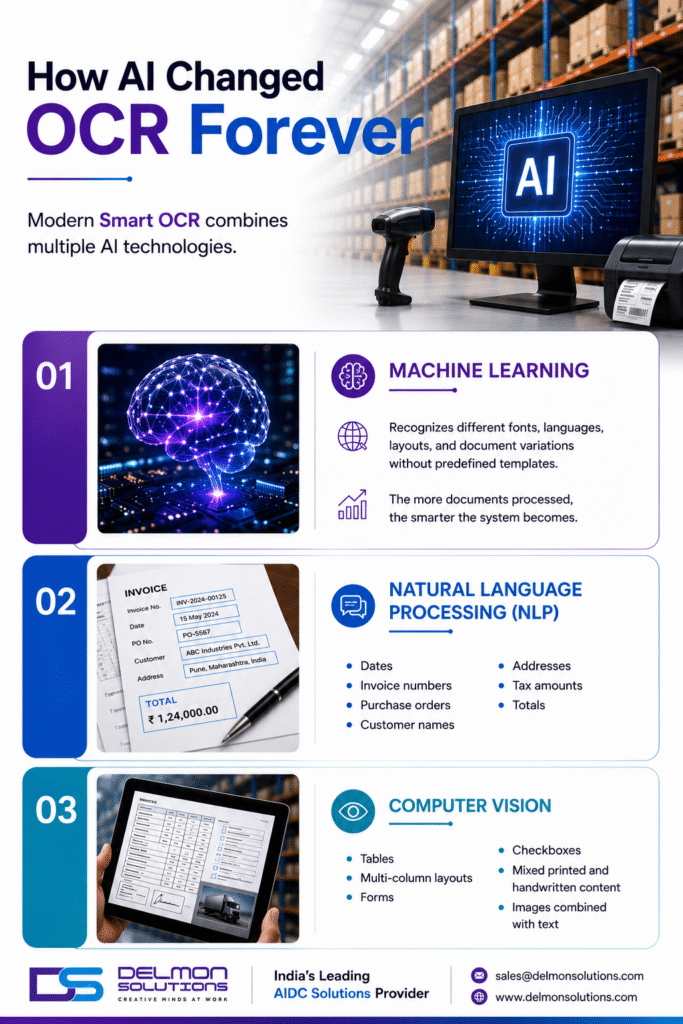
Modern Smart OCR combines multiple AI technologies.
Machine Learning: Machine Learning enables OCR systems to recognize different fonts, languages, layouts, and document variations without requiring predefined templates.
The more documents processed, the smarter the system becomes.
Natural Language Processing (NLP): NLP gives OCR contextual understanding. Instead of simply reading characters, it understands:
- Dates
- Invoice numbers
- Purchase orders
- Customer names
- Addresses
- Tax amounts
- Totals
The system identifies relationships between extracted fields rather than treating every character equally.
Computer Vision: Computer Vision enables Smart OCR to interpret documents the way humans do.It understands:
- Tables
- Multi-column layouts
- Forms
- Checkboxes
- Mixed printed and handwritten content
- Images combined with text
This dramatically improves extraction accuracy across complex documents.
What is Smart OCR?
Smart OCR is AI-powered Optical Character Recognition that not only extracts text but also understands, organizes, validates, and structures information automatically.
Unlike traditional OCR, Smart OCR can:
- Identify document types
- Detect key-value pairs
- Extract structured data
- Validate information
- Classify documents
- Prepare data for downstream systems
Rather than producing plain text, Smart OCR delivers business-ready information.
For example, instead of returning an invoice as unstructured text, Smart OCR identifies:
- Vendor Name
- Invoice Number
- Invoice Date
- GST Number
- Line Items
- Tax Amount
- Total Amount
All fields are automatically mapped into structured formats.
Traditional OCR vs Smart OCR
| Traditional OCR | Smart OCR |
| Requires clean scans | Handles poor-quality images |
| Fixed document templates | Works with dynamic layouts |
| Cannot read handwriting effectively | Reads handwritten text with increasing accuracy |
| Converts images into text | Understands document context |
| Limited automation | End-to-end document automation |
| Static performance | Continuously improves using AI |
| Requires manual validation | Automatically validates extracted data |
How AI Improves OCR Accuracy
Modern AI OCR achieves significantly higher accuracy through several intelligent mechanisms.
Learning from Massive Datasets
Machine Learning models are trained on millions of real-world documents, enabling them to recognize variations they were never explicitly programmed for.
Context-Aware Recognition
If extracted data appears inconsistent, AI uses context to identify likely corrections.
For example:
A date recognized as 45/19/2025 can be automatically corrected because the value doesn’t match valid date formats.
Validation Rules
Smart OCR validates extracted information against predefined business rules.
Examples include:
- Invoice totals
- GST formats
- Postal codes
- Customer IDs
- Currency formats
This significantly reduces downstream errors.
Continuous Learning
Unlike traditional OCR, Smart OCR improves over time.
Every processed document helps refine future recognition accuracy.
Beyond OCR: Intelligent Document Processing (IDP)
The biggest advancement isn’t OCR itself. It’s Intelligent Document Processing (IDP).
IDP combines Smart OCR with Artificial Intelligence to automate the complete document lifecycle.
A typical IDP workflow includes:
- Document Classification
- Data Extraction
- Data Validation
- Business Rule Verification
- Workflow Routing
- ERP or CRM Integration
Instead of simply reading documents, IDP transforms them into actionable business data.
Can Smart OCR Read Handwritten Documents?
Yes.
One of the biggest improvements in AI-powered OCR is handwriting recognition.
Modern AI document recognition models are trained using extensive handwritten datasets, enabling them to accurately interpret:
- Handwritten forms
- Delivery notes
- Inspection reports
- Medical prescriptions
- Signatures
- Field service reports
Although handwriting recognition is still evolving, today’s Smart OCR performs dramatically better than traditional OCR.
Industries Using Smart OCR Solutions
Smart OCR is transforming document-heavy industries worldwide.
Some of the biggest adopters include:
- Banking & Financial Services
- Insurance
- Healthcare
- Manufacturing
- Logistics & Supply Chain
- Retail
- Government
- Legal Services
- Education
- Human Resources
Wherever manual document processing exists, Smart OCR delivers immediate efficiency gains.
Frequently Asked Questions
What is Smart OCR?
Smart OCR is AI-powered Optical Character Recognition that extracts, understands, validates, and structures information from documents automatically.
How is Smart OCR different from Traditional OCR?
Traditional OCR simply converts images into text.
Smart OCR understands document context, extracts structured information, validates data, and continuously improves using Artificial Intelligence.
How does AI improve OCR accuracy?
AI improves OCR using Machine Learning, Natural Language Processing, Computer Vision, contextual understanding, validation rules, and continuous learning.
What is AI-powered OCR?
AI-powered OCR combines Optical Character Recognition with Artificial Intelligence technologies to accurately process real-world documents with varying layouts and quality.
Can Smart OCR read handwriting?
Yes.
Modern AI OCR can recognize handwritten text with significantly greater accuracy than traditional OCR systems.
What is Intelligent Document Processing (IDP)?
Intelligent Document Processing combines Smart OCR with Artificial Intelligence to automatically classify, extract, validate, and route document information into enterprise systems.
How accurate is AI OCR?
AI-powered OCR delivers significantly higher accuracy than legacy OCR, particularly when processing unstructured documents, poor-quality scans, and handwritten content.
Transform Documents into Actionable Data
Manual data entry and traditional OCR are no longer enough for today’s document-intensive businesses.
At Delmon Solutions Pvt Ltd, we help organizations implement Smart OCR Solutions, AI-powered OCR, and Intelligent Document Processing (IDP) to automate document extraction, improve accuracy, and accelerate business workflows.
Whether you’re processing invoices, purchase orders, forms, contracts, or logistics documents, our AI-driven solutions can help you eliminate manual effort and unlock faster, smarter document processing.
Ready to modernize your document workflows? Contact us today.