A warehouse can have a Warehouse Management System (WMS), barcode scanners, mobile computers and real-time inventory records, yet still struggle with delayed dispatches, picking errors, congestion and uneven workforce productivity.
The problem is not necessarily a lack of technology. It is often the gap between recording warehouse activity and using operational data to improve decisions.
Traditional warehouse systems are designed to manage transactions, inventory and workflows. AI introduces another capability: analysing operational patterns, identifying exceptions and helping teams determine what needs attention before small inefficiencies become expensive problems.
For warehouse operators in India, the next stage of optimisation is not simply replacing existing software. It is connecting warehouse data, automatic identification, analytics and operational processes into a system that supports better decisions.
Where Conventional Warehouse Management Reaches Its Limits
A WMS remains essential for inventory control, order management, location assignment and warehouse execution. The limitation appears when businesses expect a transaction-management system to solve every operational problem.
Consider four common situations:
- Inventory discrepancies: System records show stock availability, but physical quantities or locations do not match.
- Picking and dispatch delays: Orders are released, yet congestion, travel distances or poor task sequencing slow fulfilment.
- Limited operational visibility: Managers discover bottlenecks through end-of-shift reports rather than identifying them as they develop.
- Disconnected data: Barcode scanners, mobile computers, RFID readers and other systems capture information that does not flow consistently into operational decisions.
These problems require more than another dashboard. They require reliable data capture, contextual analysis and workflows that translate information into action.
The Warehouse Optimization Stack: Five Layers That Work Together
AI-powered warehouse optimization is best understood as an operating model built from complementary technologies, rather than a standalone AI application.
| Technology layer | Primary role | Example warehouse application |
| WMS and ERP | Manage inventory, orders and business transactions | Order allocation and stock records |
| AIDC hardware | Capture item and asset identification data | Barcode scanning, RFID reading and mobile data capture |
| Data integration | Connect operational events across systems | Synchronising scans, inventory movements and order status |
| AI and analytics | Identify patterns, predict outcomes and recommend actions | Detecting recurring picking delays or potential stock shortages |
| Workflow execution | Put decisions into operational processes | Exception alerts, task prioritisation and escalation |
Automatic Identification and Data Capture (AIDC) is particularly important because AI recommendations are only as useful as the underlying data. GS1’s identification and capture framework similarly connects physical identification technologies with the business systems that use the resulting information.
For example, barcode scanners and rugged mobile computers can capture item movements at receiving, picking and dispatch. RFID can support automated identification at suitable checkpoints. When this information is integrated with warehouse records, analytics can help managers understand where delays, discrepancies or recurring exceptions occur.
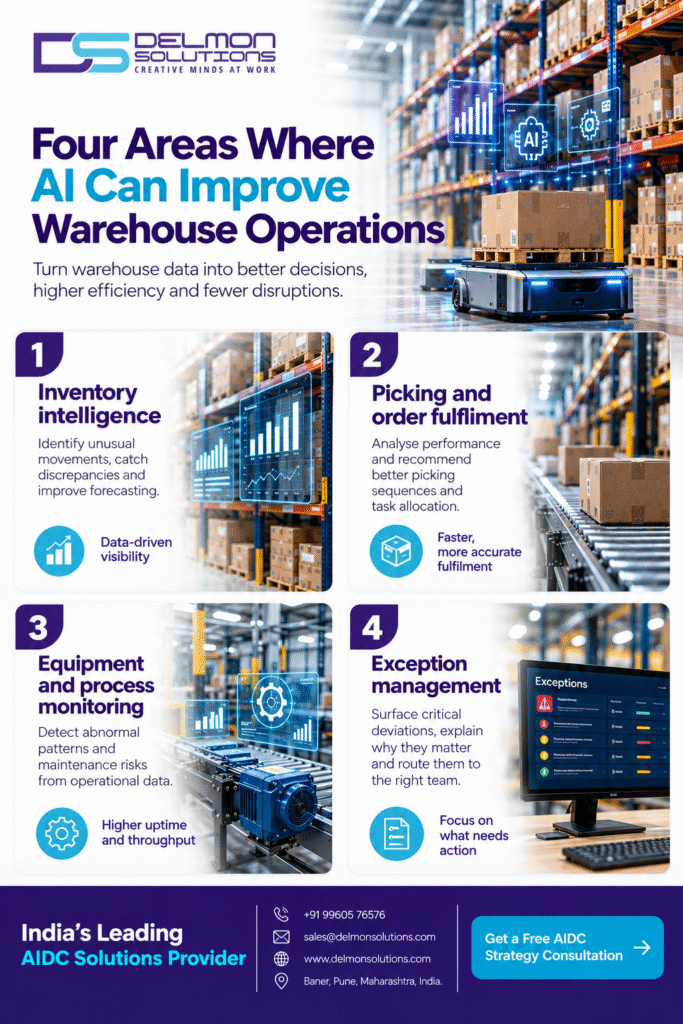
Four Areas Where AI Can Improve Warehouse Operations
1. Inventory intelligence
AI-assisted analytics can help identify unusual inventory movements, recurring stock discrepancies and patterns associated with inaccurate records. Depending on the available data, predictive models may also support demand forecasting and replenishment planning.
These capabilities do not eliminate the need for physical verification. They help teams prioritise the exceptions that deserve investigation.
2. Picking and order fulfilment
Order fulfilment performance depends on several variables, including item location, order profile, travel distance, staffing and dispatch deadlines.
Analytics can identify recurring bottlenecks and compare performance across shifts, zones or order types. More advanced systems may recommend picking sequences or task allocation, subject to warehouse constraints and integration with the WMS.
3. Equipment and process monitoring
Warehouse equipment, conveyors, scanners, printers and material-handling systems all influence throughput.
Where suitable sensor or operational data is available, analytics can help identify abnormal patterns, recurring interruptions and maintenance-related risks. Predictive maintenance requires appropriate historical data and validated models; it should not be assumed that every equipment problem can be predicted accurately.
4. Exception management
One of AI’s practical uses is helping teams focus on deviations rather than reviewing every transaction manually.
Examples include repeated scan failures, unusual order-processing times, discrepancies between expected and recorded movements, and recurring delays at dispatch checkpoints.
The objective is to surface actionable exceptions, explain why they matter and direct them to the appropriate team. Human oversight remains important, particularly when recommendations affect inventory commitments, safety or customer delivery promises.
What Is Driving Warehouse Automation in India?
Warehouse technology investment is being shaped by fulfilment expectations, changing distribution networks and the need to manage operations more efficiently.
CBRE’s India Logistics Market Outlook 2026 projects that India’s warehouse automation market will reach US$1.42 billion by 2030. The report also highlights quick-commerce growth and micro-fulfilment models as factors influencing warehouse infrastructure and operating requirements.
Meanwhile, DHL’s Logistics Trend Radar 8.0, published in September 2026, identifies AI analytics and agentic AI among the trends expected to influence logistics over the coming decade. It describes a shift towards systems that can increasingly plan, coordinate and act, while emphasising workforce capability, cybersecurity and human oversight.
These developments point towards a more connected warehouse environment. They do not mean every facility needs autonomous operations or a complete technology overhaul. The appropriate investment depends on warehouse complexity, transaction volumes, data quality and the business case for each use case.
How to Start an AI-Powered Warehouse Optimization Project
A practical implementation should begin with a measurable operational problem.
Step 1: Establish a baseline. Measure inventory accuracy, order-picking time, dispatch turnaround, scan compliance and recurring exceptions.
Step 2: Validate data capture. Check whether barcode systems, RFID readers, mobile computers and existing software capture reliable, consistent information.
Step 3: Select one high-value use case. Start with a defined problem, such as repeated picking delays or recurring inventory discrepancies, rather than deploying AI across every process.
Step 4: Integrate and pilot. Connect the relevant data sources, test the proposed workflow and compare results against the baseline.
Step 5: Scale on evidence. Expand only when the pilot demonstrates operational value, acceptable error rates and a clear path to ongoing maintenance and governance.
Frequently Asked Questions
Can AI optimize a warehouse without replacing its WMS?
Yes. AI and analytics can complement an existing WMS by analysing operational data, identifying exceptions and supporting decisions. The level of integration depends on the systems, data quality and use case.
What role does AIDC play in AI-powered warehouses?
AIDC technologies such as barcode scanners, RFID readers and mobile computers capture identification data from physical operations. This data can feed warehouse systems and analytics, helping connect inventory movements with operational decisions.
Does every warehouse need RFID and AI?
No. The right technology depends on the business problem, transaction volume, identification requirements and expected return. Barcode-based workflows may be sufficient for many facilities, while selected operations may benefit from RFID or AI-assisted analytics.
How should a warehouse measure the success of AI optimization?
Use operational metrics such as inventory accuracy, picking productivity, order cycle time, dispatch turnaround, exception rates and cost per order. Establish a baseline before deployment and evaluate the results against it.
Building a More Intelligent Warehouse with Delmon Solutions
Warehouse optimization starts with reliable identification and data capture. AI can add value when that information is accurate, connected and relevant to the decisions warehouse teams make every day.
Delmon Solutions Pvt. Ltd. provides AIDC solutions for businesses across logistics, manufacturing, warehousing and retail, including barcode scanners, RFID readers, rugged mobile computers and barcode printing solutions.
As India’s Leading AIDC Solutions Supplier, Delmon helps businesses evaluate identification technologies and build practical foundations for more connected warehouse operations.
Planning your next warehouse technology upgrade? Speak with Delmon Solutions about the AIDC hardware and data-capture approach that fits your operational requirements.
Website: https://delmonsolutions.com/
Email: sales@delmonsolutions.com
Phone: +91 99605 76576
Location: Baner, Pune, Maharashtra, India.