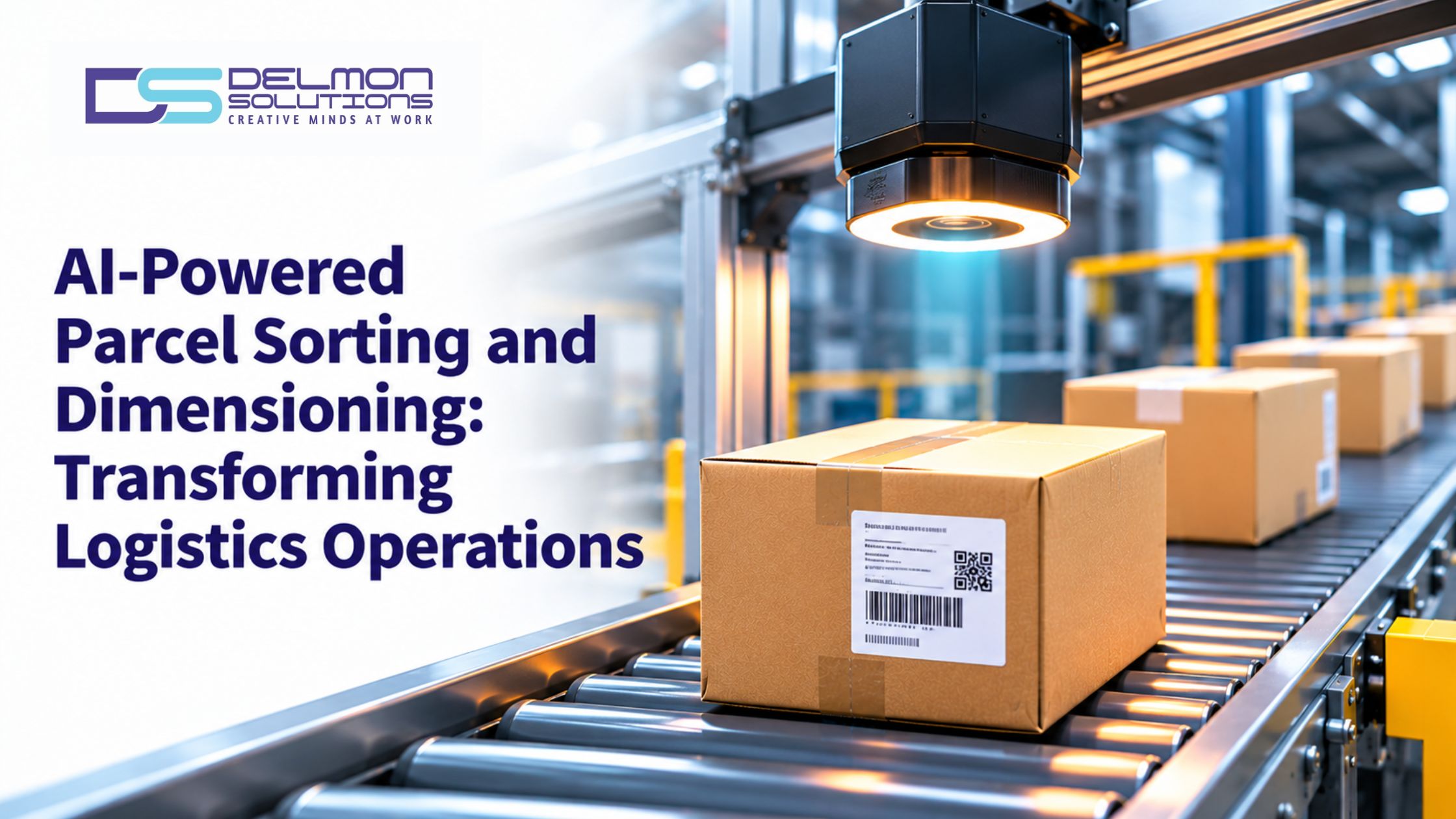
E-commerce growth, increasing shipment volumes and tighter delivery expectations have placed greater pressure on logistics operators to process parcels accurately and efficiently.
Distribution hubs and fulfilment centres handle thousands of packages across inbound receiving, identification, sorting, weighing, dimensioning and dispatch. Each parcel must be identified correctly, assigned to the appropriate destination and processed with accurate shipment information.
Manual identification and measurement can become operational bottlenecks, particularly in facilities handling high parcel volumes.
AI-powered machine vision, automated dimensioning systems and intelligent barcode scanning are helping logistics businesses automate these activities. By combining visual recognition with automatic identification and data capture (AIDC), logistics operators can improve parcel processing, reduce manual intervention and establish more reliable shipment records.
Why parcel identification and dimensioning matter
Parcel sorting depends on accurate information about each shipment. Before a package can be routed through a distribution facility, the system needs to establish its identity, destination and relevant physical characteristics.
- Shipment or tracking number.
- Barcode or QR code information.
- Parcel dimensions.
- Actual weight.
- Volumetric weight.
- Destination and routing information.
- Package condition and handling requirements.
Errors in any of these data points can affect downstream operations. An incorrectly read barcode may prevent shipment identification. An inaccurate dimension measurement can affect freight calculations. A parcel routed to the wrong sorting lane can create additional handling and delivery delays.
For logistics operators, automated identification and measurement are therefore essential components of efficient parcel processing.
1. How AI-powered machine vision improves parcel identification
Machine vision uses cameras and image-processing software to capture and analyse visual information. In logistics environments, machine vision systems can inspect parcels moving along conveyor belts, identify package characteristics and support automated sorting decisions.
AI enhances this process by enabling systems to recognise more complex visual patterns and classify objects based on their appearance.
- Parcel recognition: Computer vision can identify packages based on their shape, size, orientation and visual characteristics.
- Label detection: Vision systems can locate shipping labels and identify the areas where barcode information needs to be captured.
- Package condition monitoring: Image analysis can help identify visible damage, deformation or irregularities that may require additional inspection.
- Orientation detection: Vision systems can determine parcel positioning and support automated handling and conveyor control.
These capabilities can help logistics facilities process different parcel types without relying entirely on manual visual checks. However, visual recognition does not replace the need for reliable shipment identification. Barcode decoding remains essential for associating a physical parcel with its tracking and routing information.
2. Automated barcode scanning and shipment identification
Barcodes are central to parcel identification across logistics networks. Each shipment carries a unique identifier that connects the physical parcel to its digital shipping record.
Traditional handheld scanning is suitable for many operations, but high-volume sorting facilities often require fixed scanning infrastructure to capture shipment information without stopping the conveyor workflow.
Fixed industrial barcode readers can capture information from shipping labels as parcels move through scanning stations. Multi-sided scanning configurations can improve the ability to read labels placed on different surfaces.
When integrated with logistics software, captured information can be used to retrieve shipment records, validate parcel identity, determine destination information, trigger automated sorting instructions and record parcel movement through the facility.
AI-powered vision can complement barcode reading by helping locate labels, recognise package characteristics and identify cases requiring additional inspection. The distinction is important: AI visual recognition interprets the image, while the barcode reader decodes the encoded shipment identifier.
3. Automated parcel dimensioning and volumetric measurement
Parcel dimensioning is the process of measuring a package’s length, width and height. These measurements are used for freight calculations, warehouse space planning, shipment classification and transport capacity management.
Manual measurement becomes difficult to sustain in high-throughput facilities, especially when parcels have different shapes and dimensions. Automated dimensioning systems use cameras, 3D sensors or other measurement technologies to capture package dimensions without relying on manual tape measurements.
- Time-of-Flight (ToF): Measures distance by analysing the time taken for emitted light to return after reflecting from an object.
- Stereo vision: Uses images captured from different camera positions to estimate depth and reconstruct three-dimensional information.
- 3D machine vision: Captures spatial information to determine object dimensions, orientation and volume.
These technologies can support automated dimensioning of cartons, packages and pallets. The appropriate method depends on parcel characteristics, required measurement accuracy, throughput and operating environment.
4. Integrating dimensioning, weighing and scanning
One of the most useful developments in logistics automation is the integration of dimensioning, weighing and scanning (DWS). A DWS system combines three important shipment data capture activities.
| Function | Information captured | Operational purpose |
| Dimensioning | Length, width and height | Calculate parcel volume |
| Weighing | Actual package weight | Freight and shipment calculations |
| Scanning | Barcode and shipment ID | Identify and retrieve shipment records |
When integrated, these functions create a consolidated shipment record. For example, as a parcel moves through a DWS station, the system can capture its barcode, measure its dimensions and record its weight. The information can then be transferred to a Warehouse Management System (WMS), Transportation Management System (TMS) or shipping platform.
This reduces the need for separate manual data entry and helps maintain consistency across shipment processing activities.
An important consideration is measurement compliance. Where dimensions or weight are used for commercial freight billing, the equipment must meet the applicable legal-for-trade and metrology requirements. Not every dimensioning system is automatically suitable for billing purposes.
5. AI-powered parcel sorting and automated routing
Once a parcel has been identified and its shipment information captured, it must be routed to the appropriate destination. Automated sorting systems use conveyor infrastructure, barcode readers, control systems and mechanical diverters to direct parcels through designated routes.
AI can contribute by analysing operational data, supporting parcel classification and identifying exceptions.
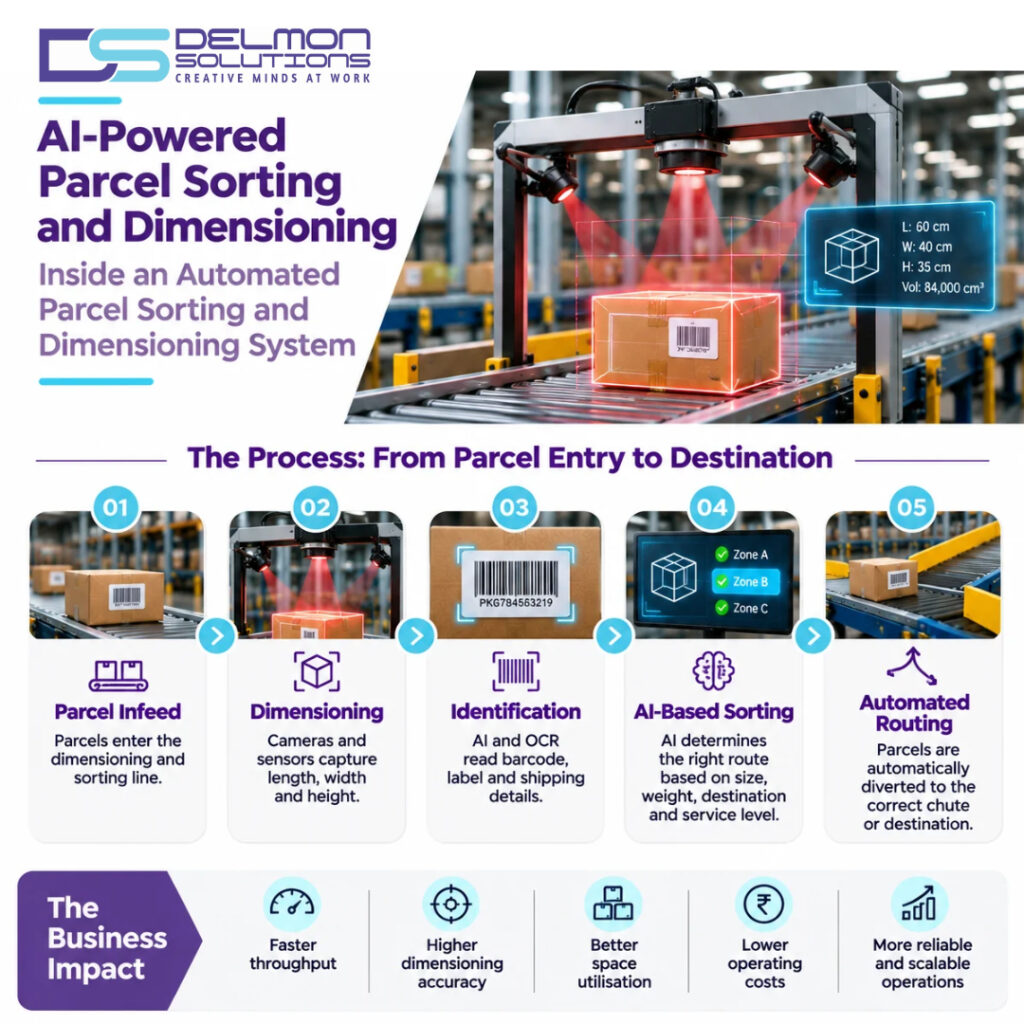
- A parcel enters the scanning conveyor.
- Cameras capture package images.
- Barcode readers identify the shipment.
- Dimensioning and weighing systems record physical measurements.
- The sorting software retrieves destination information.
- The conveyor control system directs the parcel to the appropriate sorting lane.
- Shipment movement is recorded in the logistics platform.
AI-based visual analysis can help identify parcels with irregular shapes, damaged packaging or uncertain label positions, allowing the system to flag them for additional handling. The sorting decision itself must still be based on reliable shipment data and properly configured operational rules.
6. Benefits of intelligent parcel processing
| Operational area | Potential benefit |
| Shipment identification | More consistent barcode capture |
| Dimensioning | Reduced dependence on manual measurement |
| Sorting | Improved routing and exception handling |
| Freight management | More accurate shipment measurements |
| Quality checks | Identification of visible package abnormalities |
| Shipment records | Better integration of parcel data |
| Facility operations | Improved processing visibility |
The actual benefits depend on conveyor configuration, package characteristics, scanning performance, system integration and parcel volumes.
7. What logistics operators should evaluate before implementation
- Parcel variation: Regular cartons, polybags, irregular packages and oversized shipments.
- Scanning performance: Barcode readability across different label positions and orientations.
- Measurement requirements: Required dimensioning accuracy and legal-for-trade certification.
- Conveyor speed: Ability to capture data at the required throughput.
- System integration: Connectivity with WMS, TMS, ERP and shipping platforms.
- Exception management: Procedures for unreadable labels, overlapping parcels and damaged shipments.
- Scalability: Ability to accommodate higher shipment volumes and additional sorting lanes.
The objective should be to build an integrated identification and measurement environment rather than deploy isolated automation equipment.
Building intelligent logistics operations with AIDC
Parcel automation increasingly depends on the convergence of machine vision, barcode scanning, 3D measurement and intelligent data processing.
Machine vision helps systems interpret physical packages. Barcode technology establishes shipment identity. Automated dimensioning captures package measurements, while logistics software connects the resulting information with routing and fulfilment workflows.
AI adds another layer of intelligence by helping identify visual patterns, detect exceptions and analyse operational data.
For logistics businesses, these technologies provide a foundation for more connected parcel processing and distribution operations.
For organisations evaluating parcel identification and automated data capture, selecting the right AIDC infrastructure is an important step towards improving shipment visibility and operational accuracy.
Delmon Solutions Pvt. Ltd. provides AIDC technologies for logistics, warehousing and distribution operations, including industrial barcode scanners, mobile computers and RFID solutions. Email us.