For years, enterprises viewed Automatic Identification and Data Capture (AIDC) as a tactical investment focused primarily on barcode scanning and labeling. That approach is rapidly becoming obsolete.
Modern industrial operations demand far more than isolated scanners and standalone print systems. Today, AIDC sits at the center of warehouse modernization, workforce mobility, real-time visibility, and AI-assisted operational execution.
According to VDC Research, enterprises across logistics, manufacturing, and supply chain operations are accelerating investments in rugged mobility and intelligent data capture technologies to improve operational responsiveness. Publications such as IoT World Today and Supply Chain Digital have similarly highlighted how connected mobility ecosystems are becoming foundational to intelligent operations.
The distinction between basic digitization and operational intelligence now depends on one factor: ecosystem maturity. Let us delve into this as we discuss AIDC Capability Roadmap in detail.
Understanding the Modern AIDC Ecosystem Architecture
A modern AIDC environment extends far beyond barcode scanners. Mature deployments integrate mobility, printing, connectivity, enterprise systems, and operational analytics into a unified execution framework.
| AIDC Layer | Operational Purpose | Core Technologies |
| Data Capture Layer | Real-time operational visibility | Barcode scanners, RFID |
| Mobility Layer | Workforce execution | Android Mobile Computers, Industrial Mobile Computers |
| Print Infrastructure | Traceability and labeling | Barcode Label Printer, Mobile Printer |
| Integration Layer | Enterprise synchronization | ERP, WMS, MES |
| Intelligence Layer | Automation and analytics | AI workflows, predictive systems |
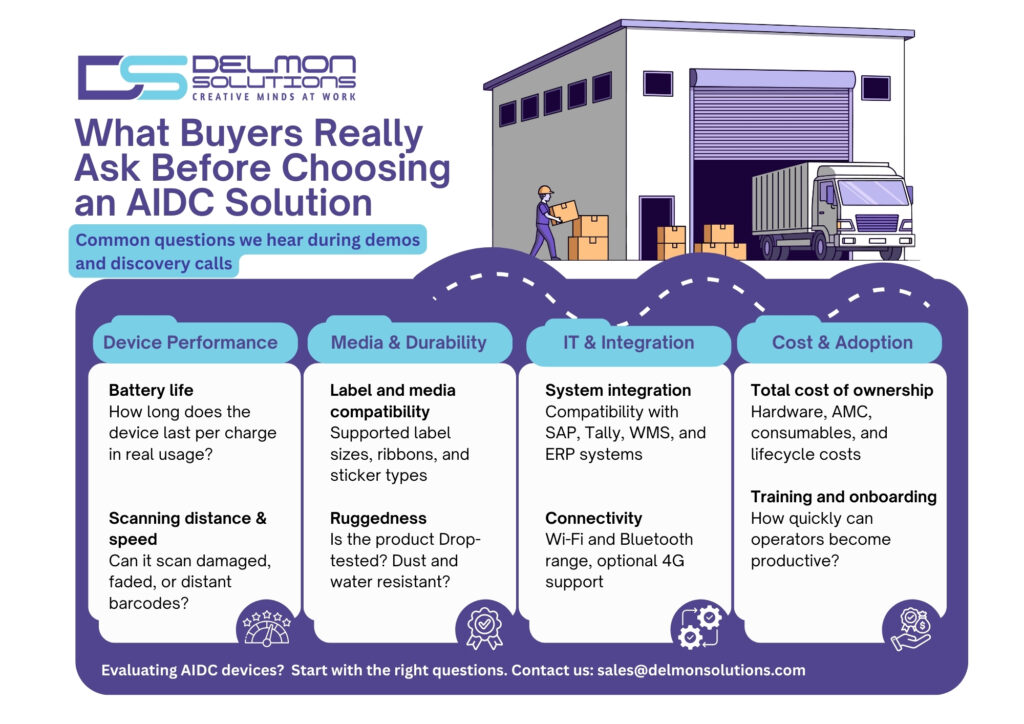
How Leading AIDC Vendors Build Scalable Mobility Infrastructure
Most organizations invest only in the first layer. Operational maturity begins when these systems function as an integrated ecosystem.
Stage 1: Barcode Digitization and Foundational Visibility
The first stage of AIDC adoption typically focuses on barcode digitization. Here is where why barcode label printer infrastructure remains critical.
Enterprises deploy barcode scanners, Barcode Label Printer systems, and entry-level Mobile Printer environments to improve inventory accuracy, shipment tracking, and warehouse traceability.
While this creates operational visibility, the environment often remains fragmented. Device interoperability is limited, synchronization delays persist, and operational intelligence remains minimal.
This stage improves data capture efficiency but rarely transforms operational agility.
Stage 2: Android Mobile Computers and Workforce Mobility
The second stage introduces enterprise mobility orchestration through Android Mobile Computers and rugged handheld ecosystems.
Modern Industrial Mobile Computers in India now support:
- Real-time inventory execution
- Warehouse management applications
- GPS-enabled field operations
- IoT-connected workflows
- Cloud synchronization
- AI-assisted operational processes
This transition has fundamentally changed enterprise procurement priorities.
Organizations are no longer evaluating standalone hardware. They are evaluating mobility ecosystems capable of supporting long-term automation initiatives.
This shift has also increased enterprise demand for proven AIDC products such as:
- Handheld mobile computer Supplier in India
- Cipherlab Mobile Computer supplier in India
- Cipherlab Barcode Scanners in India
- Cipherlab Scanner Suppliers in India
| Capability Area | Legacy Handhelds | Android Mobile Computers |
| Scalability | Moderate | Enterprise-grade |
| Integration | Limited | API-driven |
| Device Management | Fragmented | Centralized MDM |
| AI Compatibility | Minimal | Advanced |
Stage 3: Intelligent AIDC Ecosystems and AI Automation
As enterprises mature operationally, disconnected hardware environments evolve into synchronized mobility ecosystems.
Barcode scanners communicate directly with warehouse management platforms. Mobile Printer environments synchronize in real time with inventory systems. Android Mobile Computers continuously exchange operational data with ERP and analytics platforms.
The operational objective shifts from simple data capture toward intelligent operational orchestration.
This ecosystem-driven model enables:
- Continuous inventory visibility
- Faster fulfillment cycles
- Workforce productivity optimization
- Centralized operational analytics
- AI-assisted exception handling
This is also why enterprises increasingly evaluate specialized providers such as TSC Barcode Printer Supplier in India and advanced enterprise mobility partners capable of supporting scalable AIDC transformation initiatives.
FAQs About AIDC Vendors and Enterprise Mobility Infrastructure
What do AIDC Vendors provide?
AIDC Vendors provide technologies such as barcode scanners, Android Mobile Computers, RFID systems, Mobile Printer solutions, and enterprise mobility infrastructure designed to improve operational visibility and automation.
Why are Android Mobile Computers replacing legacy handheld devices?
Android Mobile Computers offer better scalability, cloud integration, enterprise application compatibility, centralized device management, and AI-readiness compared to legacy handheld systems.
How do Industrial Mobile Computers improve warehouse operations?
Industrial Mobile Computers improve inventory accuracy, workforce productivity, real-time communication, and operational synchronization across warehouse and logistics environments.
Why is integrated AIDC infrastructure important for AI automation?
AI systems require structured, real-time operational data. Integrated AIDC ecosystems provide the connected visibility layer necessary for predictive analytics and intelligent workflow automation.
Delmon Solutions Committed to Building Intelligent AIDC Operations for the Future
Enterprises that continue treating barcode infrastructure as an isolated utility will eventually encounter limitations in visibility, scalability, and automation readiness.
Organizations investing in connected Android Mobile Computers, intelligent print ecosystems, and integrated operational mobility environments are building the foundations required for AI-driven operations.

At Delmon Solutions, we help enterprises architect scalable AIDC ecosystems across Industrial Mobile Computers in India, Barcode Label Printer environments, Mobile Printer deployments, warehouse mobility infrastructure, and intelligent operational workflows. Contact us to build your operational intelligence at scale.