Artificial Intelligence is reshaping warehouse operations, but building an AI-powered warehouse doesn’t begin with AI.
It begins with data.
Many organizations invest in AI expecting immediate results, only to discover that disconnected systems, poor data quality, and manual workflows limit its potential. Successful AI adoption requires a structured approach where data capture, automation, and operational intelligence evolve together.
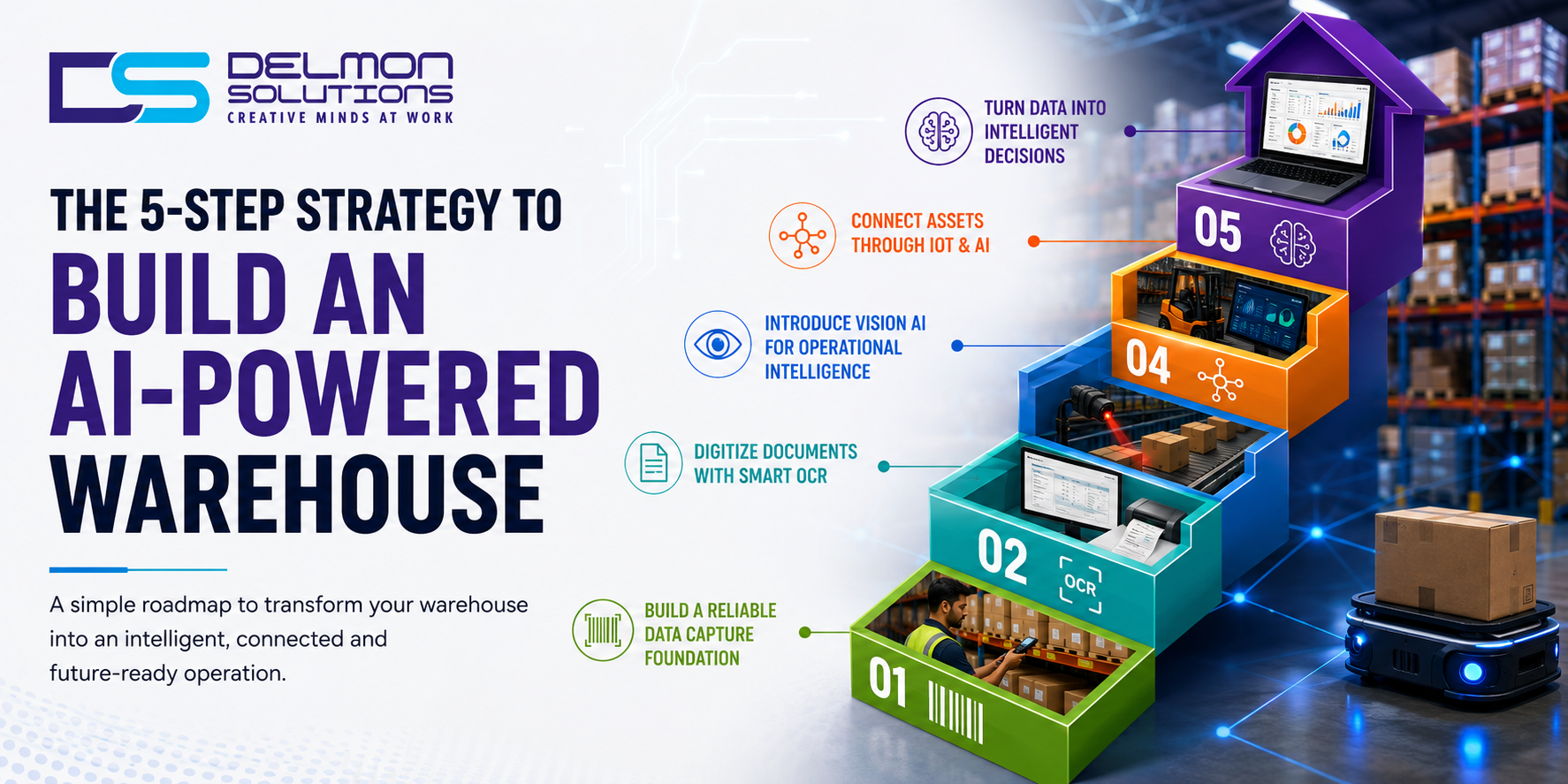
This five-step strategy provides a practical roadmap for organizations looking to modernize warehouse operations and unlock the full value of AI.
Key Takeaways
- AI delivers the greatest value when built on reliable operational data.
- AIDC technologies provide the foundation for AI-powered warehouses.
- Vision AI, Smart OCR, RFID, and IoT complement traditional barcode scanning.
- Warehouse transformation is a phased journey, not a one-time project.
- Organizations that combine AI with connected operations improve visibility, productivity, and decision-making.
Why AI Needs a Strong Foundation
Artificial Intelligence cannot optimize processes it cannot see.
If inventory records are inaccurate, warehouse documents remain paper-based, or assets cannot be tracked in real time, AI has limited visibility into warehouse operations.
Before introducing AI, organizations should establish a connected digital ecosystem where information flows seamlessly across people, assets, and systems.
Step 1: Build a Reliable Data Capture Foundation
The first step is ensuring every warehouse activity is digitally captured.
This includes:
- Barcode scanners
- Mobile computers
- RFID systems
- Industrial barcode printers
- Wireless connectivity
- Warehouse Management Software
Together, these AIDC technologies create accurate, real-time operational data that AI can analyze.
Without reliable data capture, warehouse intelligence cannot scale.
Step 2: Digitize Documents with Smart OCR
Warehouses process thousands of documents every day.
Examples include:
- Goods receipt notes
- Delivery challans
- Purchase orders
- Shipping labels
- Quality inspection reports
- Compliance documentation
Manual document processing slows operations and introduces errors.
AI-powered Smart OCR automatically extracts, validates, and classifies information while integrating it directly into ERP and Warehouse Management Systems.
The result is faster workflows, improved traceability, and significantly reduced manual effort.
Step 3: Introduce Vision AI
Traditional warehouse systems identify products.
Vision AI understands what cameras observe.
Applications include:
- Pallet verification
- Carton damage detection
- Label verification
- Empty shelf identification
- Safety monitoring
- Loading accuracy
Instead of relying solely on barcode scans, warehouses gain an additional layer of visual intelligence.
Vision AI doesn’t replace existing AIDC technologies. It makes them more powerful.
Step 4: Connect Assets Through IoT and AI
Modern warehouses contain valuable operational assets including:
- Forklifts
- Conveyors
- Printers
- Storage systems
- Refrigeration units
- Automated handling equipment
IoT sensors continuously monitor these assets.
Artificial Intelligence then analyzes this information to:
- Predict equipment failures
- Detect operational bottlenecks
- Monitor energy consumption
- Improve asset utilization
- Reduce unexpected downtime
Instead of reacting to problems, operations teams can prevent them.
Step 5: Turn Data into Intelligent Decisions
This is where AI creates its greatest business value.
Rather than producing reports after events occur, AI continuously evaluates warehouse operations and recommends improvements.
Examples include:
- Optimizing picking routes
- Predicting inventory shortages
- Improving workforce allocation
- Identifying process bottlenecks
- Detecting unusual inventory movement
- Supporting faster operational decisions
The warehouse evolves from a reactive operation into an intelligent decision-making environment.
AI Warehouse Maturity Model
| Stage | Warehouse Capability |
| Level 1 | Manual processes and paper-based workflows |
| Level 2 | Barcode scanning and Warehouse Management Software |
| Level 3 | Connected AIDC with RFID and mobile computing |
| Level 4 | Vision AI, Smart OCR, and IoT-enabled operations |
| Level 5 | AI-powered predictive and autonomous warehouse operations |
Every organization progresses at its own pace.
The objective isn’t to reach Level 5 overnight. It’s to establish a scalable digital foundation.
Common Challenges During AI Adoption
Organizations often face similar obstacles:
| Challenge | Recommended Approach |
| Poor inventory accuracy | Strengthen AIDC infrastructure |
| Manual documentation | Deploy Smart OCR |
| Limited warehouse visibility | Implement RFID and IoT |
| Disconnected systems | Integrate ERP, WMS, and AIDC |
| Reactive operations | Introduce AI analytics and automation |
Addressing these challenges early accelerates long-term AI success.
Benefits of an AI-Powered Warehouse
Organizations following a structured implementation strategy can achieve:
- Improved inventory accuracy
- Faster order fulfillment
- Better warehouse visibility
- Reduced manual data entry
- Improved manufacturing traceability
- Lower operational costs
- Increased labour productivity
- Better customer satisfaction
- Faster operational decision-making
The greatest advantage isn’t automation.
It’s building a warehouse that continuously learns and improves.
Frequently Asked Questions
What is an AI-powered warehouse?
An AI-powered warehouse uses Artificial Intelligence alongside AIDC technologies, Vision AI, RFID, Smart OCR, and IoT to improve warehouse efficiency, visibility, and decision-making.
Can AI replace warehouse employees?
No. AI supports warehouse teams by automating repetitive tasks and providing actionable insights that help employees work more efficiently.
What technologies are essential for AI warehouse implementation?
Barcode scanners, RFID, mobile computers, Warehouse Management Software, Smart OCR, Vision AI, IoT sensors, and AI analytics form the foundation of an AI-powered warehouse.
How does Vision AI improve warehouse operations?
Vision AI enables automated quality inspection, pallet verification, label recognition, safety monitoring, and inventory validation using computer vision.
Why is Smart OCR important?
Smart OCR digitizes warehouse documents, extracts critical information, reduces manual entry, and strengthens manufacturing traceability.
Is AI suitable for small and mid-sized warehouses?
Yes. AI adoption can begin with targeted use cases such as inventory optimization, document automation, or Vision AI and expand as operational maturity grows.
The Future of Warehousing
The next generation of warehouses will not be defined by automation alone.
They will combine Artificial Intelligence, Vision AI, Smart OCR, RFID, IoT, and AIDC technologies into connected ecosystems capable of understanding operations, predicting disruptions, and supporting faster business decisions.
Organizations that begin this transformation today will be better equipped to meet increasing customer expectations, supply chain complexity, and competitive pressures.
Build Your AI-Powered Warehouse with Delmon Solutions
Transforming warehouse operations requires more than deploying new technology. It requires the right strategy, integration expertise, and long-term vision.
At Delmon Solutions, we help manufacturers, logistics providers, and warehouse operators modernize their facilities through intelligent AIDC solutions, including barcode scanning, RFID, mobile computing, Vision AI, Smart OCR, industrial printing, and AI-enabled warehouse technologies.
Whether you’re taking the first step toward warehouse automation or building a fully connected AI-powered warehouse, our experts can help you design a scalable roadmap tailored to your operational goals.
Ready to future-proof your warehouse?
📧 Email: sales@delmonsolutions.com
🌐 Website: www.delmonsolutions.com