Warehouse operations today are not constrained by systems. They are constrained by the limits of those systems.
For years, warehouse management software (WMS) has served as the backbone of inventory control and operational coordination. It standardizes processes, enforces workflows, and improves baseline efficiency. However, as warehouses scale in complexity, velocity, and volume, rule-based systems begin to show their limits.
Expert Insight
“Warehouse management software standardizes operations. AI optimizes them. The real value emerges when both operate as a unified system.”
Where Traditional Warehouse Management Software Falls Short
Optimization, in its true sense, requires more than predefined logic. It requires the ability to adapt, learn, and respond in real time.
AI-powered warehouse optimization is redefining what operational excellence looks like.
1. Static Rules in a Dynamic Environment
WMS platforms operate on predefined rules. Slotting logic, replenishment triggers, and picking paths are configured based on historical assumptions.
- Limited adaptability to demand fluctuations
- Inefficiencies during peak variability
- Manual intervention required for adjustments
2. Limited Real-Time Decision Intelligence
While WMS provides visibility, it does not inherently generate decisions.
- Data is available but underutilized
- Operational decisions rely on human interpretation
- Delays between insight and action
3. Fragmented Optimization Across Functions
Most warehouse systems optimize individual functions, not the entire operation.
- Picking optimized separately from replenishment
- Labor allocation disconnected from workload variability
- Inventory placement not aligned with real-time demand
4. Reactive, Not Predictive
Traditional systems respond to events after they occur.
- Replenishment triggered after stock depletion
- Bottlenecks identified after delays
- Exception handling remains manual
What AI Brings to Warehouse Optimization
AI introduces a fundamentally different approach. Instead of executing predefined rules, it continuously analyzes data and adjusts operations dynamically.
- Continuous Learning and Adaptation: AI models learn from historical and real-time data, refining decisions over time.
- Predictive Decision-Making: From demand forecasting to movement planning, AI anticipates rather than reacts.
- Cross-Functional Optimization: AI evaluates warehouse operations holistically, not in silos.
- Real-Time Execution: Decisions are not just generated, they are embedded into workflows instantly.
Key Use Cases of AI in Warehouse Operations
1. Intelligent Slotting Beyond Static Logic
Unlike traditional slotting, AI continuously re-evaluates product placement based on movement patterns and dynamic slotting.
- Faster picking cycles
- Reduced travel time
- Improved space utilization
2. AI-Driven Labor Optimization
AI aligns workforce allocation with real-time workload conditions.
- Dynamic task assignment
- Reduced idle time
- Improved productivity per operator
3. Predictive Replenishment
Instead of threshold-based triggers, AI forecasts demand and initiates replenishment proactively.
- Reduced stockouts
- Better inventory flow
- Smoother operations during demand spikes
4. Route and Picking Optimization
AI continuously recalculates optimal picking paths based on current warehouse conditions.
- Reduced congestion
- Faster order fulfillment
- Improved operational throughput
5. Exception Detection and Resolution
AI identifies anomalies in operations before they escalate.
- Early detection of inventory mismatches
- Automated alerts and resolution workflows
- Reduced operational disruptions
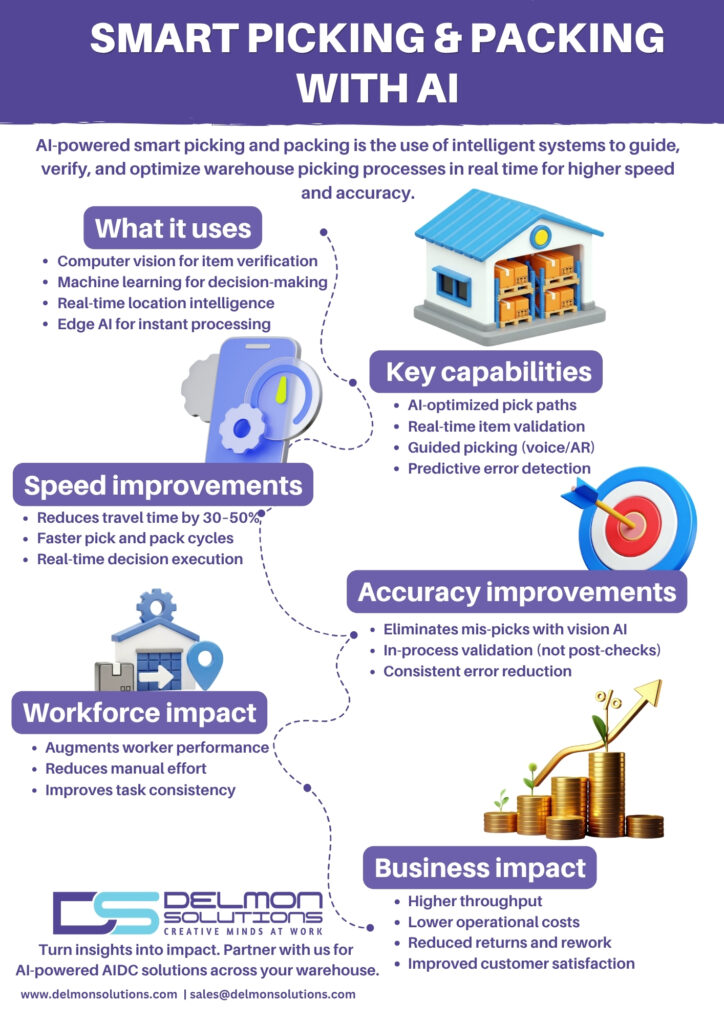
Why AI in AIDC Needs a Strong Data Foundation
AI-driven optimization is only as effective as the data it receives.
This is where technologies like AIDC become critical. Real-time data capture through barcode, RFID, and scanning systems ensures that AI models operate on accurate, live inputs.
Without this foundation, even the most advanced AI systems revert to assumptions.
From Warehouse Management Software to Intelligent Warehouse Systems
The shift is not about replacing WMS. It is about augmenting it.
- WMS provides structure and process control
- AI introduces intelligence and adaptability
Together, they enable a transition from process-driven warehouses to decision-driven warehouses.
Organizations evaluating AI in warehouse management and top warehouse solutions in India are increasingly adopting this layered approach.
Quick Takeaways
- Traditional WMS is rule-based and reactive
- AI introduces predictive and adaptive decision-making
- Optimization shifts from static configuration to continuous improvement
- Real-time data capture is essential for AI effectiveness
FAQs: AI in Warehouse Management
What is AI-powered warehouse optimization?
It refers to the use of artificial intelligence to continuously improve warehouse operations through predictive analytics, real-time decision-making, and adaptive workflows.
How is AI different from warehouse management software?
Warehouse management software follows predefined rules, while AI systems learn from data and dynamically adjust operations.
Can AI replace warehouse management software?
No. AI complements WMS by adding an intelligence layer on top of existing systems.
What are the benefits of AI in warehouses?
Improved efficiency, reduced errors, better inventory management, faster fulfillment, and enhanced decision-making.
Is AI suitable for all warehouses?
AI is most impactful in high-volume, complex environments where variability and scale require dynamic optimization.

Optimization Is No Longer Static
Warehouse operations are evolving from structured execution to intelligent orchestration.
As complexity increases, relying solely on warehouse management software limits the ability to adapt. AI changes this by embedding intelligence directly into operations.
The result is not incremental efficiency, but continuous optimization.
If you are evaluating how to move beyond traditional warehouse management software,
let’s explore how AI-powered warehouse optimization can be implemented in your operations. Schedule a free consultation with us.