Manufacturing has spent decades making machines programmable. The next transformation is making the things moving through those machines digitally identifiable.
When the physical objects carry machine-readable identities, they stop being anonymous objects moving through a factory. They become identifiable data points that can participate in digital workflows.
That changes the potential role of artificial intelligence in manufacturing.
AI can analyse what happened. But when physical items are consistently identifiable, AI can increasingly analyse what happened to what, where, when and in which sequence.
“When physical items become machine-readable, the factory gains a digital memory of what moved, where it moved and what happened next.”
From Counting Things to Understanding Things
Traditional inventory systems are very good at recording quantities.
A system may report that a warehouse contains 10,000 components.
But quantity alone does not tell an intelligent manufacturing system everything it may need to know.
- Which components arrived first?
- Which batch is associated with a particular production run?
- Which serialised units passed through a specific workstation?
- Which pallets have been waiting longer than expected?
- Which assets moved between locations?
- Which materials were consumed by a particular work order?
- Which products are associated with a particular supplier lot?
Machine-readable identification introduces another dimension: identity.
And identity makes operational data more precise.
GS1’s traceability framework distinguishes between identification at class, lot and individual-instance levels. At greater levels of identification precision, businesses can establish more detailed relationships between products and manufacturing, picking, packing and shipping events.
Machine-Readable Does Not Mean Only RFID
The phrase “machine-readable” encompasses several technologies.
Barcodes remain one of the most widely used mechanisms for automatically capturing identifiers.
RFID can identify tagged objects using radio communication and, depending on the deployment, can capture multiple objects without requiring direct line-of-sight scanning.
2D barcodes can carry more structured information and support newer digital-link approaches.
GS1 Digital Link provides a standardised method for connecting GS1 identifiers with online information. GS1 notes that identifiers such as GTINs, GLNs and SSCCs can be encoded in barcodes and connected to digital information.
The technology therefore matters less than the architectural principle:
Give the physical object a reliable digital identity that systems can understand.
Why Identity Matters to AI
AI thrives on relationships.
A model can detect a pattern in machine data. But the usefulness of that pattern increases when it can be connected to the physical entities involved.
Consider a production line generating an unusual number of quality alerts.
Without item-level identity, the system may know:
Station 4 → abnormal rejection rate
With stronger identification and event capture, it may be possible to establish:
Station 4 → product family X → component batch Y → supplier lot Z → process event A → inspection result B
That is a fundamentally richer information structure.
It can help analytics teams investigate relationships that would otherwise remain hidden inside disconnected operational records.
This is one reason the concept of machine-readable physical objects matters to the future of AI in manufacturing industry applications.
The Factory Becomes an Event Stream
When objects are consistently identified, manufacturing can increasingly be represented as a sequence of events.
For example:
Raw material received -> Batch identified -> Material issued to production ->
Component processed -> Inspection completed -> Component accepted ->
Product assembled -> Finished unit serialised -> Pallet created -> Shipment dispatched
Each event adds information to the digital history of the physical object.
AI can then operate on these event histories alongside machine, quality, inventory and production data.
This is considerably more powerful than treating the factory as a collection of isolated databases.
The most interesting opportunity is not simply knowing where something is.
It is understanding its relationships.
- A serialised finished product can be connected to its component history.
- A component can be connected to its supplier lot.
- A production event can be connected to the machine that processed it.
- A machine can be connected to maintenance records.
- A pallet can be connected to the products it contains.
- A shipment can be connected to the orders it fulfils.
These relationships create a richer operational graph.
AI and advanced analytics can then work with those relationships to identify patterns, anomalies and dependencies.
This is particularly relevant in sectors where traceability is operationally significant, including automotive, electronics, pharmaceuticals, food and beverage, aerospace and industrial manufacturing.
The Value of Machine-Readable Operations Is Not Just Traceability
Traceability is an obvious benefit, but it is only one application.
1. Faster root-cause analysis
When products, components and production events have consistent identities, quality teams can trace relationships more systematically.
Instead of investigating an entire production period, analysts may be able to narrow the investigation to specific batches, components, machines or events.
2. More precise inventory intelligence
An inventory balance tells an organisation how much stock it has.
Machine-readable identification can provide additional information about which stock, where it is and how it moved.
This can improve the quality of data available to inventory analytics and optimisation systems.
3. Better production context
AI models can become more useful when production data can be associated with the products and materials actually involved.
A machine event without product context is one data point.
A machine event linked to a product, component, batch and process stage is a much richer event.
4. Stronger recall and containment processes
When products are uniquely identified and traceability relationships are maintained, organisations can narrow affected populations more precisely.
GS1’s traceability standards emphasise unique identification and links between inputs, processes and outputs as foundational elements of traceability.
5. More useful operational AI
AI systems can analyse richer event histories when physical objects have consistent identities.
This can support applications such as anomaly detection, workflow optimisation, demand analysis, quality analytics and operational decision support.
The critical point is that machine readability does not make AI intelligent by itself.
It gives AI better material to work with.
Why Artificial Intelligence in Manufacturing is Assuming Prominence
Manufacturers are already increasing their investment in AI.
Deloitte’s 2025 Smart Manufacturing and Operations Survey found that 29% of respondents were using AI/ML at facility or network level, while 23% were piloting AI/ML. At the same time, data analytics was the highest-ranked technology investment priority, with 40% of respondents placing it among their top priorities for the next 24 months.
Deloitte’s findings are important because they show that AI adoption and data infrastructure investment are happening together.
The reason is straightforward.
AI needs operational data.
And manufacturing generates much of its most valuable operational data through physical events.
If an item cannot be reliably identified, it becomes harder to associate those events with the right object.
Machine-Readable Manufacturing in India
Indian manufacturing is becoming increasingly digitised across automotive, electronics, pharmaceuticals, engineering and industrial production.
As organisations expand production capacity and integrate suppliers, plants and distribution networks, maintaining consistent identification becomes more important.
A component manufactured in one location may be assembled somewhere else.
A pharmaceutical batch may move through several controlled stages.
An automotive component may pass through multiple processing and inspection points before becoming part of a finished vehicle.
An electronics manufacturer may manage thousands of components with different specifications and lot relationships.
In each case, machine-readable identity can provide a common reference across physical and digital workflows.
For enterprises operating across Pune, Chennai, Bengaluru, Hyderabad, Gujarat and other manufacturing centres, this becomes particularly valuable when standardised identification needs to work across plants, warehouses and supply-chain partners.
The objective is not geographic complexity for its own sake.
It is consistency of identity wherever the physical object moves.
The Next Step: From Identified Objects to Intelligent Objects
There is an important distinction between an object being identifiable and an object becoming digitally connected.
A barcode may identify a component.
An RFID tag may identify and help locate it within an appropriately instrumented environment.
A connected software architecture can associate that identity with operational events.
AI can then analyse the resulting information.
This produces a progression:
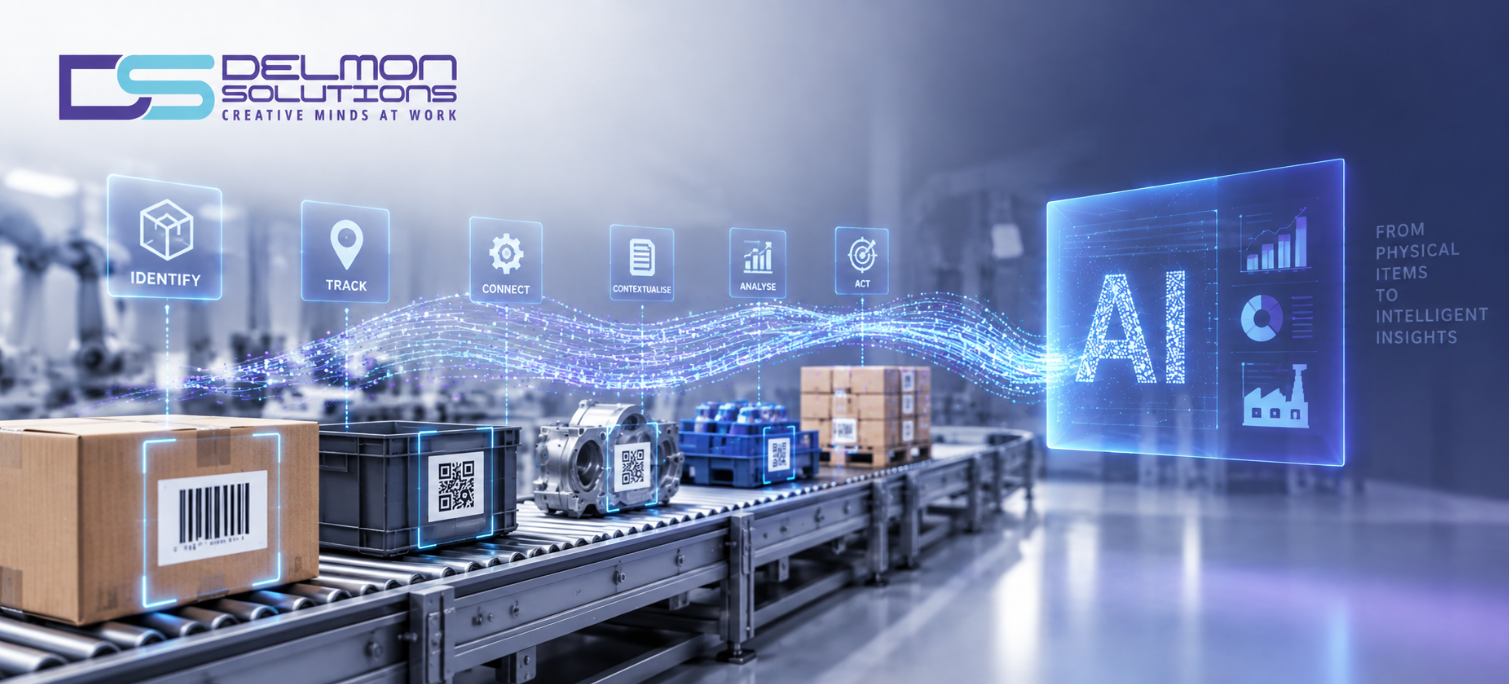
Identify → Capture → Connect → Contextualise → Analyse → Act
The first two stages belong strongly to AIDC.
The later stages increasingly involve enterprise software, analytics, IoT and AI.
This is why AIDC should not be viewed as an isolated hardware category.
In a mature digital manufacturing architecture, it can become part of the infrastructure that translates physical operations into machine-readable events.
What Changes on the Floor When Everything Has an Identity?
The biggest change may not be technological.
It may be organisational.
Once physical objects become consistently identifiable, processes can be measured at a much finer level of resolution.
Manufacturers can move from:
“We produced 20,000 units.”
towards:
“These units were produced through these processes, using these materials, on these assets, during these events.”
That additional context can support more precise analysis.
And as artificial intelligence in manufacturing industry environments becomes more sophisticated, the quality of that context will increasingly determine how useful AI becomes.
The Intelligent Factory Is Observable
Automation makes machines perform tasks.
AI makes systems capable of analysing patterns and supporting decisions.
Machine-readable identification makes the physical flow of products, materials and assets more observable.
Together, these capabilities create a different model of manufacturing.
The factory becomes less like a collection of machines and more like a continuously updating operational information system—one in which physical events can be captured, connected and analysed.
That is the larger significance of machine-readable manufacturing.
The question is not whether every physical item needs RFID or a barcode.
It is whether the items that matter to a business can be identified at the level of precision required to make better operational decisions.
For some environments, that may mean item-level serialisation.
For others, batch-level identification may be sufficient.
In still others, RFID, barcodes, mobile computing and IoT may work together.
The right architecture depends on the process, the required traceability level and the decisions the business wants to improve.
The Future Is a Factory Where Physical Events Have Digital Meaning
Artificial intelligence will continue to expand across manufacturing. But AI will not eliminate the physical nature of manufacturing.
What changes is whether those physical events remain isolated from the digital world or become structured, machine-readable information.
When they do, the factory gains something more valuable than another technology layer.
It gains operational memory.
And that memory can become one of the most important foundations for the next generation of manufacturing intelligence.
Frequently Asked Questions
What does machine-readable mean in manufacturing?
Machine-readable means that a physical item carries or is associated with information that can be automatically captured by digital systems. Barcodes, 2D codes and RFID are common examples used to identify products, components, assets and logistics units.
How does machine-readable identification support AI in manufacturing?
It connects physical objects to digital events. This allows manufacturing systems to associate production, inventory, quality and movement data with specific products, batches, components or assets, creating richer datasets for analytics and AI.
Is RFID necessary to make manufacturing items machine-readable?
No. Barcodes, 2D codes and RFID can all support machine-readable identification. The appropriate technology depends on factors such as line-of-sight requirements, reading distance, item volume, environment, data requirements and the required level of automation.
What is the difference between barcode and RFID in manufacturing?
A barcode generally requires the scanner to capture the printed code with an appropriate optical view, while RFID uses radio communication to identify tagged objects. RFID can support non-line-of-sight reading and multiple-tag identification in suitable environments.
Can machine-readable identification improve manufacturing traceability?
Yes. Consistent identification allows organisations to associate products or assets with events such as receiving, production, inspection, packing and shipping. GS1 standards define identification and event relationships as important components of traceability.
Make Physical Operations Machine-Readable
Delmon Solutions helps manufacturers connect physical operations with reliable identification and data capture. Our AIDC capabilities span barcode, RFID, industrial mobile computing and traceability technologies that can form part of a connected manufacturing environment. Whether the requirement is component identification, inventory visibility, asset tracking or production traceability, the right architecture starts with understanding what needs to be identified and captured. Connect with Delmon Solutions to build an AIDC foundation that is ready for increasingly data-driven and AI-enabled manufacturing.