RFID technology is helping businesses automate identification, improve inventory visibility and capture operational data with less dependence on manual scanning. For organisations in logistics, manufacturing, warehousing and retail, it offers a way to identify tagged items without requiring direct line of sight.
However, RFID is not simply a replacement for barcode scanning. Its value depends on the application, the operating environment and how identification data connects with business systems.
For companies evaluating AIDC solutions in India, understanding how RFID works, where it fits and what implementation requires is the first step towards making an informed investment.
What Is RFID Technology?
Radio Frequency Identification (RFID) is an automatic identification and data capture technology that uses radio waves to identify tagged objects. A typical RFID system consists of four components:
- RFID tags: Attached to products, pallets, containers or assets. A tag typically contains a microchip and antenna.
- RFID readers: Communicate with tags and capture their identification data.
- Antennas: Transmit and receive radio-frequency signals, either as part of a reader or as separate components.
- Software and business systems: Process captured data and connect it with inventory, warehouse, asset-management or enterprise applications.
RFID tags can be passive, active or battery-assisted, depending on how they are powered and communicate. The appropriate technology depends on the required read range, application and operating conditions.
How Does RFID Work?
An RFID system captures identification data through radio-frequency communication.
- Tagging: An RFID tag is attached to an item, package, pallet or asset.
- Signal transmission: The reader sends a radio-frequency signal through its antenna.
- Tag communication: A passive tag responds using energy from the reader’s field. An active tag uses its own power source to transmit a signal.
- Data capture: The reader receives and decodes the tag’s response.
- Data processing: Software interprets the captured identifier and associates it with the relevant item or business record.
- Workflow execution: Depending on the system configuration, the event can update inventory records, support reconciliation or trigger an exception alert.
Unlike barcode scanning, RFID does not generally require direct optical line of sight. Compatible systems can also read multiple tags within a reader’s coverage area.
This does not mean every RFID deployment delivers continuous, real-time location tracking. That capability depends on the reader infrastructure, tag technology, software and tracking design. Read performance is also affected by tag orientation, interference, surrounding materials and antenna placement.
What Are the Main Types of RFID?
RFID systems operate across different frequency ranges and use different tag designs. The main categories include:
| RFID type | Key characteristics | Common applications |
| Low Frequency (LF) | Short-range communication | Animal identification and specialised industrial applications |
| High Frequency (HF) | Short-range identification; includes technologies used in NFC applications | Access control, ticketing and selected identification workflows |
| Ultra-High Frequency (UHF) / RAIN RFID | Supports rapid multi-tag identification within a suitable reading zone | Warehousing, logistics, retail inventory and supply-chain applications |
| Active RFID | Battery-powered tags can transmit over longer distances | Selected asset-tracking and location-monitoring applications |
For warehouse and supply-chain applications, passive UHF RFID, commonly associated with RAIN RFID, is particularly relevant because it supports identification of multiple tagged items without requiring individual optical scans. Actual performance depends on the system design and environment.
Where Is RFID Used in Business Operations?
RFID can support identification and tracking processes across several industries.
- Warehousing and logistics: Capture tagged items at receiving, dispatch and transfer points, helping businesses improve inventory visibility.
- Manufacturing: Identify components, work-in-progress, tools and reusable containers as they move through production.
- Retail: Support stocktaking, inventory reconciliation and product-availability processes.
- Asset management: Record the movement and identification of tagged equipment and reusable assets.
- Healthcare: Support tracking of selected medical equipment, supplies and tagged products.
For businesses operating across multiple warehouses, production facilities or distribution centres, RFID can reduce reliance on manual scanning at selected process points. The operational benefit depends on how accurately the system captures events and how effectively the resulting data is integrated into business workflows.
RFID vs Barcode: Which Technology Should Businesses Choose?
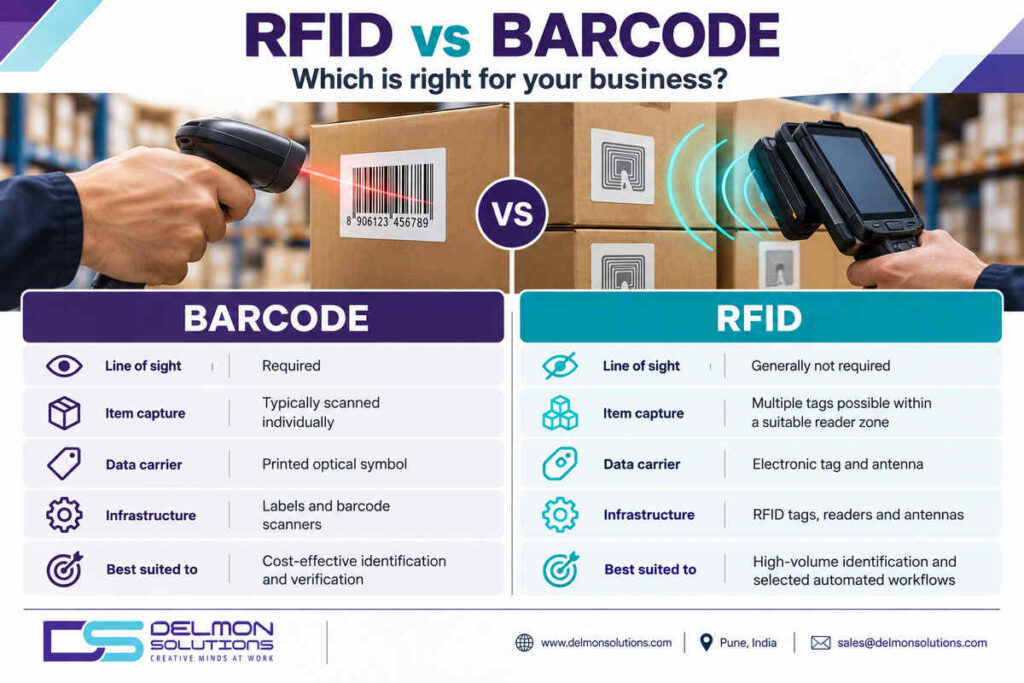
RFID and barcodes both support automatic identification, but they differ in how data is captured.
| Consideration | RFID | Barcode |
| Line of sight | Generally not required for compatible RFID reads | Required for optical scanning |
| Multiple-item capture | Possible within a suitable reader zone | Typically scanned individually |
| Data carrier | Electronic tag and antenna | Printed optical symbol |
| Infrastructure | Tags, readers, antennas and supporting software | Printed labels, scanners and supporting software |
| Best suited to | High-volume identification and selected automated tracking workflows | Cost-effective identification, verification and transaction capture |
RFID can be advantageous when businesses need to identify multiple items quickly or automate data capture at defined operational points. Barcodes remain effective for many applications because labels and scanning equipment can be comparatively simple and economical.
The decision should be based on the workflow, volume of items, accuracy requirements, environment and total cost of ownership. In some operations, combining RFID and barcode technology is more practical than replacing one with the other.
What Should Businesses Consider Before Implementing RFID?
An effective RFID implementation starts with a clearly defined operational problem, not a hardware purchase.
1. Tag and material compatibility
Metal surfaces, liquids, packaging and tag orientation can affect read performance. Test tags on the actual products and materials that will be used.
2. Reader and antenna placement
Reader position, antenna configuration, interference and read-zone design influence which tags are captured. Testing should take place in the intended operating environment.
3. Integration with business systems
Captured identifiers need to connect with the relevant WMS, ERP, inventory or asset-management records. Without this integration, RFID may capture data without improving the underlying workflow.
4. Process and exception handling
Define when an RFID read should register a business event, how duplicate reads are handled and what happens when an expected tag is not detected.
5. Pilot testing and scalability
Begin with a specific use case, measure read performance and operational impact, and expand only when the results justify the investment.
For businesses in Pune, Hyderabad, Bengaluru and other Indian manufacturing and logistics hubs, a site-specific assessment is particularly important. A configuration that performs well in a demonstration may behave differently around metal racks, dense product loads or busy dispatch areas.
RFID Market Outlook: From Identification to Supply-Chain Visibility
RFID is part of the broader shift towards automated identification, traceability and digitally connected operations.
MarketsandMarkets estimates that the global RFID market will grow from US$14.58 billion in 2025 to US$30.47 billion by 2034, representing a projected compound annual growth rate of 8.5%. The forecast reflects demand across sectors including retail, transportation, logistics, manufacturing and healthcare. It is a third-party market estimate, not a guarantee of future growth.
India’s broader warehouse-technology investment provides additional context. CBRE’s India Logistics Market Outlook 2026 projects that the country’s warehouse automation market will reach US$1.42 billion by 2030. This figure covers warehouse automation broadly, not RFID alone.
For businesses, the practical implication is to evaluate RFID as part of an integrated AIDC and warehouse technology strategy. When connected to WMS, ERP and other operational systems, RFID can help capture identification events more efficiently and make inventory movement more visible.
The objective is not to deploy RFID everywhere. It is to identify where automated data capture can solve a measurable operational problem, validate the use case and scale where the results justify the investment.
RFID Solutions from Delmon Solutions Pvt. Ltd.
Delmon Solutions provides AIDC hardware and solutions for businesses looking to improve identification, data capture and operational visibility. Its published portfolio includes UHF RFID readers such as the CipherLab RS38, RK26 and RS36, alongside barcode scanners, rugged mobile computers and barcode label printers.
For logistics providers, manufacturers, retailers and warehouse operators, selecting the right RFID solution requires an understanding of the operating environment, data-capture requirements and integration needs.
As India’s Leading AIDC Solutions Supplier, Delmon Solutions helps businesses evaluate identification technologies suited to their operational requirements.
Planning an RFID deployment? Talk to Delmon Solutions about the right RFID hardware and AIDC approach for your business.
Contact Delmon Solutions Pvt. Ltd.
- Website: www.delmonsolutions.com
- Email: sales@delmonsolutions.com
- Phone: +91 99605 76576
- Location: Baner, Pune, Maharashtra, India