For years, manual inventory tracking formed the operational backbone of warehouse management. As warehousing becomes more data-intensive and operationally interconnected, manual inventory management is rapidly becoming one of the largest hidden inefficiencies inside logistics operations.
The reason is simple. Manual inventory processes were never designed for real-time warehouse environments operating at modern supply chain velocity.
Here are eight reasons why manual inventory tracking fails at scale in today’s warehouses.
1. Manual Processes Cannot Match Modern Inventory Velocity
Warehouse throughput has accelerated dramatically over the last decade.
E-commerce expansion, same-day delivery expectations, and SKU proliferation have fundamentally changed how inventory moves through fulfillment environments.
In high-volume warehouses, inventory locations can change hundreds or thousands of times daily.
Manual tracking systems struggle to maintain synchronization with this level of operational movement.
By the time inventory records are updated manually, warehouse reality has often already changed.
This creates delays in inventory visibility, replenishment accuracy, and fulfillment coordination.
“Modern warehouses no longer operate in static inventory cycles. They operate in continuous motion.”
That operational shift is one of the primary reasons enterprises are moving toward automated inventory visibility systems.
2. Human Error Scales with Operational Complexity
Even highly disciplined warehouse operations remain vulnerable to manual input errors.
Common issues include:
- incorrect stock entries,
- mis-scanned inventory,
- duplicate records,
- location mismatches,
- delayed inventory updates.
At smaller operational scales, these errors may appear manageable. At enterprise warehouse scale, they compound rapidly.
A single inventory discrepancy can trigger:
- picking errors,
- shipment delays,
- replenishment inaccuracies, and
- fulfillment disruptions across multiple operational layers.
As SKU complexity increases, the margin for manual error decreases significantly.
3. Manual Inventory Tracking Creates Delayed Decision-Making
One of the most overlooked consequences of manual inventory management is decision latency.
Warehouse leaders increasingly require:
- real-time stock visibility,
- continuous replenishment awareness,
- live inventory movement data, and
- predictive operational insights.
Manual tracking environments typically operate on delayed reporting cycles. This means operational decisions are often based on outdated inventory conditions.
The result is reactive warehouse management rather than responsive warehouse management. In modern logistics environments, delayed visibility frequently translates into delayed operational action.
4. Cycle Counting Becomes Operationally Expensive
Manual inventory auditing consumes significant warehouse labor hours.
Large warehouses often dedicate entire operational windows to:
- physical stock verification,
- inventory reconciliation,
- manual counting,
- discrepancy investigations.
These activities not only increase labor costs but also disrupt operational throughput.
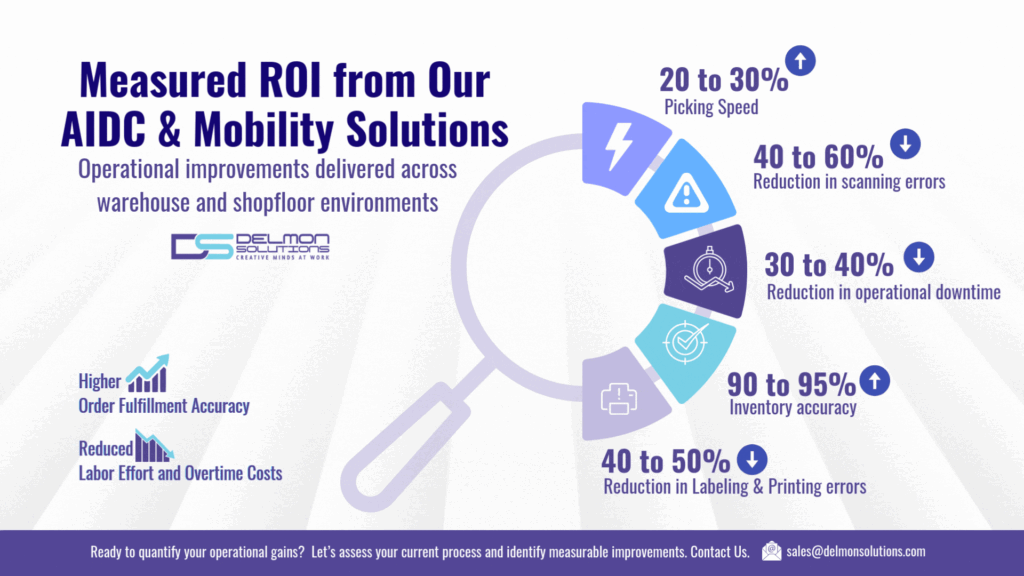
According to supply chain analysts, inventory inaccuracies remain one of the largest contributors to warehouse inefficiency globally. As warehouse scale expands, manual cycle counting becomes increasingly difficult to sustain without operational interruptions.
This is one reason technologies such as RFID and automated inventory capture systems are gaining rapid adoption across warehousing environments.
5. Manual Systems Create Inventory Blind Spots
Traditional inventory tracking methods often lack continuous visibility across warehouse movement.
Inventory may be:
- misplaced,
- moved without updates,
- stored incorrectly, or
- dispatched with delayed record synchronization.
These blind spots create uncertainty inside warehouse operations.
And uncertainty introduces operational risk.
Without real-time inventory visibility, warehouses struggle to maintain accurate stock allocation, order fulfillment, inventory forecasting, and replenishment planning. In fast-moving supply chains, visibility gaps become increasingly expensive.
6. Scaling Workforce Dependency Is Operationally Unsustainable
Manual inventory management scales through labor.
But labor-intensive scaling creates operational fragility.
As warehouses expand, organizations often require more inventory personnel, more reconciliation processes, more verification layers, and more supervisory oversight.
This increases operational costs while simultaneously introducing greater process variability.
The challenge becomes particularly severe during:
- peak demand cycles,
- seasonal surges,
- labor shortages.
Modern warehouses increasingly require systems capable of scaling operational visibility without proportionally scaling manual dependency.
7. Manual Inventory Systems Limit Real-Time Warehouse Intelligence
Today’s intelligent warehouse environments rely heavily on operational data.
Warehouse Management Systems, AI analytics platforms, RFID ecosystems, and predictive inventory tools all depend on accurate, continuous inventory visibility.
Manual processes create fragmented operational intelligence.
Without real-time inventory synchronization, advanced warehouse technologies cannot operate effectively.
This limits the organization’s ability to implement:
- AI-driven forecasting,
- predictive replenishment,
- dynamic slotting,
- real-time inventory optimization, and
- intelligent warehouse orchestration.
In other words, manual inventory tracking restricts warehouse modernization itself.
8. Supply Chains Now Demand Continuous Visibility
Modern supply chains increasingly operate as interconnected ecosystems.
Inventory visibility inside the warehouse now impacts transportation planning, supplier coordination,
customer fulfillment, production scheduling, and omnichannel inventory allocation.
Manual inventory tracking was designed for isolated operational environments.
Modern logistics requires continuous visibility across the entire supply chain network.
“Inventory visibility is no longer just a warehouse metric. It is a business continuity metric.”
That shift is fundamentally changing how enterprises approach inventory infrastructure investments.
Why Warehouses Are Moving Toward Automated Inventory Intelligence
| Technology Investment | Operational Impact | Business Outcome |
| RFID-Enabled Inventory Systems | Enables real-time inventory visibility and automated asset tracking | Faster inventory accuracy and reduced stock discrepancies |
| Barcode Automation | Accelerates scanning, receiving, picking, and dispatch workflows | Improved fulfillment speed and reduced manual errors |
| Industrial Mobility Solutions | Empowers warehouse staff with real-time operational access | Higher workforce productivity and operational agility |
| AI-Powered Warehouse Analytics | Continuously analyzes inventory and workflow patterns | Predictive decision-making and faster issue resolution |
| Real-Time Warehouse Management Systems (WMS) | Synchronizes warehouse activity continuously across operations | Improved operational responsiveness and inventory coordination |
| IoT-Enabled Inventory Visibility | Monitors warehouse movement, equipment, and environmental conditions in real time | Greater operational transparency and supply chain visibility |
| Automated Data Capture Infrastructure | Reduces dependency on manual inventory updates and reconciliation | Scalable warehouse operations with lower operational friction |
These technologies enable continuous inventory synchronization while significantly reducing manual dependency. More importantly, they improve operational responsiveness across warehouse environments.
Because in modern logistics, inventory accuracy alone is no longer enough. Enterprises now require inventory intelligence.
Contact us
Manual inventory tracking is not failing because warehouse teams are inefficient. It is failing because modern warehouse complexity has outgrown manual operational models.
As warehouses become faster, larger, and more interconnected, inventory visibility must evolve from periodic verification toward continuous operational intelligence.
That transition is already reshaping warehouse operations globally. And increasingly, enterprises adopting automated inventory visibility systems will be better positioned to improve fulfillment accuracy, operational scalability, and supply chain responsiveness in the years ahead.
Contact us to discuss your Inventory Management Requirements.