For decades, Automatic Identification and Data Capture (AIDC) technologies have helped businesses identify products, capture information and automate operational transactions.
Barcode scanners, RFID systems, optical character recognition (OCR), mobile computers and machine vision have become integral to manufacturing, retail, logistics and warehousing operations.
However, the requirements of modern businesses are changing. Identifying a product is no longer sufficient. Organisations increasingly need to interpret captured information, identify operational exceptions, understand movement patterns and connect physical assets with digital business systems.
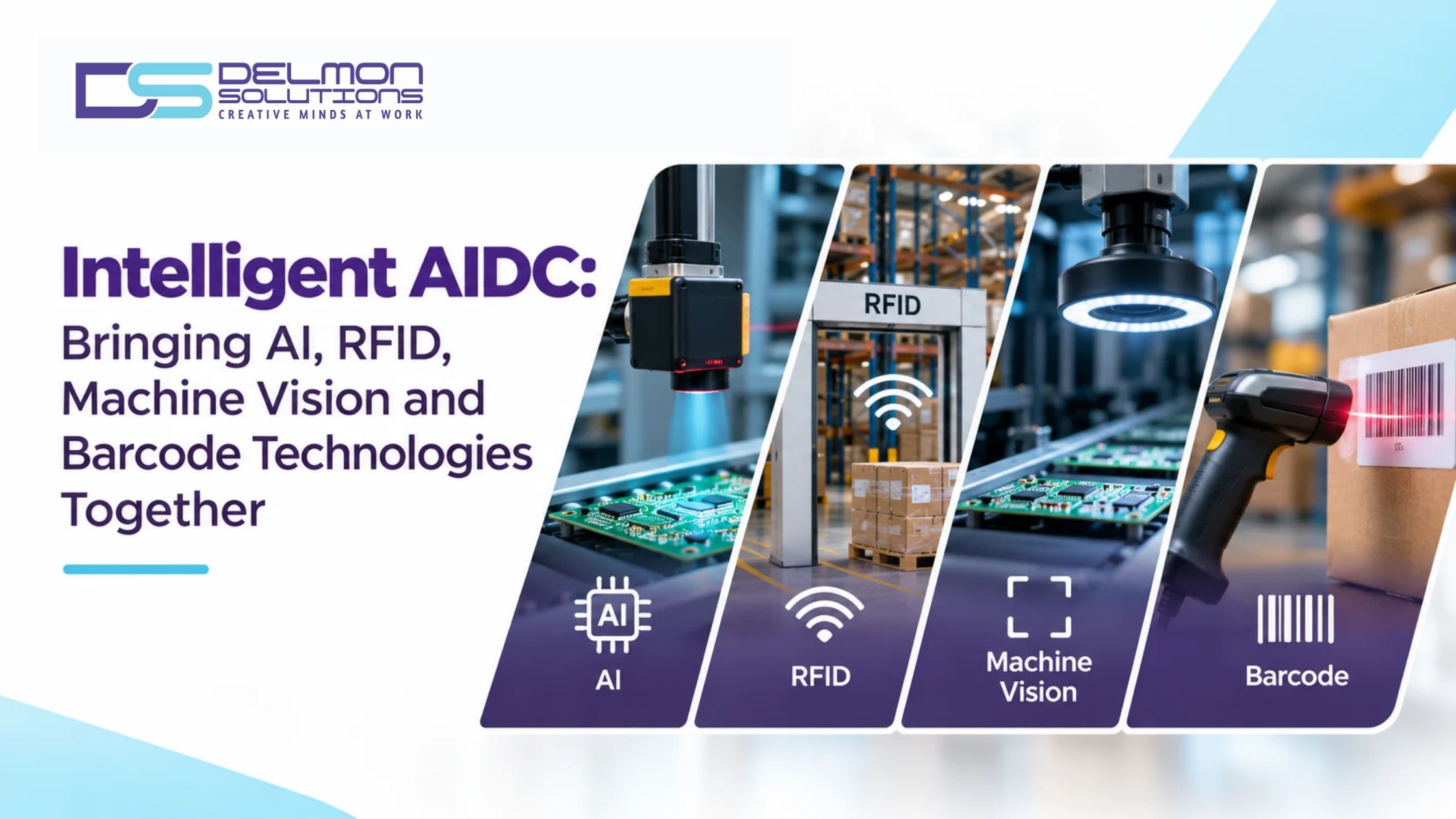
Artificial Intelligence (AI) is expanding what AIDC infrastructure can accomplish. By combining machine vision, OCR, RFID, barcode identification and AI-powered analytics, businesses can move beyond conventional data capture towards more intelligent identification and operational workflows.
This shift to Intelligent AIDC is particularly relevant to industries managing large volumes of products, assets, components and inventory transactions.
What is AIDC, and how is it evolving?
Automatic Identification and Data Capture refers to technologies used to identify objects, collect information and transfer that information into digital systems with minimal manual data entry.
| Technology | Primary application |
| Barcode scanning | Product and shipment identification |
| RFID | Wireless identification and tracking |
| OCR | Converting printed or marked text into digital information |
| Machine vision | Visual inspection, identification and measurement |
| Direct Part Marking | Identifying components through permanently marked codes |
| Industrial mobile computers | Capturing and processing operational data |
These technologies serve different purposes but often operate together within an integrated identification system. AI introduces an additional layer by enabling systems to analyse information and recognise patterns beyond basic identification.
1. From identifying objects to interpreting visual information
Traditional barcode systems are designed to decode encoded information. Machine vision expands this capability by enabling systems to analyse images of objects, components and products.
AI-powered computer vision can identify visual characteristics, classify objects and detect deviations based on trained models.
Consider an electronics manufacturing facility. A barcode reader can identify a circuit board through its encoded identification number. A machine vision system can inspect the board for missing components, incorrect placement or visible defects. OCR can extract serial numbers and manufacturing codes.
When these capabilities are integrated, the manufacturing system can connect product identification with inspection results and traceability records.
This represents an important evolution in AIDC:
moving from capturing an identifier to understanding the visual and operational context associated with an object.
2. AI and OCR: Making product information machine-readable
Many industrial products carry identification information in the form of printed labels, engraved markings, serial numbers and batch codes. Although this information is visible to human operators, it is not automatically available to digital systems.
OCR addresses this gap by converting text in images into machine-readable information. AI-enhanced OCR can help process variations in character sizes and fonts, label positioning, image quality, surface conditions, marking orientation and background contrast.
In manufacturing, OCR can support component identification and batch traceability. In logistics, it can help extract information from labels and documents. In warehousing, it can assist with reading product markings and location identifiers.
OCR is not a substitute for barcode scanning. It complements barcode technology by extracting information from human-readable text that may not be encoded in a barcode.
3. AI and RFID: Improving visibility across physical operations
RFID enables businesses to identify tagged products and assets using radio-frequency communication. Unlike conventional barcode scanning, RFID can capture tag information without requiring direct line of sight, subject to tag and reader conditions.
This makes RFID particularly useful in environments with frequent inventory movement. AI can add value by analysing RFID-generated information and identifying operational patterns.
- Detecting unexpected inventory movements.
- Identifying discrepancies between physical and recorded inventory.
- Analysing movement patterns across warehouse locations.
- Supporting inventory reconciliation.
- Identifying unusual asset utilisation patterns.
However, reliable RFID deployment requires appropriate tag selection, reader placement, read-zone configuration and integration with inventory systems. AI-based analysis becomes useful when these identification events are connected to accurate operational data.
4. AI-powered AIDC applications across industries
The convergence of AI and AIDC is relevant to several industries, although the applications differ according to operational requirements.
| Industry | AIDC technologies | AI applications |
| Manufacturing | Barcode, OCR, machine vision | Defect detection, component verification and traceability |
| Warehousing | RFID, mobile computers, barcode scanners | Inventory discrepancy detection and movement analysis |
| Logistics | Barcode, machine vision, dimensioning | Parcel recognition, sorting support and exception detection |
| Retail | RFID, barcode scanning, computer vision | Inventory monitoring and shelf visibility |
| E-commerce | Barcode, OCR, machine vision | Order verification, parcel identification and returns processing |
| Healthcare | Barcode, RFID, OCR | Medication identification and asset visibility |
5. The role of industrial hardware in AI-powered AIDC
While AI algorithms receive considerable attention, the hardware used to capture information remains equally important. Industrial environments require identification devices capable of operating under specific conditions involving dust, vibration, temperature variations, high-volume transactions and continuous usage.
Industrial barcode scanners
Barcode scanners capture product, component and shipment identifiers. They are used across manufacturing, inventory management, logistics and retail operations.
RFID readers and tags
RFID infrastructure supports wireless identification and tracking of tagged inventory, assets and shipments.
Industrial mobile computers
Rugged mobile computers allow warehouse and manufacturing employees to capture information, access operational applications and update transactions directly from the shop floor.
Machine vision systems
Industrial cameras and vision systems capture visual information for inspection, identification, measurement and verification.
OCR and imaging devices
Imaging technologies support the extraction of human-readable information from labels, documents and product markings.
The selection of appropriate hardware depends on the application, operating environment, identification requirements and integration architecture.
6. Connecting AIDC data with enterprise systems
An intelligent AIDC environment must connect captured information with the software systems responsible for managing business operations.
- Warehouse Management Systems (WMS).
- Enterprise Resource Planning (ERP).
- Manufacturing Execution Systems (MES).
- Transportation Management Systems (TMS).
- Inventory management platforms.
- Quality management systems.
For example, when an RFID reader captures a tagged pallet entering a distribution centre, the identification event can be transmitted to the WMS. The system can compare the event against expected receiving information and update the relevant inventory transaction.
AI-based analytics can then examine the accumulated operational data to identify unusual movement patterns or recurring discrepancies.
This creates a connected workflow in which identification, data processing, operational transactions and analytics work together. However, integration architecture matters. Organisations must establish consistent product identifiers, data formats, event validation and access controls before introducing advanced analytics.
7. What businesses should consider when adopting AI-powered AIDC
| Evaluation parameter | Key consideration |
| Business requirement | Which identification or operational problem needs to be addressed? |
| Data capture | Barcode, RFID, OCR or machine vision? |
| Hardware | Which devices suit the operating environment? |
| AI application | Inspection, classification, anomaly detection or analytics? |
| Integration | How will data connect with existing systems? |
| Data quality | Are identification records complete and consistent? |
| Scalability | Can the architecture accommodate future applications? |
A phased implementation can help organisations validate the technology within a specific workflow before expanding it across multiple facilities or business functions. It is also important to distinguish between AI capabilities that can be implemented at the edge for immediate processing and those that depend on centralised infrastructure or cloud-based analytics.
The future of AIDC is intelligent, connected and data-driven
AIDC technologies have always played an important role in connecting physical operations with digital information systems. AI is extending this role.
Machine vision makes visual inspection more intelligent. OCR converts printed information into structured data. RFID improves the visibility of tagged inventory and assets. AI-based analytics helps organisations interpret operational information and identify exceptions.
The opportunity lies in bringing these technologies together within an integrated architecture.
For manufacturers, logistics providers, retailers and distribution businesses, the next phase of operational automation will depend on how effectively they combine identification infrastructure with intelligent data processing.
As organisations evaluate AI-powered operational improvements, selecting the right intelligent AIDC technologies and integration approach is essential to building more connected and efficient business operations.
Delmon Solutions Pvt. Ltd. is an AIDC solutions provider supporting businesses with barcode scanning, RFID technologies, industrial mobile computers and data capture solutions. Contact our AIDC experts.