Artificial Intelligence is changing the expectations placed on modern warehouses.
Warehouse operators are no longer looking only for faster scanning, better inventory accuracy, or improved picking productivity. They want real-time visibility, predictive insights, intelligent exception handling, and the ability to respond to operational changes before they become costly disruptions.
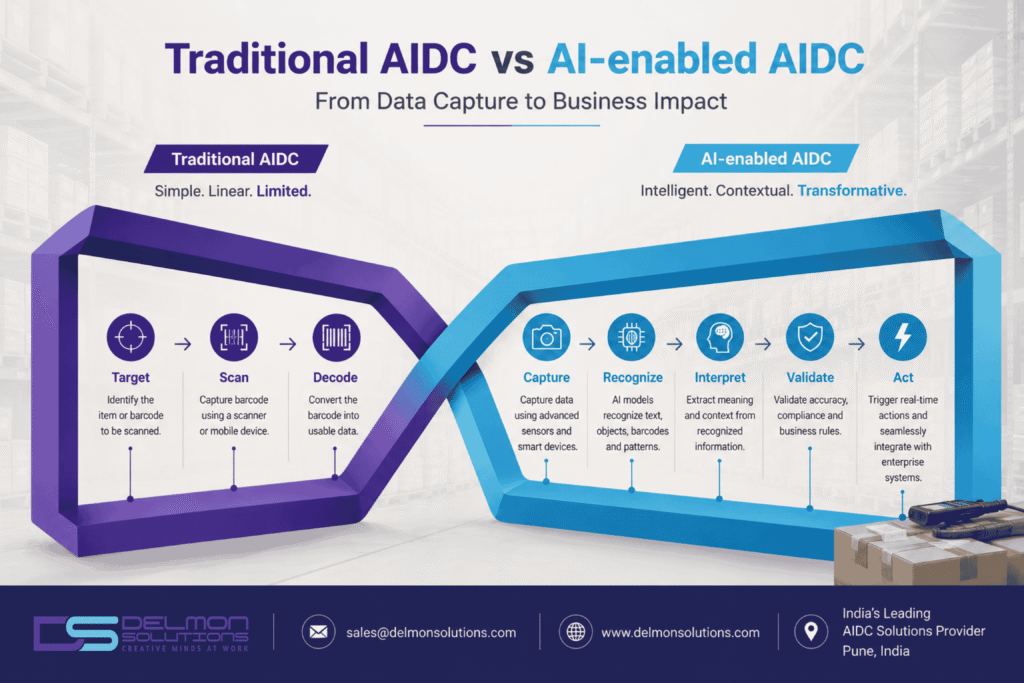
This has accelerated interest in AI-powered warehouse solutions, Vision AI, Smart OCR, RFID, predictive analytics, and intelligent automation.
However, introducing AI into warehouse operations is not as simple as purchasing a software platform or installing a few connected devices.
AI depends on the quality of operational data, the maturity of existing systems, the consistency of workflows, and the clarity of business objectives. When these foundations are overlooked, even sophisticated technology can produce limited results.
For warehouse managers, supply chain leaders, manufacturers, logistics companies, and distribution businesses, understanding the common implementation mistakes is essential.
Here are ten issues to address before beginning an AI warehouse transformation.
1. Starting with AI Before Identifying the Business Problem
One of the most common mistakes is beginning with the technology instead of the operational challenge.
A business may decide to implement AI because it is becoming an industry priority. But without a defined use case, the project can quickly become a collection of disconnected tools, dashboards, and pilot initiatives.
A more practical approach is to begin with a specific business problem.
For example:
- Inventory discrepancies are increasing.
- Manual document processing is delaying receiving.
- Picking routes are inefficient.
- Shipment verification is inconsistent.
- Material-handling equipment is experiencing frequent downtime.
- Supervisors lack real-time operational visibility.
Each problem may require a different combination of AIDC, AI, IoT, or software capabilities.
The right question is not “Where can we use AI?” but “Which operational problem should AI solve first?”
2. Ignoring the Quality of Data Capture
AI systems are only as reliable as the data they receive.
If product identifiers are inconsistent, inventory records are incomplete, or warehouse transactions are entered manually with frequent errors, AI-generated recommendations may be unreliable.
This is why AIDC infrastructure remains central to warehouse intelligence.
Barcode scanners, RFID readers, industrial mobile computers, and automated data capture systems help establish a dependable record of:
- Product identity
- Asset movement
- Storage location
- Batch and serial numbers
- Receiving transactions
- Dispatch activity
- Inventory status
Before introducing advanced analytics or predictive models, businesses should examine whether their data capture processes are accurate, consistent, and sufficiently comprehensive.
AI cannot compensate for a weak data foundation.
3. Treating AI as a Replacement for the WMS
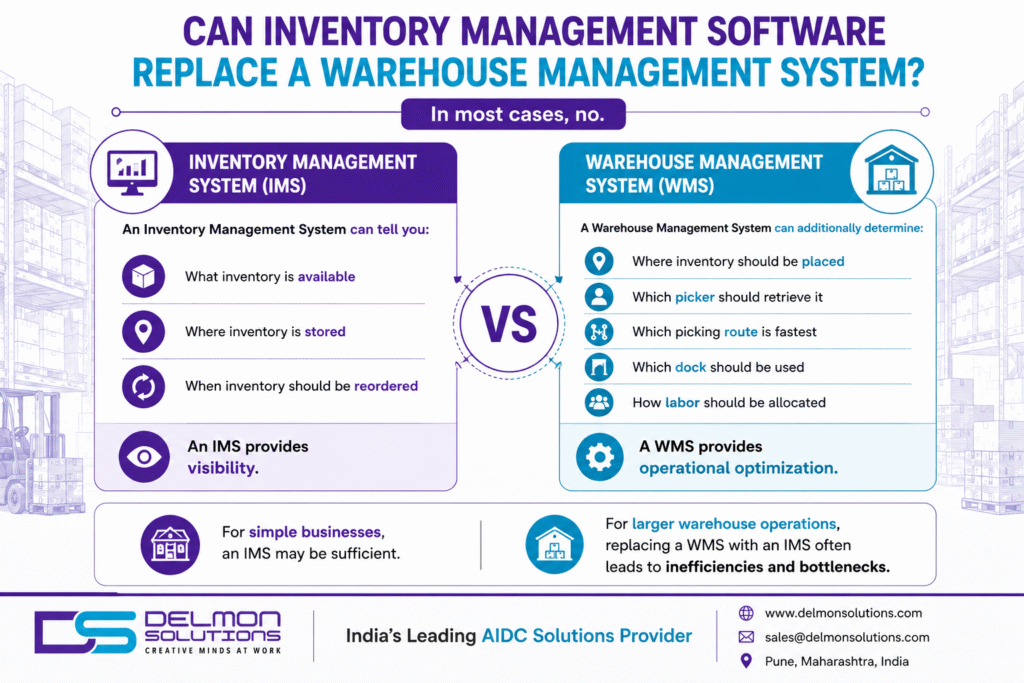
Warehouse Management Software remains an important system of record for inventory, orders, locations, receiving, picking, and dispatch.
AI should not automatically be treated as a replacement for the WMS.
In most cases, the greater opportunity lies in connecting AI capabilities with existing warehouse and enterprise systems.
AI can enhance a WMS by providing:
- Demand forecasting
- Intelligent slotting recommendations
- Picking route optimization
- Inventory anomaly detection
- Predictive maintenance insights
- Exception prioritization
- Operational performance analysis
The objective is to create a more intelligent warehouse environment without unnecessarily dismantling systems that already support core operations.
A well-designed implementation should clarify which functions remain within the WMS, which are supported by AI, and how information moves between platforms.
4. Trying to Automate Everything at Once
Warehouse transformation can become unnecessarily complex when businesses attempt to automate every process simultaneously.
Receiving, putaway, picking, replenishment, dispatch, inventory counting, document processing, and equipment maintenance may all present opportunities for AI. But implementing them together can create integration challenges, training requirements, and operational disruption.
A focused pilot is often more effective.
For example, an organization may begin with:
- Smart OCR for inbound documents
- Vision AI for pallet verification
- RFID for asset tracking
- AI-based inventory anomaly detection
- Predictive maintenance for a specific equipment category
The pilot should have a defined scope, responsible stakeholders, implementation timeline, and measurable outcome.
Once the use case demonstrates value, the organization can expand the approach to other warehouse processes.
A successful AI transformation is usually sequenced, not rushed.
5. Overlooking Integration with Existing Systems
A warehouse rarely operates through one system.
Its technology environment may include:
- Warehouse Management Software
- Enterprise Resource Planning
- Transportation Management Software
- Barcode and RFID systems
- Industrial printing platforms
- Mobile computing devices
- Manufacturing systems
- IoT platforms
- Supplier and customer portals
If an AI solution operates independently, employees may need to duplicate data entry or consult multiple systems to understand the same transaction.
This reduces the value of automation.
Before selecting an AI warehouse solution, businesses should assess:
- Available APIs
- Data formats
- Integration protocols
- Device compatibility
- Network infrastructure
- User access controls
- System ownership
- Data synchronization requirements
The goal is to create a connected operational environment, not another isolated application.
6. Choosing Technology Without Considering the Warehouse Environment
A technology that performs well in one facility may not be suitable for another.
Warehouse conditions vary considerably. Cold storage, manufacturing warehouses, outdoor yards, high-dust environments, hazardous areas, and high-volume distribution centres may require different hardware and connectivity choices.
For example, the selection of industrial mobile computers should consider:
- Screen visibility
- Battery performance
- Drop resistance
- Ingress protection
- Temperature range
- Scan range
- Ergonomics
- Wireless connectivity
- Mounting and wearable options
RFID performance can also vary depending on materials, tag placement, metal surfaces, liquids, and reading distance.
Vision AI depends on camera position, lighting, image quality, and the consistency of the objects being inspected.
AI implementation must therefore account for the physical environment. Technology selection should follow operational requirements, not the other way around.
7. Measuring Technology Deployment Instead of Business Outcomes
A warehouse project should not be considered successful simply because a new AI platform has been installed.
The more important question is whether the technology has improved operational performance.
Relevant KPIs may include:
| Warehouse Objective | Possible Measurement |
| Improve inventory accuracy | Inventory discrepancy rate |
| Reduce manual processing | Document processing time |
| Improve picking productivity | Lines picked per hour |
| Reduce equipment downtime | Unplanned downtime |
| Improve dispatch accuracy | Shipment error rate |
| Improve visibility | Time required to identify exceptions |
| Reduce operating costs | Cost per transaction |
The right metrics will depend on the use case.
A Smart OCR project may be measured through processing time and data extraction accuracy. A Vision AI project may be measured through inspection accuracy and exception detection. An RFID project may focus on inventory visibility and asset location accuracy.
Without a clear measurement framework, it becomes difficult to distinguish genuine operational improvement from technology activity.
8. Underestimating Employee Adoption
Warehouse AI does not operate in isolation from people.
Employees interact with scanners, mobile computers, software interfaces, cameras, printers, and automated workflows throughout the day. If the new system is difficult to use or poorly explained, adoption may remain weak.
Resistance is not always a technology problem. It may indicate that the implementation has not adequately addressed:
- Workflow changes
- Training requirements
- User responsibilities
- Performance expectations
- Exception handling
- System usability
- Concerns about job impact
Training should be practical and role-specific.
Warehouse operators need to understand how to use the devices and applications. Supervisors need to understand alerts, recommendations, and exception dashboards. IT teams need to understand system maintenance, integration, and access controls.
The objective is not simply to deploy AI. It is to make AI usable within everyday warehouse operations.
9. Neglecting Data Security and Governance
As warehouses become more connected, they generate and exchange more operational information.
This may include inventory records, supplier information, customer orders, employee activity, equipment data, and production details.
AI implementations should therefore include appropriate controls for:
- User authentication
- Role-based access
- Data encryption
- Device security
- Network segmentation
- Audit trails
- Data retention
- Third-party access
- Model and application monitoring
Businesses should also clarify where data is stored, how it is processed, and which external platforms can access it.
Security should not be added after deployment. It needs to be considered during solution architecture, system integration, and vendor evaluation.
A connected warehouse must also be a controlled and resilient warehouse.
10. Expecting Immediate Transformation
AI can create measurable value, but warehouse transformation rarely happens overnight.
The timeline depends on several factors:
- Existing infrastructure
- Data quality
- System complexity
- Number of facilities
- Workforce readiness
- Integration requirements
- Use case maturity
- Availability of technical support
Some projects may produce early benefits through Smart OCR or improved barcode workflows. Others, such as predictive maintenance or advanced demand forecasting, may require longer periods of historical data and operational validation.
Businesses should establish realistic milestones:
- Assess the current environment.
- Select a high-value use case.
- Establish the data and integration foundation.
- Run a controlled pilot.
- Measure the outcome.
- Improve the workflow.
- Scale to additional processes or facilities.
This approach reduces unnecessary disruption and creates a stronger basis for long-term adoption.
A Practical Checklist Before Implementing Warehouse AI
Before selecting an AI-powered warehouse solution, ask:
- Is the business problem clearly defined?
- Are product and asset records accurate?
- Is barcode or RFID usage consistent?
- Can the existing WMS and ERP integrate with the proposed solution?
- Is the warehouse environment suitable for the selected devices?
- Are the required KPIs documented?
- Have employees been included in the planning process?
- Are cybersecurity and data governance requirements defined?
- Is the pilot scope realistic?
- Is there a plan for scaling after validation?
If several answers are unclear, the organization may need to strengthen its operational foundation before moving to advanced AI applications.
Frequently Asked Questions
What are the biggest challenges in implementing AI in warehouses?
The most common challenges include poor data quality, weak system integration, unclear use cases, inadequate employee training, unsuitable hardware, and the absence of measurable business objectives.
Can AI work with an existing Warehouse Management System?
Yes. AI can often integrate with an existing WMS to support forecasting, anomaly detection, route optimization, document processing, and operational decision-making.
Why is AIDC important for warehouse AI?
AIDC technologies such as barcode scanning and RFID provide accurate information about products, assets, and movements. This data supports reliable analytics and AI-driven recommendations.
Should a warehouse start with a complete AI transformation?
Not necessarily. A focused pilot based on one high-value operational problem is often a more practical starting point.
How long does warehouse AI implementation take?
The timeline varies according to the complexity of the warehouse, existing systems, data quality, integration requirements, and selected use cases.
Build Your Intelligent Warehouse with Delmon Solutions
Warehouse intelligence is not created by adding AI to an otherwise disconnected operation.
It is built through the careful integration of reliable data capture, industrial hardware, software systems, and intelligent technologies.
At Delmon Solutions, we help organizations strengthen this foundation through a broad portfolio of AIDC and warehouse technology solutions, including:
- Barcode scanning systems
- RFID solutions
- Industrial mobile computers
- Industrial printers
- Smart OCR
- Vision AI
- Warehouse data capture solutions
- Traceability and automation technologies
As a leading AIDC solutions provider in India, Delmon Solutions works with manufacturers, logistics companies, distributors, retailers, and warehouse operators seeking greater accuracy, visibility, and operational control.
Whether you are evaluating your first AI use case or planning a larger warehouse digital transformation programme, the right implementation begins with a clear assessment of your processes, systems, and data.
The future of warehousing will not be defined by how much technology a facility adopts. It will be defined by how intelligently that technology works together.
Connect with Delmon Solutions to identify the right AIDC, Smart OCR, RFID, Vision AI, and warehouse intelligence solutions for your operation.