The warehouse of the future will not be defined by the number of scanners it uses, the size of its storage capacity, or the sophistication of its Warehouse Management Software.
It will be defined by how quickly it can understand what is happening inside its operations and respond to it.
Every event in a warehouse creates operational consequences. The difference is that intelligent warehouses can identify these signals earlier, connect them with other data, and support faster decisions.
This is where Artificial Intelligence and Automatic Identification and Data Capture (AIDC) begin to converge.
The objective is not to introduce AI as another isolated technology. It is to build an operational environment where barcode scanners, RFID systems, mobile computers, Smart OCR, Vision AI, IoT sensors, and warehouse software work together as one intelligent ecosystem.
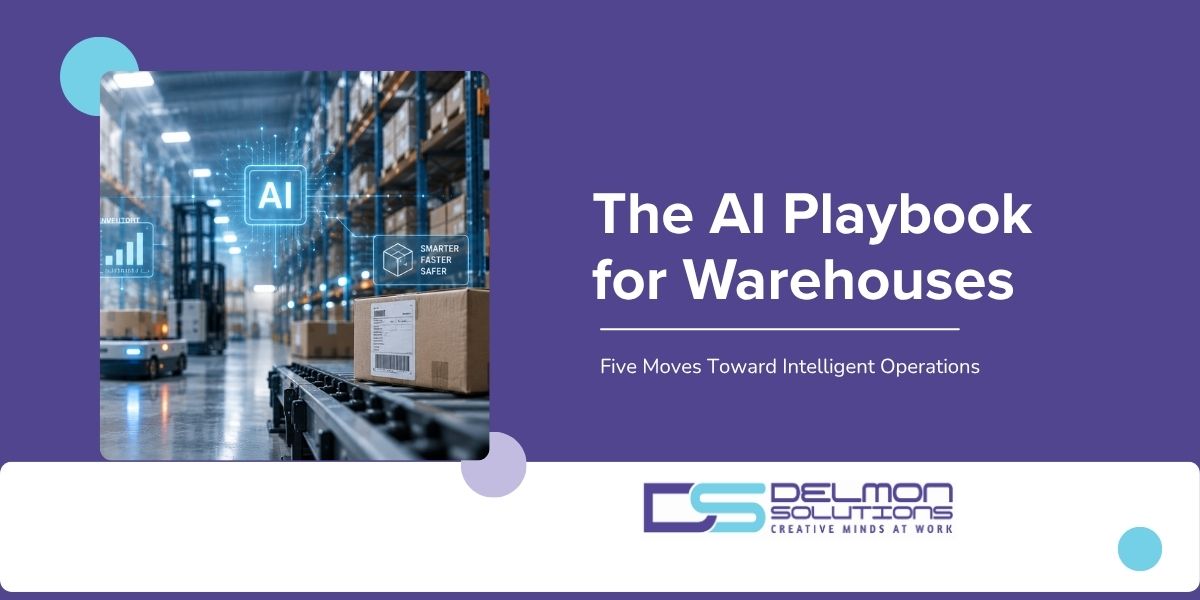
The following five-step AI playbook offers a practical roadmap for warehouse operators, supply chain leaders, manufacturers, logistics companies, and distribution businesses preparing for the next phase of warehouse transformation.
What Is an AI-Ready Warehouse?
An AI-ready warehouse is an operation where physical activities can be captured digitally, connected across systems, and analyzed to support better decisions.
This requires more than deploying an AI application.
It requires:
- Reliable data capture
- Connected warehouse systems
- Digitized documents
- Consistent operational processes
- Real-time visibility
- Clearly defined business outcomes
AIDC technologies provide much of this foundation. Barcode scanning, RFID, industrial mobile computers, and related solutions help create accurate records of inventory, assets, and movements. When this data is connected to AI systems, it becomes useful for prediction, optimization, and intelligent automation.
The Indian government’s warehousing standards handbook identifies AI, machine vision, and IoT as important technologies for future warehouse automation and augmentation. It also highlights intelligent barcode and label scanning as a high-value application area.
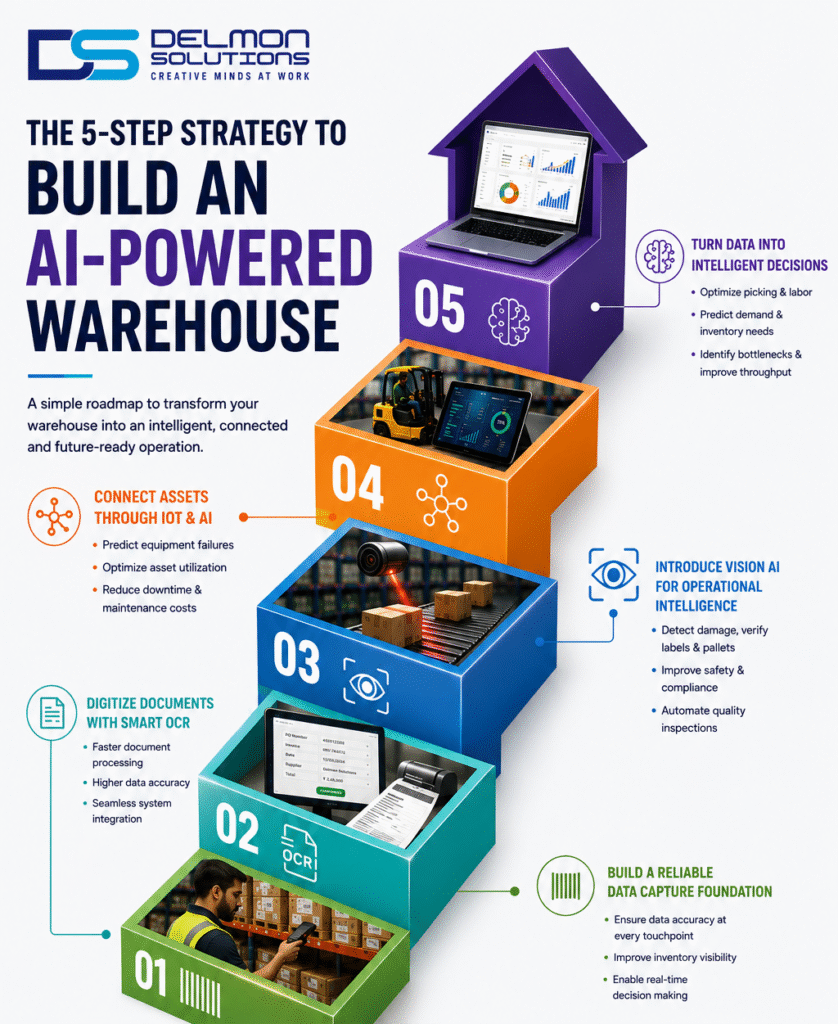
Step 1: Make Every Asset Digitally Visible
AI cannot optimize what it cannot identify.
The first move in the warehouse AI playbook is to establish a dependable data capture layer across inventory, pallets, containers, equipment, and storage locations.
This begins with technologies such as:
- Barcode scanners
- QR code scanners
- RFID readers and tags
- Industrial mobile computers
- Wearable scanners
- Barcode and RFID printers
- Fixed scanning systems
Barcode scanning remains effective for structured, item-level identification. RFID becomes valuable where organizations need wireless identification, bulk reading, or tracking without direct line of sight.
The right technology depends on the operating environment, product characteristics, transaction volume, and required level of visibility.
The goal is not to use RFID everywhere or replace every barcode scanner. The goal is to ensure that the right data is captured at the right point in the workflow.
What this enables
- More accurate receiving
- Better inventory location tracking
- Faster cycle counting
- Improved asset traceability
- Reduced manual data entry
- More reliable warehouse analytics
A warehouse cannot become intelligent if its underlying inventory data remains incomplete or inconsistent.
Step 2: Convert Documents into Operational Data
A significant amount of warehouse information still exists in documents.
Goods receipt notes, purchase orders, delivery challans, shipping labels, invoices, quality reports, and compliance records often contain information that must be manually read and entered into business systems.
This creates delays and increases the risk of transcription errors.
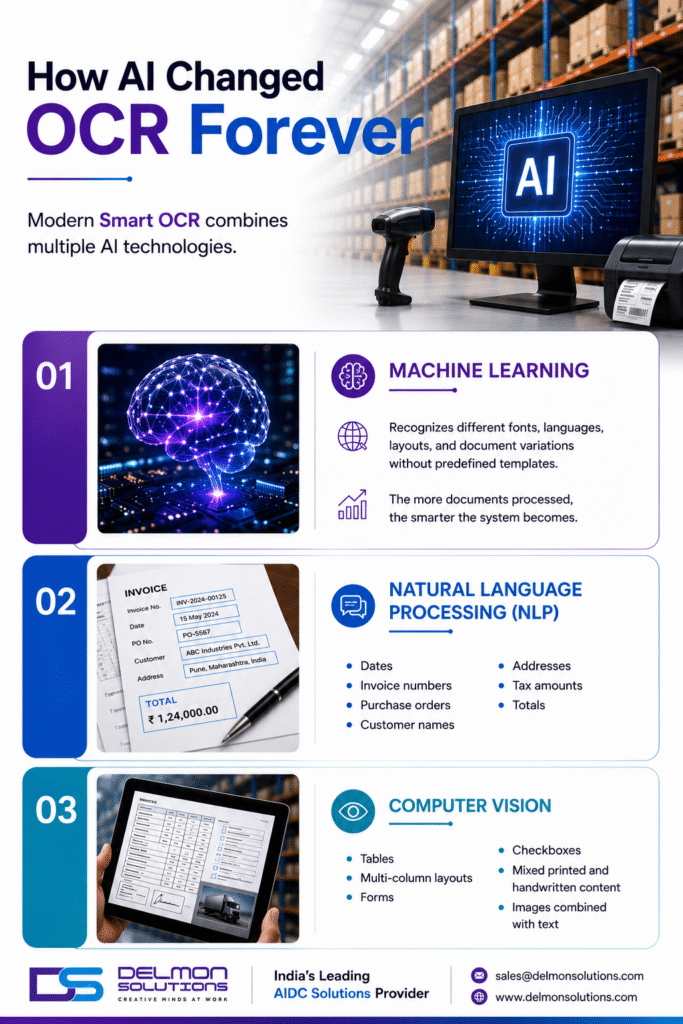
Traditional Optical Character Recognition converts printed text into digital characters. Smart OCR goes further by using Artificial Intelligence to identify document structures, extract relevant fields, classify content, and validate information against predefined rules.
For example, a Smart OCR solution can identify:
- Purchase order numbers
- Invoice details
- Product codes
- Batch numbers
- Serial numbers
- Dates
- Quantities
- Supplier information
The extracted information can then be routed to a Warehouse Management System, Enterprise Resource Planning platform, or manufacturing traceability system.
Why Smart OCR matters
Smart OCR helps bridge the gap between physical documentation and digital workflows.
It can support:
- Faster goods receiving
- More efficient dispatch documentation
- Improved manufacturing traceability
- Reduced manual processing
- Better document searchability
- Stronger data consistency
For warehouses handling high document volumes, this can become one of the most practical starting points for AI adoption.
Step 3: Give the Warehouse Visual Intelligence
Barcodes provide structured identity.
Vision AI adds visual context.
A barcode scanner may confirm the identity of a product. A computer vision system can help determine whether the carton is damaged, whether the pallet is correctly configured, or whether the shipment contains the expected number of packages.
Vision AI uses cameras and machine learning models to interpret images and video. In warehouse environments, it can support:
- Pallet verification
- Carton damage detection
- Label inspection
- Package counting
- Loading validation
- Shelf monitoring
- Safety observation
- Product and packaging inspection
This is particularly useful in operations where visual checks are repetitive, time-consuming, or difficult to standardize manually.
For example, a camera positioned near a dispatch area can examine package labels and compare them against shipment information. A receiving station can combine barcode scanning, image capture, and OCR to verify incoming goods.
The strongest implementations do not treat Vision AI as a replacement for AIDC. They combine visual intelligence with structured identification data.
This creates a richer operational record: what the item is, where it is, what it looks like, and whether it meets the required condition.
Step 4: Move from Monitoring to Prediction
Most warehouse systems are designed to record what has already happened.
AI can help identify what may happen next.
Once warehouse data is captured consistently, AI and analytics can examine patterns across inventory, equipment, orders, workforce activity, and material movement.
Potential applications include:
| Operational Area | AI-Enabled Capability |
| Inventory | Demand forecasting and shortage prediction |
| Picking | Route and sequence optimization |
| Storage | Intelligent slotting recommendations |
| Equipment | Predictive maintenance |
| Receiving | Dock congestion analysis |
| Dispatch | Shipment verification and exception detection |
| Workforce | Workload and resource planning |
Consider inventory management.
A conventional system may show current stock levels and historical movement. An AI-enabled system can examine demand patterns, order frequency, supplier lead times, and inventory velocity to identify potential shortages or slow-moving stock.
Similarly, AI can analyze equipment data to detect patterns associated with future failures. This creates an opportunity to schedule maintenance before a breakdown disrupts warehouse operations.
The distinction is important:
Monitoring tells you what is happening. Prediction helps you prepare for what may happen next.
Step 5: Build an Intelligent Decision Layer
The final move is to connect the information gathered across the warehouse and turn it into operational action.
This is where AI begins to move beyond analytics.
An intelligent decision layer can:
- Prioritize exceptions
- Recommend corrective actions
- Suggest replenishment
- Identify inefficient workflows
- Recommend picking routes
- Flag unusual inventory movement
- Escalate high-risk events
- Support faster managerial decisions
The system does not necessarily need to make every decision autonomously. In many warehouses, the immediate value comes from providing employees with better information at the right moment.
For example:
- A warehouse supervisor receives an alert about an unusual inventory discrepancy.
- A maintenance team is notified that a conveyor shows abnormal operating behaviour.
- A picker receives a more efficient route based on current order priorities.
- A receiving operator is alerted that a document does not match the expected purchase order.
- A dispatch team receives a warning that a package label does not correspond with the shipment record.
This is the transition from a warehouse that records transactions to one that actively supports decisions.
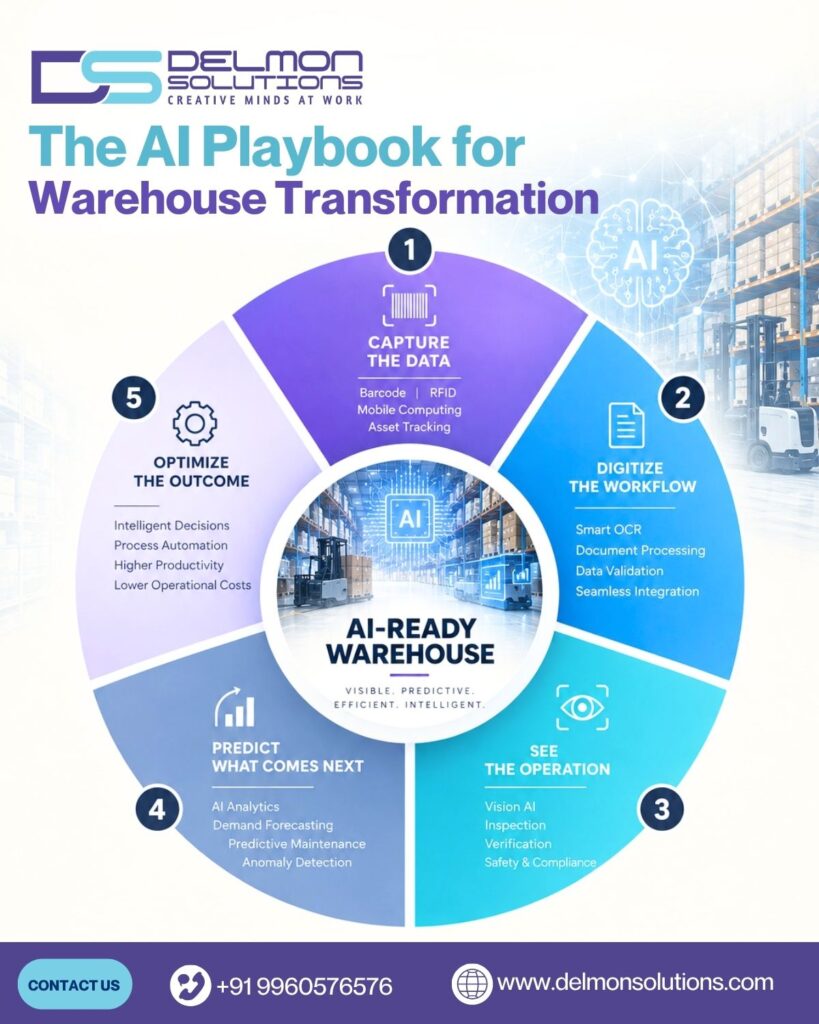
A Practical AI Adoption Roadmap
Warehouse AI adoption should be phased and measurable.
| Phase | Primary Focus | Expected Outcome |
| Phase 1 | Audit workflows and data capture | Identify operational gaps |
| Phase 2 | Strengthen barcode, RFID, and mobility infrastructure | Improve data reliability |
| Phase 3 | Digitize documents through Smart OCR | Reduce manual processing |
| Phase 4 | Introduce Vision AI or predictive analytics | Improve visibility and forecasting |
| Phase 5 | Integrate recommendations into workflows | Enable intelligent operations |
A warehouse does not need to implement every technology at once.
A focused pilot can begin with one high-value problem, such as:
- Inventory discrepancy detection
- Smart OCR for receiving documents
- Vision AI for pallet verification
- RFID-based asset tracking
- Predictive maintenance for material-handling equipment
The pilot should be measured against operational outcomes rather than technology deployment alone.
Useful performance indicators include:
- Inventory accuracy
- Order processing time
- Picking productivity
- Manual data entry time
- Equipment downtime
- Dispatch accuracy
- Exception resolution time
Briefly: What Can Hold the Transformation Back?
Warehouse AI initiatives can lose momentum when organizations treat AI as a standalone purchase rather than an operational transformation.
Three considerations deserve early attention:
- Data quality: AI recommendations depend on reliable source data.
- Integration: New tools must connect with existing WMS, ERP, and AIDC infrastructure.
- Business ownership: Each AI use case should have a clear operational owner and measurable objective.
The focus should remain on solving a defined warehouse problem, then expanding from a validated use case.
A separate, detailed article can examine the common mistakes organizations make during warehouse AI implementation.
Frequently Asked Questions
What is an AI playbook for warehouses?
An AI playbook for warehouses is a practical roadmap for adopting Artificial Intelligence across inventory, receiving, picking, dispatch, equipment, and documentation processes.
What technologies are required for an AI-ready warehouse?
An AI-ready warehouse may use barcode scanners, RFID, industrial mobile computers, Smart OCR, Vision AI, IoT sensors, Warehouse Management Software, and AI analytics.
Does a warehouse need to replace its existing WMS?
Not necessarily. AI solutions can often enhance existing WMS and ERP platforms by adding predictive analytics, intelligent document processing, visual inspection, and decision support.
What is the first step in warehouse AI adoption?
The first step is assessing existing workflows, data quality, AIDC infrastructure, software integrations, and operational bottlenecks.
How does AIDC support warehouse AI?
AIDC captures accurate information about products, assets, locations, and movements. This data provides the foundation AI needs for analysis, prediction, and optimization.
Is Vision AI useful for warehouses?
Yes. Vision AI can support package counting, pallet verification, label inspection, damage detection, loading validation, and other visual warehouse processes.
Build Your AI-Ready Warehouse with Delmon Solutions
AI-powered warehouse transformation does not begin with a single software platform.
It begins with a connected foundation.
At Delmon Solutions, we help organizations build that foundation through intelligent AIDC solutions designed for modern warehousing, manufacturing, logistics, and distribution environments.
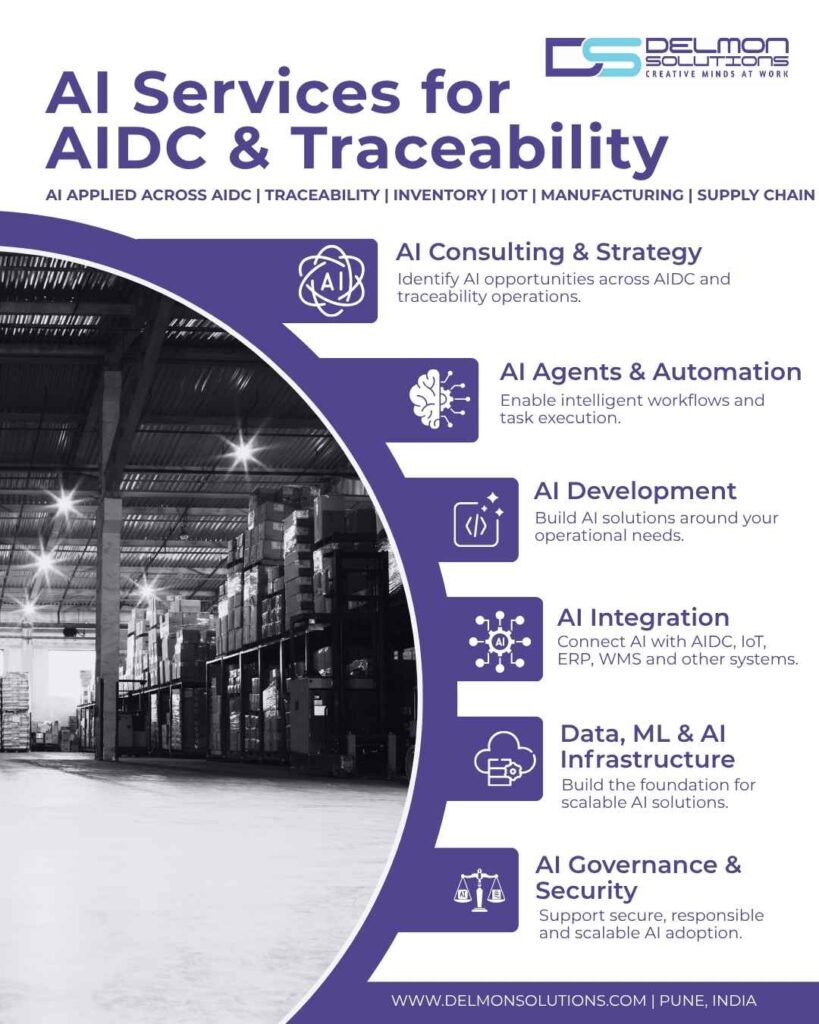
Our capabilities include:
- Barcode scanning solutions
- RFID systems
- Industrial mobile computers
- Barcode and RFID printing
- Smart OCR
- Vision AI
- Warehouse data capture
- Traceability and automation solutions
As a leading AIDC solutions provider in India, Delmon Solutions works with businesses that want to improve operational visibility, strengthen traceability, and prepare their facilities for the next generation of intelligent automation.
Whether your priority is faster receiving, more accurate inventory, smarter document processing, or a long-term AI warehouse roadmap, the right starting point is a clear understanding of your operations.
Your warehouse may already have the data. The next step is making it intelligent.
Connect with Delmon Solutions to explore the right AIDC and AI-enabled approach for your warehouse.