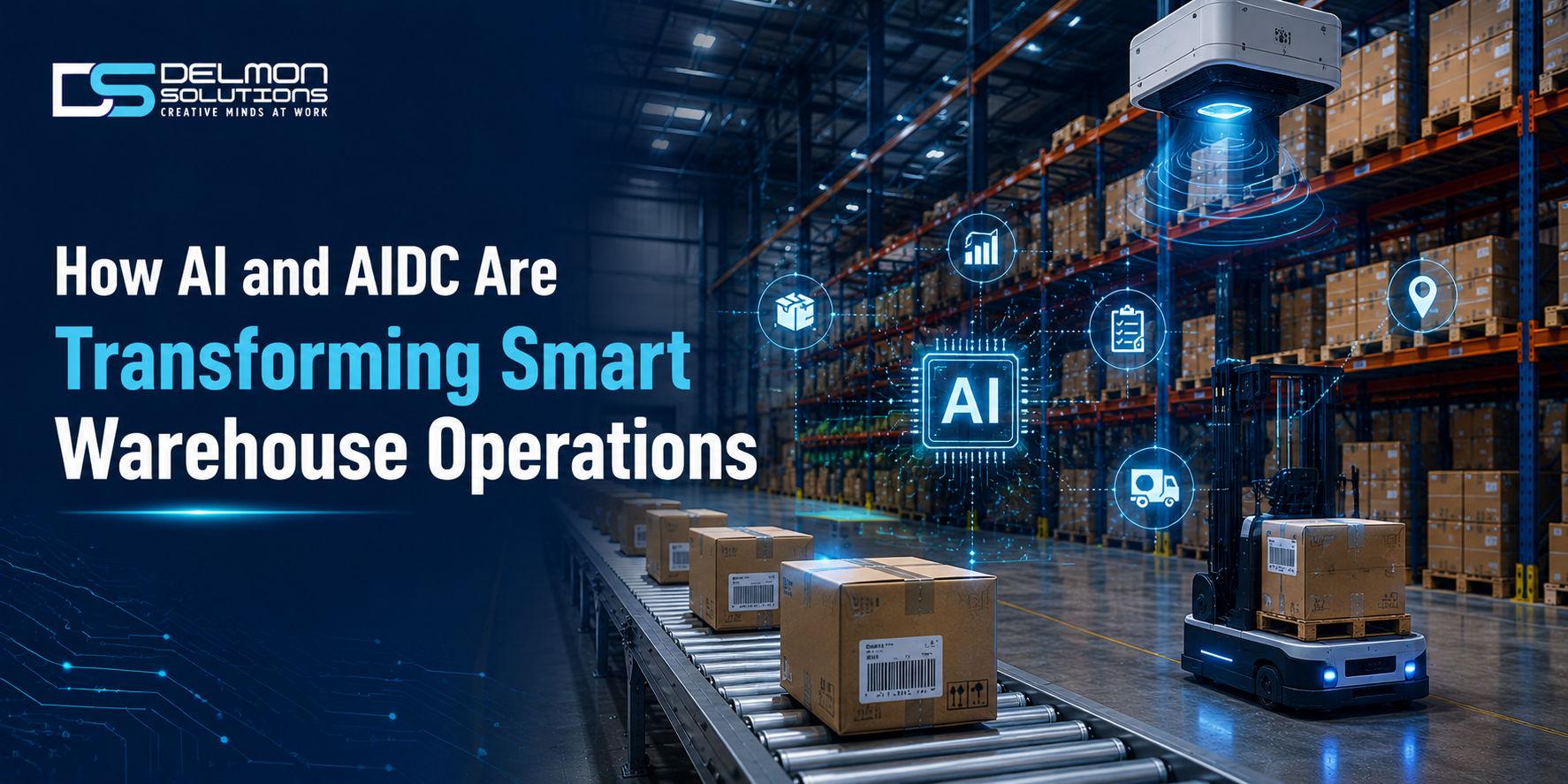
The modern warehouse is rapidly evolving from a storage-centric environment into an intelligence-driven operational ecosystem.
Across logistics, manufacturing, retail, e-commerce, pharmaceuticals, and industrial supply chains, warehouses are under growing pressure to improve throughput, inventory accuracy, fulfillment speed, and operational visibility simultaneously.
At the center of this transformation lies the convergence of two technologies:
Artificial Intelligence (AI) and Automatic Identification and Data Capture (AIDC).
Together, AI and AIDC are redefining how warehouses operate, respond, predict, and scale.
According to industry estimates, the global smart warehousing market is expected to witness significant growth over the next decade as enterprises accelerate investments in automation, AI-powered logistics infrastructure, RFID systems, industrial mobility, and real-time operational intelligence.
From Warehouse Automation to Warehouse Intelligence
For years, warehouse modernization largely focused on automating repetitive operational tasks.
Barcode scanners, RFID systems, Industrial handhelds, Warehouse Management Systems – such systems digitized inventory operations. These technologies significantly improved operational efficiency.
But modern supply chains now demand more than efficiency alone.
Warehouses today must continuously adapt to changing inventory velocity, volatile demand patterns,
labor shortages, compressed delivery timelines, and increasingly complex fulfillment environments.
This is where AI is beginning to reshape warehouse operations.
“Automation executes tasks. Intelligence optimizes outcomes.”
AI systems can analyze operational behavior in real time, identify inefficiencies, forecast disruptions, and support faster decision-making across warehouse environments. Together with AIDC infrastructure, the combination becomes strategically critical.
Why AIDC Is the Foundation of Smart Warehousing
AIDC technologies enable warehouses to capture operational data accurately and continuously across inventory movement, asset tracking, workforce mobility, and fulfillment workflows.
This includes:
- RFID systems
- Barcode scanners
- Industrial handheld terminals
- Mobile computing devices
- RFID readers
- Labeling systems
- IoT-enabled tracking infrastructure
Without reliable data capture, even the most advanced AI systems operate with incomplete visibility.
In many ways, AIDC acts as the sensory layer of the intelligent warehouse. AI becomes the analytical layer.
Together, they create connected warehouse ecosystems capable of real-time operational intelligence.
RFID and AI Are Accelerating Real-Time Warehouse Visibility
Among all AIDC technologies, RFID is emerging as one of the most transformative enablers of smart warehouse operations.
Unlike traditional barcode systems, RFID enables continuous, non-line-of-sight inventory visibility across warehouse environments.
That capability significantly reduces operational blind spots.
When integrated with AI-driven warehouse systems, RFID infrastructure can support:
- Real-time inventory intelligence
- Automated asset tracking
- Predictive replenishment
- Inventory anomaly detection
- Dock movement visibility
- Faster cycle counting
- Fulfillment validation
Industry analysts increasingly view RFID not simply as a tracking technology, but as a foundational infrastructure layer for intelligent logistics environments.
“Speed of visibility is becoming a competitive advantage in warehousing,” noted a logistics technology executive during a recent supply chain summit.
And visibility is only becoming more valuable as warehouse complexity continues rising.
AI-Powered Warehouse Operations Are Becoming Predictive
Traditional warehouse systems largely operate reactively. Managers investigate operational issues after they emerge. AI-powered warehouse environments aim to reverse that model.
Modern AI systems can analyze operational patterns continuously to identify:
- Picking inefficiencies
- Throughput slowdowns
- Inventory discrepancies
- Congestion risks
- Labor utilization gaps
- Replenishment shortages
before they significantly disrupt warehouse performance.
This transition from reactive management to predictive coordination is becoming one of the defining trends in warehouse modernization.
According to supply chain analysts, enterprises are increasingly prioritizing operational responsiveness as a key competitive metric. The ability to identify and resolve disruptions faster is becoming just as important as automation itself.
Industrial Mobility Is Reshaping Workforce Productivity
Industrial mobility solutions are also playing a major role in smart warehouse transformation.
Modern warehouse personnel increasingly rely on:
- Rugged handheld computers
- Wearable scanning devices
- Mobile RFID readers
- Voice-directed picking systems
- Real-time workforce applications
These systems improve workforce coordination while simultaneously feeding continuous operational intelligence into warehouse platforms.
The result is not simply faster workflows. It is greater operational synchronization across inventory, workforce, and fulfillment environments.
The Rise of AIoT in Warehousing
Another major trend reshaping the industry is the rise of AIoT: the convergence of Artificial Intelligence and the Internet of Things.
In warehouse environments, AIoT ecosystems combine:
- RFID infrastructure
- IoT sensors
- Edge devices
- AI analytics
- Warehouse Management Software
- Industrial mobility platforms
to create highly connected operational environments capable of dynamic decision-making.
AIoT-enabled warehouses can monitor inventory movement, equipment utilization, environmental conditions, and operational throughput continuously.
This enables warehouse systems to move beyond static workflow execution toward intelligent operational orchestration.
The Business Impact of Smart Warehouse Operations
The business case for intelligent warehousing is becoming increasingly compelling.
Enterprises adopting AI and AIDC-driven warehouse infrastructure are reporting improvements across:
- Inventory accuracy
- Fulfillment speed
- Labor productivity
- Operational visibility
- Asset utilization
- Order accuracy
- Supply chain responsiveness
More importantly, intelligent warehouse ecosystems help organizations build operational resilience in increasingly volatile supply chain environments.
That resilience is becoming strategically important across industries ranging from manufacturing and retail to pharmaceuticals, automotive, healthcare, and logistics.
The Future Warehouse Will Be Intelligence-Led
The warehouse of the future will not simply automate movement. It will continuously interpret operational behavior in real time. That evolution is already underway.
- Warehouse Management Systems are increasingly integrating AI capabilities.
- RFID infrastructure is becoming more scalable and cost-effective.
- Industrial mobility is becoming deeply connected.
- Operational analytics are becoming continuous rather than periodic.
The result is a new generation of intelligent warehouse environments capable of learning, adapting, and responding dynamically.
For enterprises investing in warehouse modernization, the strategic focus is no longer limited to operational efficiency.
It is increasingly centered on operational intelligence.
Because in modern supply chains, competitive advantage is no longer determined solely by how efficiently warehouses move inventory.
It is determined by how intelligently they respond to operational change.
Final Thoughts
AI and AIDC are no longer independent technology conversations inside warehouse operations.
They are becoming deeply interconnected components of modern logistics infrastructure.
AIDC systems provide the real-time operational visibility. AI provides the intelligence layer that transforms visibility into action. Together, they are reshaping the future of smart warehousing.
As supply chains continue becoming faster, more connected, and more data-intensive, enterprises that successfully integrate AI and AIDC technologies will be better positioned to build agile, intelligent, and resilient warehouse ecosystems for the future. Contact us to discuss your AIDC and Traceability requirements.