
Inventory accuracy is one of the most important operational requirements in a distribution centre. When physical stock does not match the quantities recorded in warehouse management systems, the consequences extend beyond inventory reporting. Picking errors, delayed dispatches, misplaced goods and inaccurate replenishment decisions can affect the entire distribution process.
Traditional barcode-based identification has helped warehouses improve inventory control by digitising product identification and movement records. However, barcode systems generally require individual labels to be presented to a scanner, creating additional scanning steps across high-volume operations.
Radio Frequency Identification (RFID) offers another approach. It enables tagged items to be identified through radio-frequency communication without requiring direct line-of-sight scanning.
When RFID infrastructure is combined with AI-powered analytics, distribution centres can move towards more intelligent inventory management, where identification data is used not only to record stock movements but also to identify discrepancies and support operational decisions.
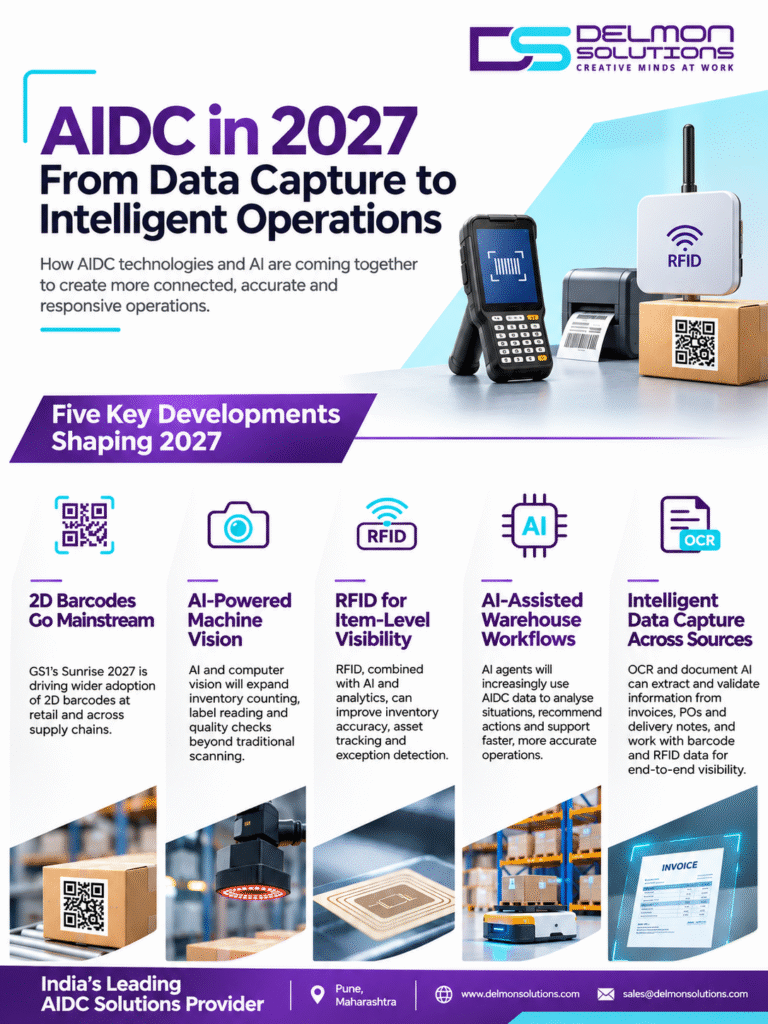
Why inventory accuracy remains a challenge in distribution centres
Distribution centres handle continuous inventory movement across receiving, put-away, storage, picking, packing and dispatch operations. At every stage, inventory records depend on accurate identification and transaction capture.
- Products received but not recorded correctly.
- Goods placed in incorrect storage locations.
- Picking and packing errors.
- Incorrect quantity updates.
- Unrecorded stock movements.
- Damaged, misplaced or unidentified inventory.
- Delays between physical movement and system updates.
A warehouse management system may show that a particular SKU is available in a specific location, but the physical product may have already moved elsewhere. This difference between recorded inventory and actual inventory is known as inventory record inaccuracy.
Improving inventory accuracy requires reliable identification, timely transaction capture and effective exception management.
1. How RFID improves inventory visibility
RFID uses radio waves to communicate between RFID tags and readers. An RFID tag stores identification information associated with a product, carton, pallet or other asset. Readers capture the tag information and transmit it to connected software systems.
Unlike conventional barcode scanning, RFID does not generally require direct visual alignment between the tag and reader. Depending on the tag, reader configuration, frequency, environment and application, multiple tagged items can be identified within a reader’s operating field.
- Receiving verification: RFID readers can identify tagged cartons and pallets as they enter receiving areas, helping compare physical deliveries against expected shipment records.
- Put-away monitoring: RFID infrastructure can help capture product or pallet movement into designated warehouse areas.
- Inventory counting: RFID handheld readers and fixed infrastructure can support faster inventory verification without requiring every individual barcode label to be presented to a scanner.
- Dispatch validation: RFID can help verify that the correct tagged goods are moving through outbound operations.
2. Where AI adds value to RFID inventory management
RFID improves the capture of inventory identification data. AI can help interpret that information and identify patterns that may require operational attention.
Consider a distribution centre processing thousands of inventory movements every day. RFID readers generate identification events as tagged products move through different locations. When this information is integrated with warehouse management data, AI-based analytical systems can examine the resulting patterns.
- Inventory discrepancy detection: AI models can analyse recorded stock levels, RFID read events and transaction histories to identify inconsistencies.
- Unusual movement identification: AI-based anomaly detection can identify unusual inventory movement patterns, such as unexpected transfers, repeated movement between locations or transactions that deviate from normal operational behaviour.
- Inventory reconciliation: RFID-generated records can be compared with WMS inventory data to identify products whose physical location or recorded quantity requires verification.
- Demand and replenishment insights: Historical inventory movement, order patterns and operational data can be analysed to support forecasting and replenishment decisions. These capabilities depend on the availability and quality of relevant data.
3. Combining RFID readers, handheld computers and warehouse software
An effective RFID inventory management system requires more than tags and readers. It needs an integrated technology environment that connects physical identification with warehouse operations.
| Technology | Operational role |
| RFID tags | Store product or asset identification data |
| Fixed RFID readers | Capture movement at defined locations |
| Handheld RFID readers | Support inventory verification and cycle counts |
| Industrial mobile computers | Enable warehouse operators to access and update inventory records |
| WMS | Manage stock locations, movements and transactions |
| AI analytics | Identify discrepancies and analyse inventory patterns |
| ERP integration | Connect inventory information with wider business operations |
The important consideration is integration. RFID data must be associated with the correct product, location, transaction and business process. Without appropriate event filtering and system integration, high volumes of raw RFID reads can create duplicate or misleading inventory events.
AI cannot compensate for poorly designed identification infrastructure or inaccurate master data.
4. Practical applications across distribution centre operations
| Warehouse process | RFID contribution | AI contribution |
| Inbound receiving | Identify tagged cartons and pallets | Flag shipment discrepancies |
| Put-away | Capture inventory movement | Identify unusual location patterns |
| Cycle counting | Accelerate stock identification | Prioritise discrepancies |
| Picking | Verify product identification | Analyse picking exceptions |
| Dispatch | Validate tagged goods | Identify unusual shipment patterns |
| Inventory planning | Provide movement records | Support demand and replenishment analysis |
5. What the research says about RFID and inventory accuracy
The relationship between RFID and inventory accuracy has also been examined through field research.
A study published in Production and Operations Management by Bill Hardgrave, John Aloysius and Sandeep Goyal investigated RFID-enabled inventory visibility through two retail field experiments. The first experiment reported an approximately 26% reduction in inventory record inaccuracy. The second found that the impact varied across product categories, demonstrating that results depend on the operational context.
Although this research examined retail inventory rather than distribution centres specifically, it provides useful evidence of how RFID-enabled visibility can improve inventory record management.
The implication for distribution operations is that RFID should be evaluated against specific workflows, product characteristics, tag performance and integration requirements rather than treated as a universal solution.
6. Implementation considerations for distribution centres
- Tag selection: Product material, packaging, metal surfaces and liquids can affect RFID performance.
- Reader placement: Receiving docks, conveyor systems and storage zones require appropriate reader positioning.
- Read accuracy: Reader configuration and tag performance must be tested under actual operating conditions.
- Data integration: RFID events must connect with WMS and ERP transactions.
- AI readiness: Reliable historical and operational data is necessary for meaningful anomaly detection and predictive analysis.
- Operational adoption: Warehouse employees need suitable handheld devices, workflows and training.
A phased implementation, beginning with a high-value inventory process or a defined distribution zone, can help organisations validate the operational benefits before expanding deployment.
Building more intelligent distribution centres
The next phase of warehouse automation will depend on how effectively businesses connect physical inventory with digital operational systems.
RFID provides a mechanism for identifying and tracking tagged goods. Industrial mobile computers support warehouse-level data capture. Warehouse management systems coordinate inventory transactions, while AI-based analytics can help identify discrepancies and operational patterns.
Together, these technologies can improve inventory visibility and support more informed warehouse decisions. For distribution centres managing increasingly complex supply chains, inventory accuracy is not merely a reporting metric. It is an operational requirement that influences fulfilment reliability, resource utilisation and customer service.
By selecting appropriate identification technologies and integrating them with existing operational systems, distribution businesses can build a more connected approach to inventory management.

Delmon Solutions Pvt. Ltd. provides AIDC solutions for warehouse, logistics and distribution operations, including RFID technologies, barcode scanning and industrial mobile computing. Consult with us.