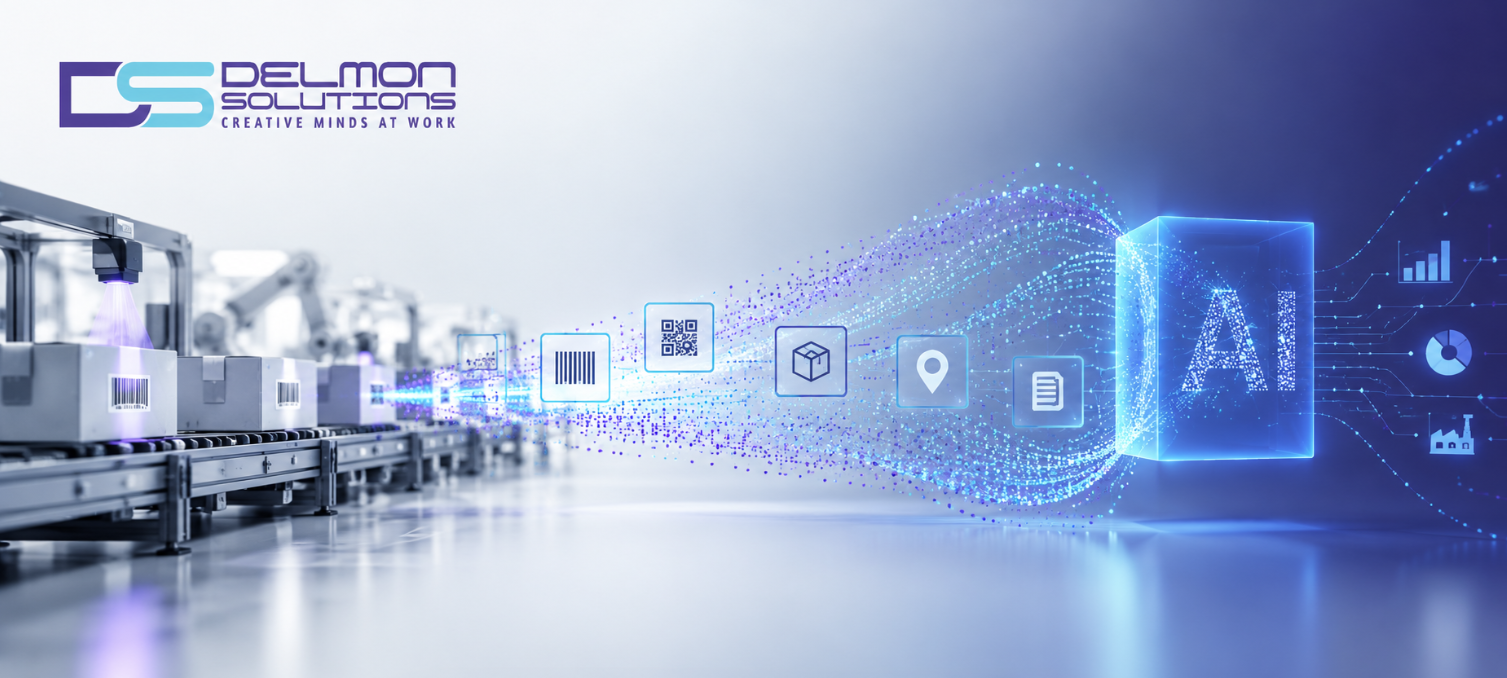
Artificial intelligence can analyse patterns, generate predictions and recommend actions at extraordinary speed. But in a manufacturing environment, there is a fundamental problem that exists before any AI model begins its work: the physical factory does not naturally speak the language of software.
AI can reason over the resulting data in a warehouse but only if those physical events are captured, identified and connected to the digital systems that AI can actually interpret.
That makes Automatic Identification and Data Capture (AIDC) more than an operational technology. It can serve as an important missing layer between the physical manufacturing environment and artificial intelligence.
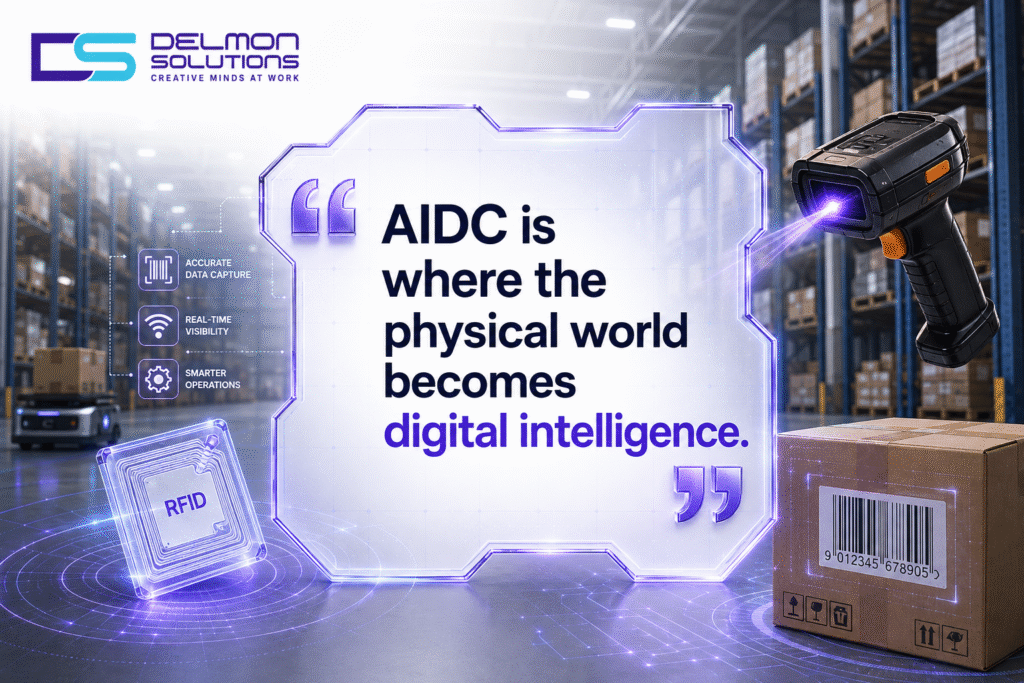
“AI can make decisions from data. AIDC helps make the physical factory legible to AI.”
AI Adoption In Manufacturing Industry
The manufacturing industry is already investing heavily in artificial intelligence.
Deloitte’s 2025 Smart Manufacturing and Operations Survey, based on responses from 600 manufacturing executives, found that 29% of respondents were already using AI or machine learning at the facility or network level, while another 23% were piloting AI/ML. For generative AI, 24% had deployed it at the facility or network level and 38% were piloting it.
Yet the same research points to a less glamorous and arguably more important: investment priority.
Forty percent of respondents ranked data analytics among their top investment priorities for the following 24 months, ahead of AI itself at 29%. Deloitte also found that 54% of surveyed manufacturers reported having a data standard based on a unified data model.
The message is clear:
AI adoption does not eliminate the need for industrial data infrastructure. It increases it.
This is particularly relevant in complex manufacturing environments where operational information is distributed across machines, MES platforms, ERP systems, WMS platforms, spreadsheets, labels, documents and physical inventory.
The Physical Factory Creates Data That AI Cannot See by Itself
Consider a component moving through an automotive manufacturing line.
A machine may know that a process occurred at 10:42:18.
An MES may know that a production order was active.
A warehouse system may know that 500 units were issued.
But AI may still need to know:
- Which specific component entered the process?
- Which batch did it belong to?
- Where did it come from?
- Which workstation handled it?
- Which operator or process was associated with it?
- Was it inspected?
- Did it pass or fail?
- Was it reworked?
- Where is it now?
- Which finished product ultimately contains it?
These are not purely machine-data questions.
They are identity and context questions.
That distinction matters because artificial intelligence in manufacturing depends not simply on large volumes of data, but on data that can be associated with the correct physical object, event, location and time.
McKinsey has highlighted this challenge directly, noting that manufacturing environments often suffer from poor data quality, legacy architectures and inconsistent data practices between plants. It identifies data quality as a central part of the infrastructure required to unlock AI use cases.
AIDC Connects Physical Identity With Digital Information
This is where AIDC becomes strategically interesting.
Barcode systems, RFID, mobile computers, scanners, printers and related identification technologies perform a deceptively important function: they establish a digital identity for something that physically exists.
A barcode can associate a product or component with an identifier.
RFID can identify tagged objects without requiring direct line of sight and can capture multiple tagged items within an appropriate reading environment.
Mobile computers can capture transactions where physical work is taking place.
The resulting events can then be passed into ERP, MES, WMS, inventory or traceability systems.
This creates a chain:
Physical object → identification → event capture → contextual data → enterprise system → AI
Without the first few stages, the AI layer may have plenty of information about the factory while still lacking reliable information about what is actually happening in the factory.
GS1’s traceability standards make the principle explicit: traceable items need globally unique identification, and traceability data can exist at class, lot or instance level depending on the required precision.
The Missing Layer Is Context
Manufacturing AI is often discussed in terms of algorithms.
In practice, the harder problem can be contextualisation.
A temperature reading of 82°C means something different depending on:
- which machine generated it;
- which product was being processed;
- which production stage was active;
- which material was involved;
- what the expected operating range was;
- whether the machine was starting, running or stopping;
- and whether the reading was associated with a normal or abnormal event.
The sensor provides the measurement.
Identity and event context provide meaning.
This is why simply increasing the number of sensors or collecting more data does not automatically produce better AI outcomes.
Deloitte’s 2025 manufacturing outlook reported that nearly 70% of manufacturers surveyed identified data issues—including data quality, contextualisation and validation—as significant obstacles to AI implementation.
The implication for manufacturers is significant: AI readiness is partly an operational data problem.
From Data Capture to Event Intelligence
The next evolution of AIDC is therefore not simply faster scanning.
It is the creation of machine-readable operational events.
Imagine a production environment in which a component’s identity can be associated with:
- what it is
- where it is
- when it moved
- which process handled it
- which batch it belongs to
- what happened to it
- where it went next
That creates a far richer dataset for analytics and AI.
Instead of an AI model seeing an isolated inventory transaction, it can potentially work with an event chain.
Instead of identifying a quantity variance, a system can investigate the movement history associated with specific items.
Instead of simply detecting that production slowed, analytics can correlate the slowdown with the materials, equipment, work orders or process events involved.
This is where the distinction between data capture and operational intelligence becomes important.
AI Does Not Replace AIDC. It Increases Its Value.
The emergence of AI does not make barcode scanners, RFID systems or industrial mobile computers obsolete.
It changes their role.
Traditional AIDC primarily answered:
“What was captured?”
Connected AIDC environments can increasingly contribute to:
“What happened, where did it happen and what should the system know about it?”
AI then adds another layer:
“What does this pattern indicate, and what action could follow?”
This creates a technology stack in which each layer has a different responsibility.
| Layer | Primary role |
| Barcode / RFID | Identify physical objects |
| Scanners / mobile computers | Capture events at the point of activity |
| IoT / sensors | Capture machine and environmental conditions |
| ERP / MES / WMS | Store and coordinate operational information |
| Analytics / AI | Detect patterns, predict outcomes and support decisions |
The strongest AI architecture is therefore not necessarily the one with the most sophisticated model.
It is the one in which physical reality can be represented accurately enough for the model to reason about it.
What This Means for Manufacturing
The manufacturing ecosystem spans automotive and auto components, electronics, pharmaceuticals, engineering, consumer goods, chemicals and industrial equipment. These environments differ considerably, but they share one requirement: physical processes have to be translated into reliable digital information.
For manufacturers scaling production across multiple plants or suppliers, this becomes even more important.
- A component identified consistently across locations creates a common reference point.
- A serialised product creates a more precise traceability record.
- An RFID-enabled movement can provide visibility without requiring every item to be manually scanned.
- A mobile computer can capture production or inventory events where the work actually happens.
These capabilities can then become inputs to broader digital systems and AI initiatives.
The objective is not to “add AI” to an existing factory.
It is to create an operational environment in which AI has enough trustworthy context to be useful.
Building the AI-Ready Factory From the Physical Layer Up
Manufacturers evaluating artificial intelligence in manufacturing industry applications often begin with the model, platform or use case.
A more durable approach is to work backwards.
Start with the decisions the business wants AI to improve.
Then identify the data required for those decisions.
Then determine whether that data is accurate, timely, contextualised and connected to the physical assets and products generating it.
Finally, examine how AIDC, IoT, mobility and enterprise systems can create that information reliably.
This changes the conversation from:
“Where can we use AI?”
to:
“What does AI need to understand about our physical operation—and how do we capture it?”
That is a much more useful starting point.
The Future of Manufacturing AI Begins Before the AI
Artificial intelligence will increasingly influence manufacturing planning, quality, maintenance, supply chains and production decisions.
But intelligence cannot operate in isolation from the physical world.
Every prediction ultimately depends on observations. Every observation depends on data. And much of the most important manufacturing data begins with something physical: a component, pallet, machine, tool, batch, finished product or movement.
That is why the future manufacturing technology stack will not be defined by AI alone.
It will be defined by how effectively physical identity, operational events, enterprise data and artificial intelligence are connected.
For manufacturers, the opportunity is not simply to deploy smarter algorithms.
It is to build a factory that gives those algorithms something reliable to understand.
Frequently Asked Questions
What is the role of AIDC in artificial intelligence in manufacturing?
AIDC technologies such as barcodes, RFID and industrial mobile computers capture the identity and movement of physical objects and convert those events into digital information. This information can provide AI and analytics systems with more accurate operational context.
Why is data quality important for AI in manufacturing?
AI models depend on the quality, consistency and context of their input data. Manufacturing data can be fragmented across machines, enterprise applications and manual processes, making data quality and contextualisation important prerequisites for reliable AI applications.
Can RFID support AI-enabled manufacturing?
Yes. RFID can provide machine-readable identification and visibility for appropriately tagged items. When RFID event data is integrated with enterprise systems, it can contribute to the operational datasets used for analytics, traceability and AI applications.
Is AIDC being replaced by AI?
No. AI and AIDC serve different functions. AIDC captures and identifies physical events, while AI can analyse data, identify patterns and support predictions or decisions. Their combination can create a stronger foundation for intelligent manufacturing.
How can manufacturers prepare their operations for AI?
Manufacturers should first establish reliable data capture, consistent identification, integration between operational systems, appropriate data governance and clear business use cases. AI can then be applied to datasets that are sufficiently accurate and contextualised to support the intended decision.
Build the Data Foundation for Intelligent Manufacturing
Delmon Solutions helps manufacturers build the operational data layer that connects physical processes with digital systems.
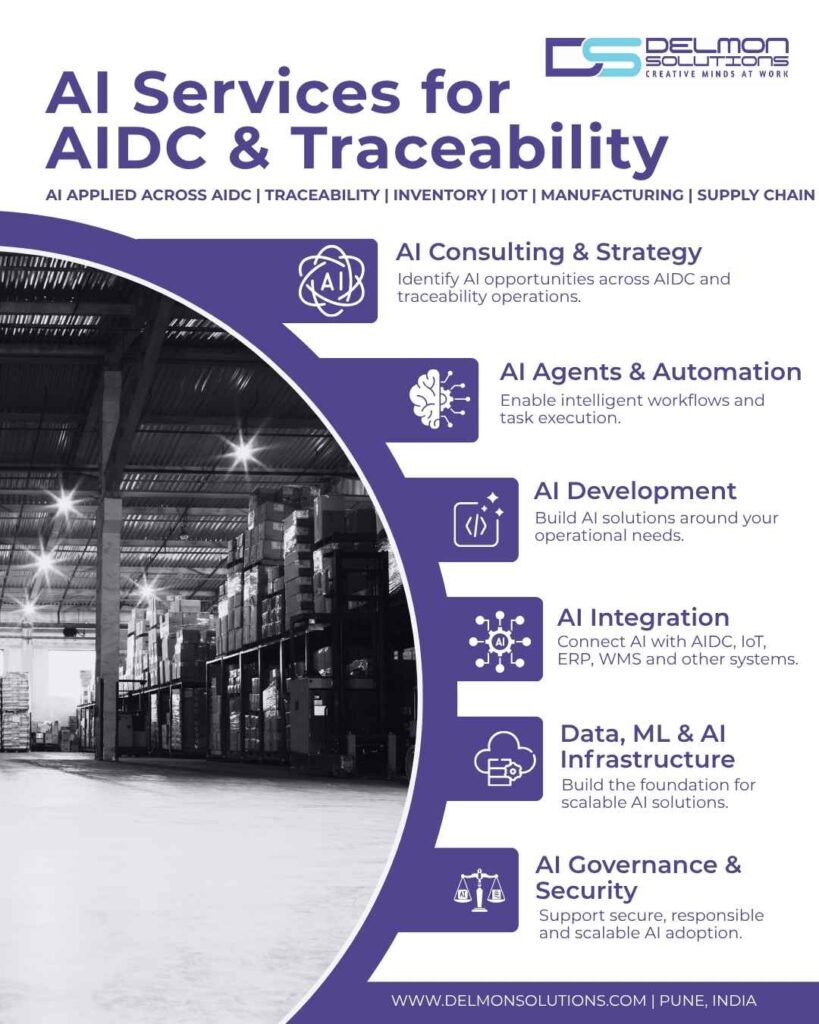
From barcode and RFID infrastructure to industrial mobility, identification and traceability solutions, the right AIDC architecture can make manufacturing data more timely, structured and usable. As AI adoption grows across Indian manufacturing, that foundation becomes increasingly important. Talk to Delmon Solutions about designing an AIDC environment aligned with your production, inventory and traceability requirements.