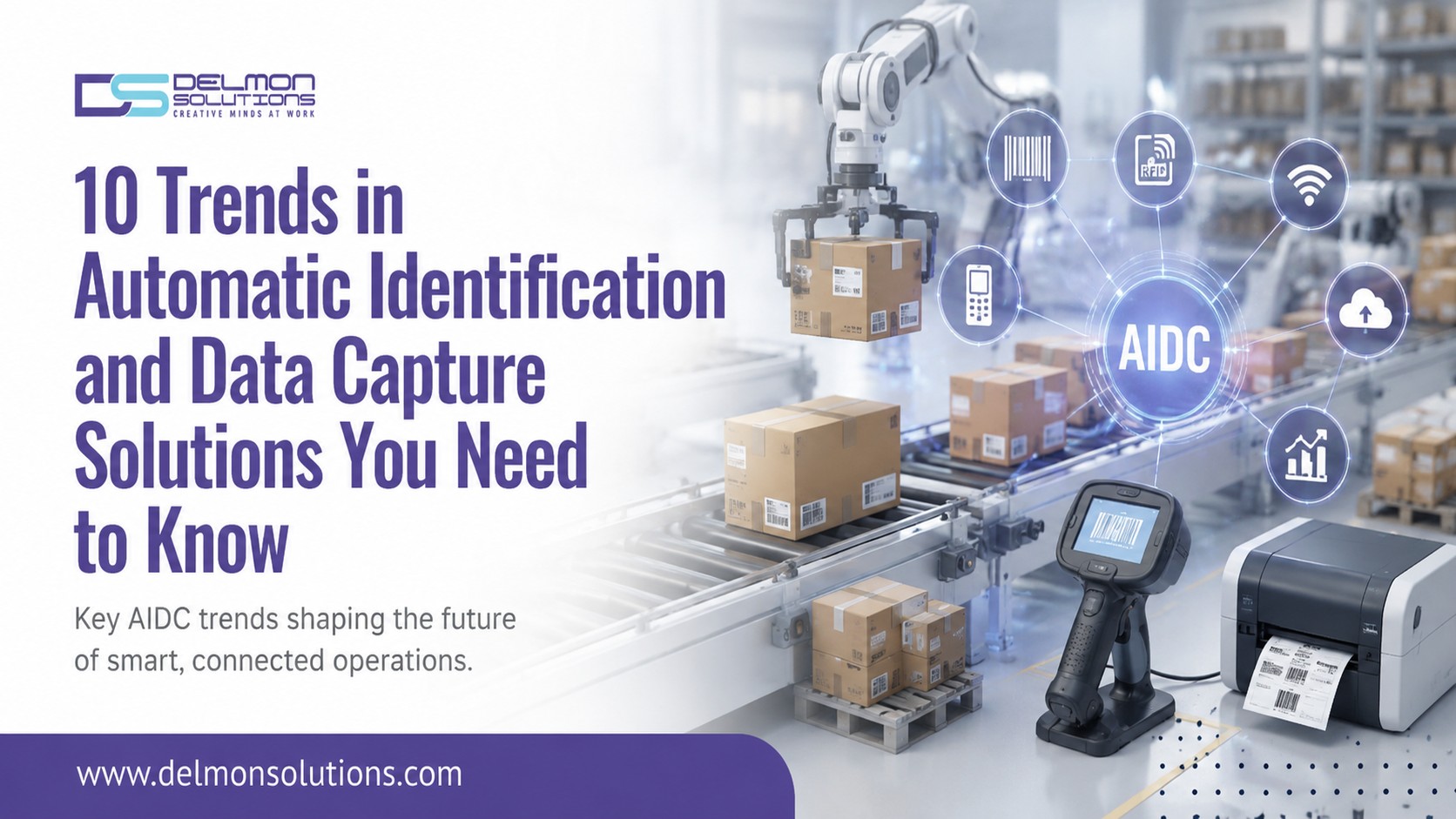
Automatic Identification and Data Capture (AIDC) is moving beyond traditional barcode scanning. Businesses are increasingly using connected scanners, RFID, mobile computers, computer vision, OCR and AI-powered data capture to create faster and more intelligent operational workflows.
AIDC technologies automatically identify products, assets, people or documents and capture relevant information without requiring employees to manually enter every data point. The technology is widely used across manufacturing, retail, warehousing, logistics, healthcare and field operations.
The shift is significant because the value of AIDC is no longer limited to capturing data. The bigger opportunity is capturing the right data, validating it, connecting it to business systems and using it immediately.
AIDC is evolving from a data capture technology into an operational intelligence layer.
Here are 10 trends businesses should watch.
1. AI-Powered Data Capture Is Changing Traditional Scanning
For decades, the standard workflow was straightforward:
Find → Aim → Scan → Confirm
AI-powered computer vision is beginning to change that model to:
Observe → Understand → Act
Modern AI-enabled devices can use cameras to identify multiple barcodes, perform OCR, recognize labels and extract information from a single image. This can reduce the number of individual scans required in environments such as warehouses and manufacturing facilities.
Instead of scanning one item at a time, workers can increasingly use intelligent mobile computers to capture an entire visual field and allow software to identify relevant data.
This is particularly valuable for:
- Warehouse inventory verification
- Shelf and rack inspection
- Shipping and receiving
- Manufacturing quality checks
- Product identification
- Document and label capture
2. 2D Barcodes Are Becoming More Important
The traditional 1D barcode is not disappearing, but 2D barcodes are expanding what a product identifier can do.
QR Codes and GS1 DataMatrix can carry more information and can connect physical products to digital information. GS1 has set an industry goal for retail point-of-sale systems to be capable of reading defined GS1-compliant 2D barcodes alongside existing linear barcodes by the end of 2027.
2D codes can contain information such as:
- Product identifiers
- Batch or lot numbers
- Expiration dates
- Serial numbers
- Digital links
- Product information
For businesses, this creates opportunities for better traceability, authentication, inventory management and consumer engagement.
3. RFID Is Moving Toward Real-Time Visibility
RFID remains one of the most important technologies within AIDC because it enables identification without requiring the same line-of-sight interaction associated with conventional barcode scanning.
RFID can support:
- Asset tracking
- Warehouse management
- Inventory visibility
- Production tracking
- Retail inventory management
- Returnable asset tracking
The bigger trend is not simply RFID adoption. It is the integration of RFID data with ERP, WMS, MES and analytics platforms.
That turns an RFID event into operational information rather than just another captured data point.
4. Mobile Computers Are Becoming the AIDC Workstation
AIDC is increasingly mobile.
Modern enterprise mobile computers combine scanning, computing, connectivity and application access in a single device. This means warehouse and field workers do not necessarily have to return to fixed workstations after every data capture task.
Mobile computers are particularly useful for:
- Receiving
- Picking and packing
- Stock counting
- Dispatch
- Asset inspection
- Field service
- Production-floor operations
The result is a more distributed model of data capture where information is collected at the point of work.
5. Wearable AIDC Is Improving Worker Productivity
Hands-free computing is another important development.
Wearable scanners, ring scanners, wrist-mounted devices and voice-enabled systems can allow workers to capture information while keeping both hands available for operational tasks.
This matters in high-throughput environments where even small interruptions accumulate over thousands of transactions.
Typical applications include:
- Order picking
- Warehouse sorting
- Manufacturing
- Inventory counting
- Parcel handling
- Field service
The objective is simple: make data capture fit the workflow instead of forcing the workflow to fit the device.
6. AIDC and IoT Are Becoming More Connected
AIDC captures identification data. IoT captures information about physical environments and assets.
Together, they can create a more complete operational picture.
For example, a manufacturing operation could use:
Barcode → identify component
RFID → track movement
IoT sensor → monitor condition
Analytics → identify operational patterns
This combination can support predictive maintenance, asset visibility, smart warehouses and connected manufacturing.
7. Cloud-Based AIDC Is Supporting Distributed Operations
Businesses operating multiple warehouses, stores or production facilities need information to move across locations.
Cloud-connected AIDC systems can help centralize information and provide access to data across distributed operations.
This is particularly useful for:
- Multi-location inventory
- Centralized reporting
- Enterprise asset tracking
- Remote device management
- Cross-location analytics
- Supply chain visibility
Cloud architecture can also make it easier to scale AIDC deployments without replicating the entire infrastructure at every location.
8. OCR and Document Capture Are Expanding the Definition of AIDC
AIDC is no longer restricted to barcodes and RFID.
OCR allows businesses to extract information from documents, labels, invoices, forms and other visual sources. AI is making this process more intelligent by combining OCR with computer vision, NLP and machine learning.
The intelligent document processing market was valued at approximately USD 10.41 billion in 2025 and is projected to reach USD 88.91 billion by 2034, according to Fortune Business Insights.
That growth reflects a broader shift from simply digitizing documents to extracting usable business information from them.
9. Data Security Is Becoming Part of AIDC Architecture
As AIDC systems become connected to enterprise applications, security cannot remain an afterthought.
A modern deployment should consider:
- Device authentication
- User access controls
- Encryption
- Secure APIs
- Network security
- Data retention
- Device management
- Software updates
This is particularly important when AIDC systems capture employee information, customer data, healthcare information or sensitive operational records.
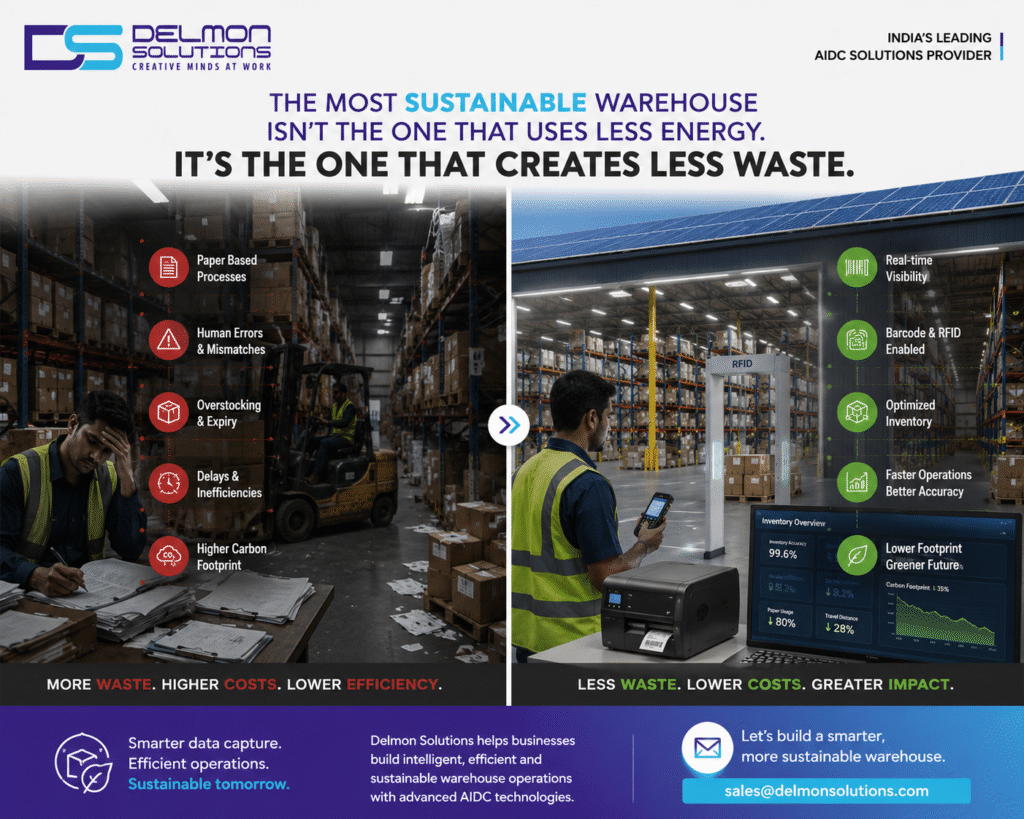
10. AIDC Is Becoming More Sustainable
Sustainability is increasingly influencing technology procurement.
Businesses are looking at the lifecycle of devices, energy consumption, consumables, label usage and infrastructure requirements.
Digital workflows can also reduce dependency on paper-based processes, while better inventory visibility can reduce overstocking, waste and unnecessary movement.
The important point is that sustainability and operational efficiency do not necessarily need to be competing objectives.
What Does the Future of AIDC Look Like?
The future is not about replacing every barcode scanner with an AI device.
Instead, AIDC will become increasingly multimodal.
A single operational environment may use:
- Barcodes
- 2D codes
- RFID
- OCR
- Computer vision
- Mobile computers
- Wearables
- IoT sensors
- AI analytics
The challenge for businesses will therefore be choosing the right combination of technologies rather than adopting technology simply because it is new.
Frequently Asked Questions
What is AIDC?
AIDC stands for Automatic Identification and Data Capture. It refers to technologies that automatically identify objects, people, assets or information and capture their data for processing by computer systems.
What are examples of AIDC technology?
Common examples include barcode scanners, RFID readers, QR codes, mobile computers, OCR systems, biometrics and NFC.
Is barcode technology becoming obsolete?
No. Barcodes remain fundamental to AIDC. However, 2D barcodes, RFID and AI-powered computer vision are expanding the capabilities of automatic data capture.
How is AI changing AIDC?
AI enables systems to interpret images, identify multiple codes, recognize text, detect anomalies and make data capture more context-aware.
Which industries use AIDC solutions?
Manufacturing, retail, logistics, warehousing, healthcare, transportation and field service are among the major users.
Build a Smarter AIDC Environment with Delmon Solutions
Choosing an AIDC solution should start with the operational problem, not the device.
Delmon Solutions helps businesses evaluate and deploy barcode scanners, mobile computers, RFID and other AIDC technologies based on their workflow, environment, data requirements and integration needs.

Whether you are modernizing warehouse operations, improving inventory accuracy or introducing mobile data capture, the right AIDC architecture can make every transaction faster and more reliable.
Talk to Delmon Solutions to identify the right AIDC technology for your business.