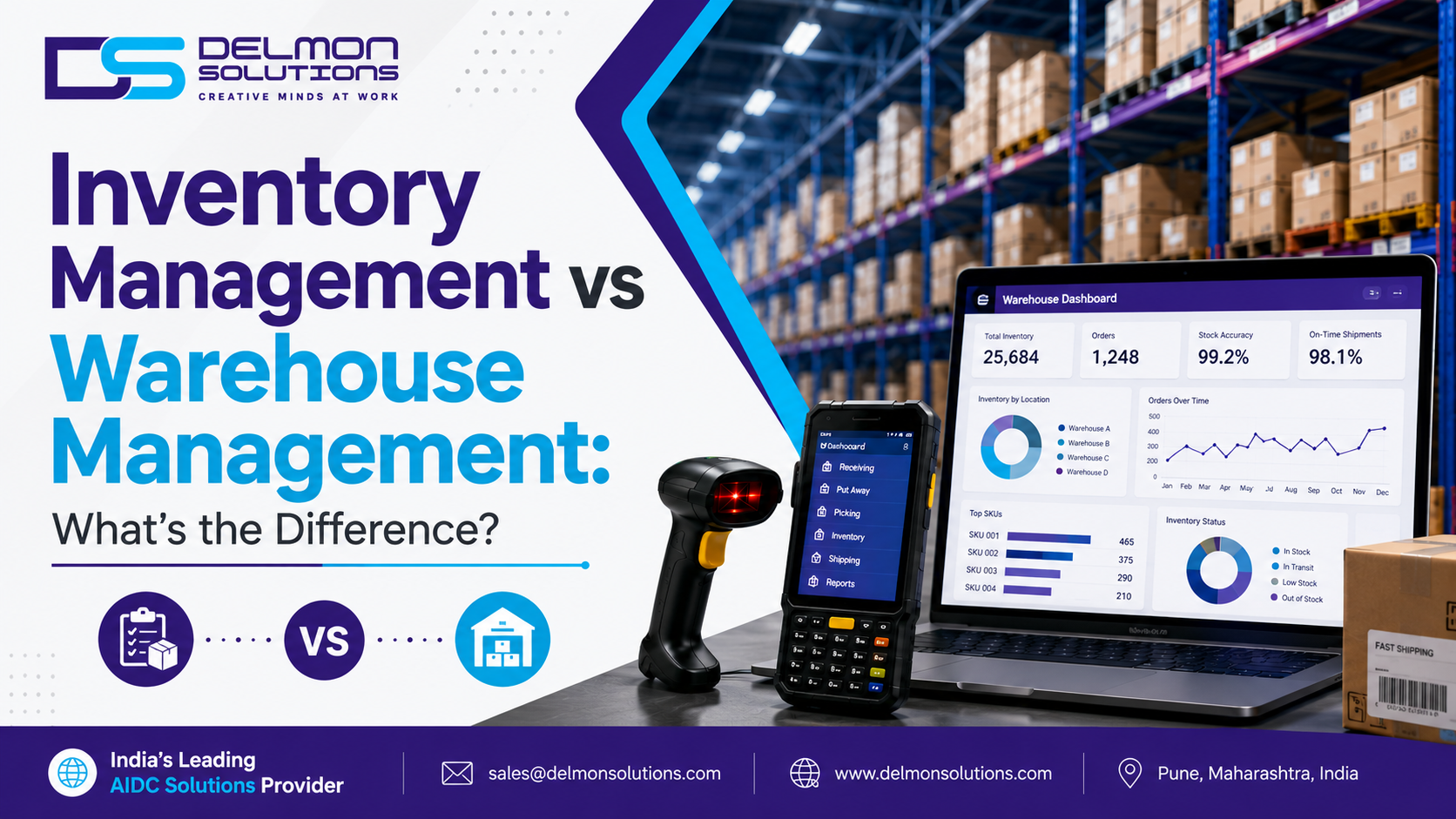
Inventory management vs warehouse management is one of the most misunderstood comparisons in supply chain operations. The two terms are often used interchangeably, leading businesses to invest in the wrong software or duplicate capabilities they don’t actually need.
While they work closely together, they solve different problems.
Inventory management focuses on what inventory you have, how much you have, and when you need more.
Warehouse management focuses on how inventory is stored, moved, picked, packed, and shipped inside a warehouse.
Understanding this distinction helps you choose the right solution for your business and avoid unnecessary operational costs.
Inventory Management vs Warehouse Management: Quick Comparison
| Feature | Inventory Management | Warehouse Management |
| Primary Focus | Managing stock levels across the business | Managing warehouse operations |
| Core Question | What inventory do we have? | How do we move inventory efficiently? |
| Scope | Company-wide | Individual warehouse or distribution center |
| Main Activities | Inventory tracking, inventory control, forecasting, replenishment | Receiving, put-away, picking, packing, shipping |
| Software | Inventory Management System (IMS) | Warehouse Management System (WMS) |
| Primary Users | Procurement, Finance, Inventory Planners | Warehouse Managers, Operations Teams |
| Main Objective | Maintain optimal stock levels | Improve warehouse productivity and accuracy |
Simply put:
- Inventory Management = Managing Stock
- Warehouse Management = Managing Warehouse Operations
What is Inventory Management?
Inventory management is the process of monitoring, controlling, and optimizing inventory throughout its lifecycle, from procurement to customer delivery.
It ensures that businesses always have the right products, in the right quantities, at the right time.
A modern Inventory Management System (IMS) helps businesses:
- Track inventory in real time
- Monitor inventory across multiple warehouses and locations
- Set reorder points
- Forecast demand
- Prevent stockouts
- Reduce excess inventory
- Improve inventory accuracy
- Generate inventory valuation reports
The primary objective is simple:
Maintain the right inventory levels while minimizing carrying costs.
What is Warehouse Management?
Warehouse management focuses on the day-to-day execution of warehouse operations.
Instead of asking how much inventory exists, it asks:
- Where should incoming goods be stored?
- Which bin should products be picked from?
- What is the fastest picking route?
- How can warehouse space be utilized efficiently?
- How can shipping be completed faster?
A Warehouse Management System (WMS) helps optimize:
- Receiving
- Put-away
- Bin management
- Inventory location tracking
- Picking
- Packing
- Shipping
- Returns
- Labor management
- Warehouse productivity
The goal is to move inventory through the warehouse as quickly and accurately as possible.
Where Inventory Management and Warehouse Management Overlap
The confusion between the two is understandable because both deal with inventory.
Both systems provide:
Real-time inventory tracking
- Inventory visibility
- Stock accuracy
- Barcode scanning
- Reporting
- Order fulfillment support
This overlap often leads businesses to assume they’re the same.
However, they operate at different levels.
Think of it this way:
- Inventory Management decides what inventory should be available.
- Warehouse Management decides how that inventory moves through the warehouse.
One manages stock strategy.
The other manages warehouse execution.
Inventory Management vs Warehouse Management: Key Differences
Inventory management focuses on business-wide inventory optimization. Typical responsibilities include:
- Inventory control
- Stock planning
- Demand forecasting
- Replenishment planning
- Inventory valuation
- Multi-location inventory tracking
- Purchase planning
- Success is measured by:
- Lower inventory costs
- Reduced stockouts
- Better inventory turnover
- Improved inventory accuracy
Warehouse management focuses on operational efficiency within the warehouse. Typical responsibilities include:
- Goods receiving
- Put-away optimization
- Bin location management
- Wave picking
- Order picking
- Packing
- Shipping
- Warehouse labor optimization
- Dock scheduling
- Success is measured by:
- Faster picking
- Higher warehouse productivity
- Better space utilization
- Lower fulfillment errors
- Faster order processing
Do You Need Both?
The answer depends on the complexity of your operations.
You may only need an Inventory Management System if:
- You operate one or two warehouses
- Order volumes are moderate
- Storage is straightforward
- Warehouse workflows are relatively simple
- Inventory planning is your biggest challenge
Many retailers, distributors, and growing businesses successfully operate using only an IMS.
You likely need both an IMS and a WMS if:
- You manage multiple warehouses
- You process thousands of orders daily
- You operate a distribution center
- Picking routes are becoming inefficient
- Warehouse productivity is declining
- Labor costs are increasing
- Order fulfillment speed is critical
As warehouse complexity grows, a dedicated WMS becomes essential.
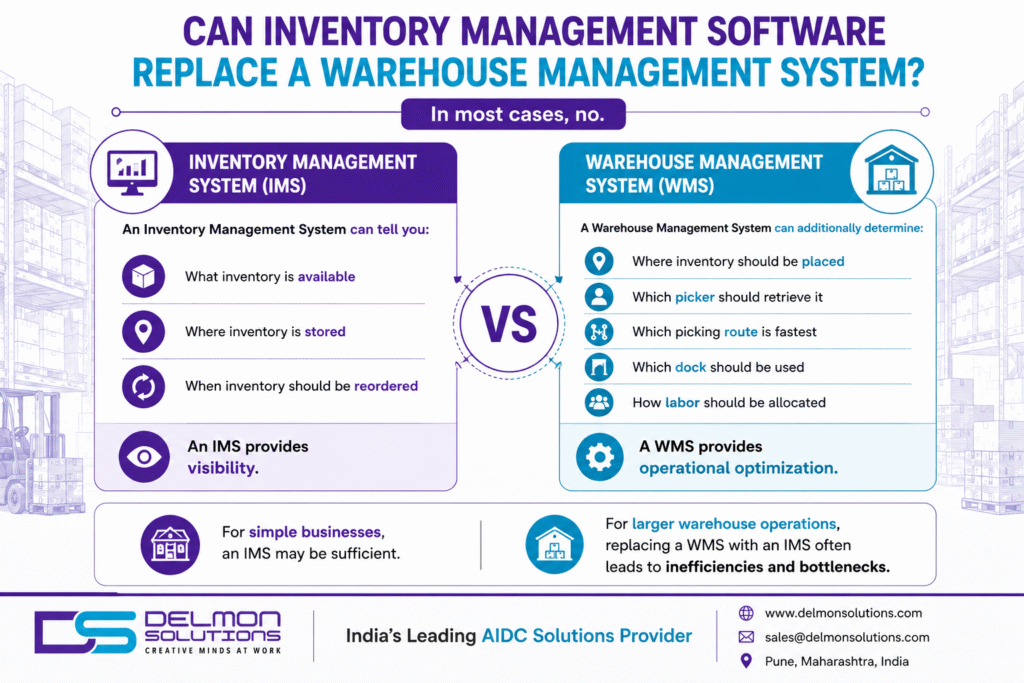
Can Inventory Management Software Replace a Warehouse Management System?
In most cases, no.
An Inventory Management System can tell you:
- What inventory is available
- Where inventory is stored
- When inventory should be reordered
A Warehouse Management System can additionally determine:
- Where inventory should be placed
- Which picker should retrieve it
- Which picking route is fastest
- Which dock should be used
- How labor should be allocated
- An IMS provides visibility.
- A WMS provides operational optimization.
For simple businesses, an IMS may be sufficient.
For larger warehouse operations, replacing a WMS with an IMS often leads to inefficiencies and bottlenecks.
How Inventory Management and Warehouse Management Work Together
The best-performing businesses don’t choose between an IMS and a WMS. They integrate both. A typical workflow looks like this:
- The Inventory Management System forecasts demand. Inventory reaches reorder levels. Purchase orders are created. Goods arrive at the warehouse.
- The Warehouse Management System manages receiving. Products are assigned optimal storage locations. Customer orders arrive.
- The WMS directs picking and packing. Inventory quantities update automatically in the IMS.
- Inventory planning continues using real-time data. Together, they create a seamless flow between planning and execution.
Which Businesses Need a Warehouse Management System?
A dedicated WMS delivers the greatest value for businesses with complex warehouse operations.
Industries that benefit include:
- Third-Party Logistics (3PL)
- Distribution Centers
- E-commerce Fulfillment
- Manufacturing
- Automotive
- Pharmaceuticals
- Food & Beverage
- Retail Distribution
- Consumer Goods
If your warehouse has become your operational bottleneck, investing in a Warehouse Management System can significantly improve productivity, accuracy, and customer satisfaction.
Frequently Asked Questions
Is warehouse management the same as inventory management?
No. Inventory management focuses on managing inventory levels across the business, while warehouse management focuses on managing the physical movement and storage of inventory within a warehouse.
What is an Inventory Management System (IMS)?
An Inventory Management System (IMS) is software that helps businesses monitor inventory, track stock levels, forecast demand, manage inventory control, and automate replenishment across multiple locations.
What is a Warehouse Management System (WMS)?
A Warehouse Management System (WMS) is software designed to optimize warehouse operations such as receiving, put-away, picking, packing, shipping, labor management, and warehouse inventory tracking.
Do I need both an IMS and a WMS?
Not always. Smaller businesses with simple warehouse operations may only require an Inventory Management System.
Businesses operating larger warehouses or multiple distribution centers typically benefit from integrating both systems.
Can inventory management software replace a WMS?
Only for simple warehouse operations. Once warehouse processes become complex, a dedicated Warehouse Management System provides capabilities that inventory software alone cannot.
How do an IMS and WMS work together?
An Inventory Management System plans inventory requirements and maintains stock visibility, while a Warehouse Management System executes warehouse operations. Together they provide end-to-end inventory and warehouse management.

Choose the Right Solution for Your Business
Selecting the wrong system can increase operational costs, reduce productivity, and limit future scalability.
At Delmon Solutions Pvt. Ltd., we help businesses evaluate, implement, and integrate the right Inventory Management System (IMS) and Warehouse Management System (WMS) based on their operational requirements.
Whether you’re improving inventory visibility, optimizing warehouse operations, or building a scalable supply chain, our experts can help you choose the right solution for long-term growth.
Ready to optimize your inventory and warehouse operations? Contact us today.