Warehouse intelligence is often associated with artificial intelligence, robotics and automated material handling. Yet many of the decisions that determine warehouse performance begin with something more fundamental: identifying the right item and capturing the event accurately.
When a product arrives at a receiving dock, moves into storage, gets picked for an order or leaves for dispatch, each movement creates an operational event. If that event is captured incorrectly, recorded late or disconnected from the warehouse system, the resulting data can become unreliable.
This is why barcode technology remains important in smart warehouse operations. It provides a standardised way to identify products and capture transactions, creating a foundation for inventory visibility, traceability and more advanced digital workflows.
For businesses investing in warehouse automation in India, the question is not whether barcode technology is old or new. It is whether their identification infrastructure supports the accuracy, integration and visibility their operations require.
A Barcode Is More Than a Label
A barcode encodes information in a machine-readable format. A compatible scanner captures that information and passes it to a connected application, where the identifier can be matched with a product record or operational transaction.
The barcode itself does not manage inventory, verify stock availability or update an order. Those actions depend on the software, business rules and integration behind the scanning process.
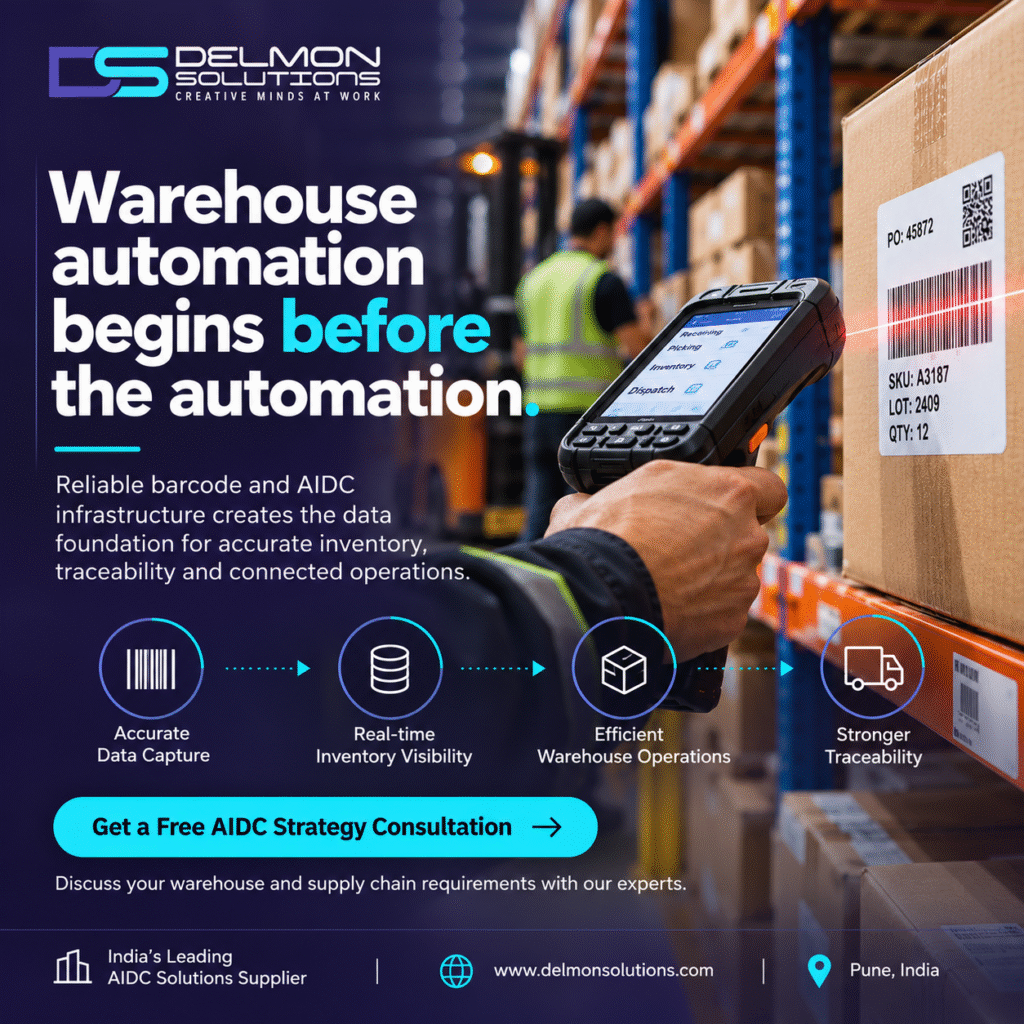
Consider a warehouse receiving operation. An employee scans a product barcode, and the system uses the identifier to retrieve the relevant item record. Depending on the implementation, the transaction can then support quantity verification, goods receipt, location assignment and inventory updates.
The same principle applies to picking, packing, cycle counting and dispatch.
The operational value comes from connecting a reliable scan to the correct business event.
A warehouse can have modern scanners and still experience inaccurate records if employees bypass scans, labels are unreadable, product identifiers are inconsistent or transactions do not synchronise with the WMS.
Where Barcode Data Creates Operational Value
Rather than viewing barcode scanning as a standalone activity, businesses should evaluate how it supports the entire warehouse workflow.
| Warehouse process | Role of barcode data | Operational value |
| Receiving | Identify incoming products and handling units | Supports goods verification and receipt recording |
| Putaway | Associate items with storage locations | Helps maintain location-level inventory records |
| Picking | Verify products against order requirements | Helps reduce item-selection errors |
| Packing | Confirm items before shipment | Supports order verification |
| Cycle counting | Capture product and location identifiers | Helps reconcile physical stock with system records |
| Dispatch | Identify packages and record shipment events | Supports dispatch documentation and traceability |
These benefits depend on correct labelling, scanning discipline and system configuration. Barcode scanning can improve transaction accuracy, but it cannot independently eliminate inventory errors or guarantee fulfilment performance.
For warehouse managers, the priority should be to identify where manual data entry, missed scans and disconnected processes create measurable operational risk.
The Missing Link: From Scanning to System Integration
A barcode scanner captures an identifier. A mobile computer can bring the scanning function, application and operational workflow together at the point of work. A Warehouse Management System (WMS) coordinates inventory and fulfilment activities.
When these components are properly integrated, a scan can become part of a controlled transaction rather than an isolated data point.
For example, a warehouse picking workflow can require an operator to scan a storage location and then verify the product before confirming the pick. The application can compare the scanned identifiers with the order requirements and guide the operator through the next step.
This is where rugged mobile computers, industrial barcode scanners, barcode printers and warehouse software work together.
The right architecture depends on the operation. Some facilities may need fixed scanners at conveyor points; others may benefit from handheld or wearable devices. Barcode labels must also remain readable under the conditions in which they are used, including exposure to handling, abrasion and environmental factors.
The objective is not to scan everything indiscriminately. It is to capture the right information at the right point in the process.
The Next Evolution: 2D Barcodes and Richer Product Information
Barcode technology is evolving beyond traditional one-dimensional formats.
Two-dimensional (2D) barcodes, including QR Codes and GS1 DataMatrix, can encode more information than conventional linear barcodes, depending on the format and data structure. They can support applications involving product identification, batch or lot numbers, expiry dates and access to additional product information.
GS1’s Sunrise 2027 initiative sets an industry goal for retail point-of-sale systems to be capable of reading and processing specified 2D barcodes alongside traditional linear barcodes by the end of 2027. It is a transition towards broader 2D barcode capability, not a requirement for all existing barcodes to disappear by that date.
For manufacturers, retailers and supply-chain businesses, this makes scanner capability, software compatibility, label design and data standards worth evaluating before introducing new barcode formats.
Not every warehouse needs to migrate immediately to 2D barcodes. The appropriate choice depends on the products being handled, customer and trading-partner requirements, and the intended use of the additional data.
How Barcode Infrastructure Fits into the Intelligent Warehouse
The next stage of warehouse development involves connecting identification technologies with operational systems, analytics and automation.
A barcode scan can record a transaction. Integrated warehouse software can use that transaction to update inventory or advance an order workflow. Analytics can then examine accumulated operational data to identify recurring delays, discrepancies or process bottlenecks.
AI may support further analysis, forecasting or recommendations where sufficient data and suitable models are available. However, these capabilities depend on the quality of the underlying data and the systems involved. A barcode alone does not create predictive intelligence.
DHL’s Logistics Trend Radar 8.0, published in September 2026, identifies AI Analytics and Agentic AI among the trends shaping logistics over the coming decade. The report highlights the growing role of AI in anticipating risks, supporting decisions and coordinating activities, while retaining the importance of people and governance.
For warehouse operators, the practical lesson is to establish dependable identification and data-capture processes before adding more advanced capabilities. Connected operations require a trustworthy record of what moved, where it was processed and which transaction took place.
A Practical Checklist for Barcode Modernisation
Before upgrading barcode infrastructure, warehouse and IT teams should assess five areas:
- Scanning requirements: Determine whether handheld, wearable, fixed or mobile scanning is appropriate for each workflow.
- Label quality: Verify barcode readability across product packaging, storage conditions and handling processes.
- Device suitability: Evaluate scan performance, durability, connectivity, battery life and compatibility with warehouse applications.
- Software integration: Confirm that scanned identifiers map correctly to product records, locations, orders and inventory transactions.
- Performance measurement: Track indicators such as scan compliance, inventory discrepancies, picking errors and transaction completion time before and after changes.
Start with the process creating the greatest operational difficulty. Establish a baseline, pilot the proposed solution and assess whether it improves the specific outcome before expanding the deployment.
Barcode and AIDC Solutions from Delmon Solutions
Delmon Solutions Pvt. Ltd. provides Automatic Identification and Data Capture (AIDC) hardware and solutions for businesses across warehousing, logistics, manufacturing, retail and distribution.
Its portfolio includes barcode scanners, rugged mobile computers, industrial barcode printers, RFID readers and warehouse-related software solutions. These technologies help businesses build identification and data-capture workflows suited to their operational requirements.

As India’s Leading AIDC Solutions Supplier, Delmon Solutions helps organisations evaluate the hardware and identification infrastructure needed to improve warehouse execution and operational visibility.
Planning to modernise your warehouse scanning infrastructure? Speak with Delmon Solutions about the right barcode scanners, mobile computers and AIDC solutions for your business.