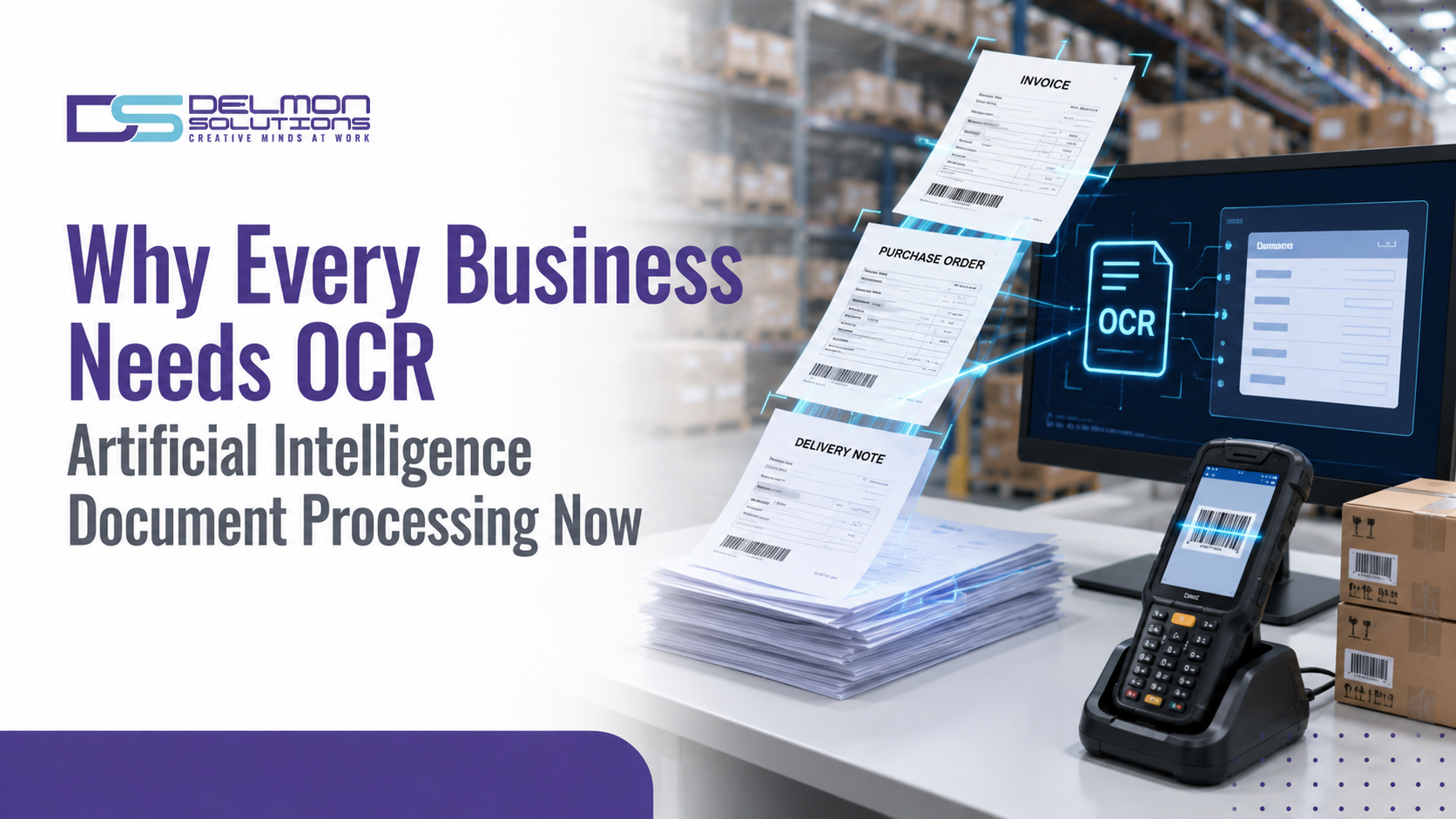
Businesses have digitized enormous amounts of information. Yet much of that information remains trapped inside documents. Invoices. Purchase orders. Delivery notes. Forms. Contracts. Identity documents. Product labels. Scanned records. PDFs.
The problem is not that these documents are unavailable.
The problem is that computers often cannot use the information inside them without additional processing.
This is where OCR artificial intelligence changes the equation.
Traditional OCR focuses primarily on converting visual text into machine-readable text. AI-powered document processing goes further by combining OCR with computer vision, machine learning and natural language processing to understand the structure and context of information.
The result is a shift from:
“Convert this document into text.”
to:
“Understand this document and turn it into usable business data.”
The real value of AI-powered OCR is not reading documents faster; it is turning document content into operational data.
What Is OCR Artificial Intelligence?
OCR stands for Optical Character Recognition. Traditional OCR identifies characters contained within an image or scanned document and converts them into digital text.
AI-powered OCR expands this capability.
A modern intelligent document processing workflow can:
- Receive a document
- Identify its type
- Detect text and layout
- Extract relevant fields
- Understand context
- Validate information
- Send structured data to another system
- Route exceptions for human review
This distinction is important.
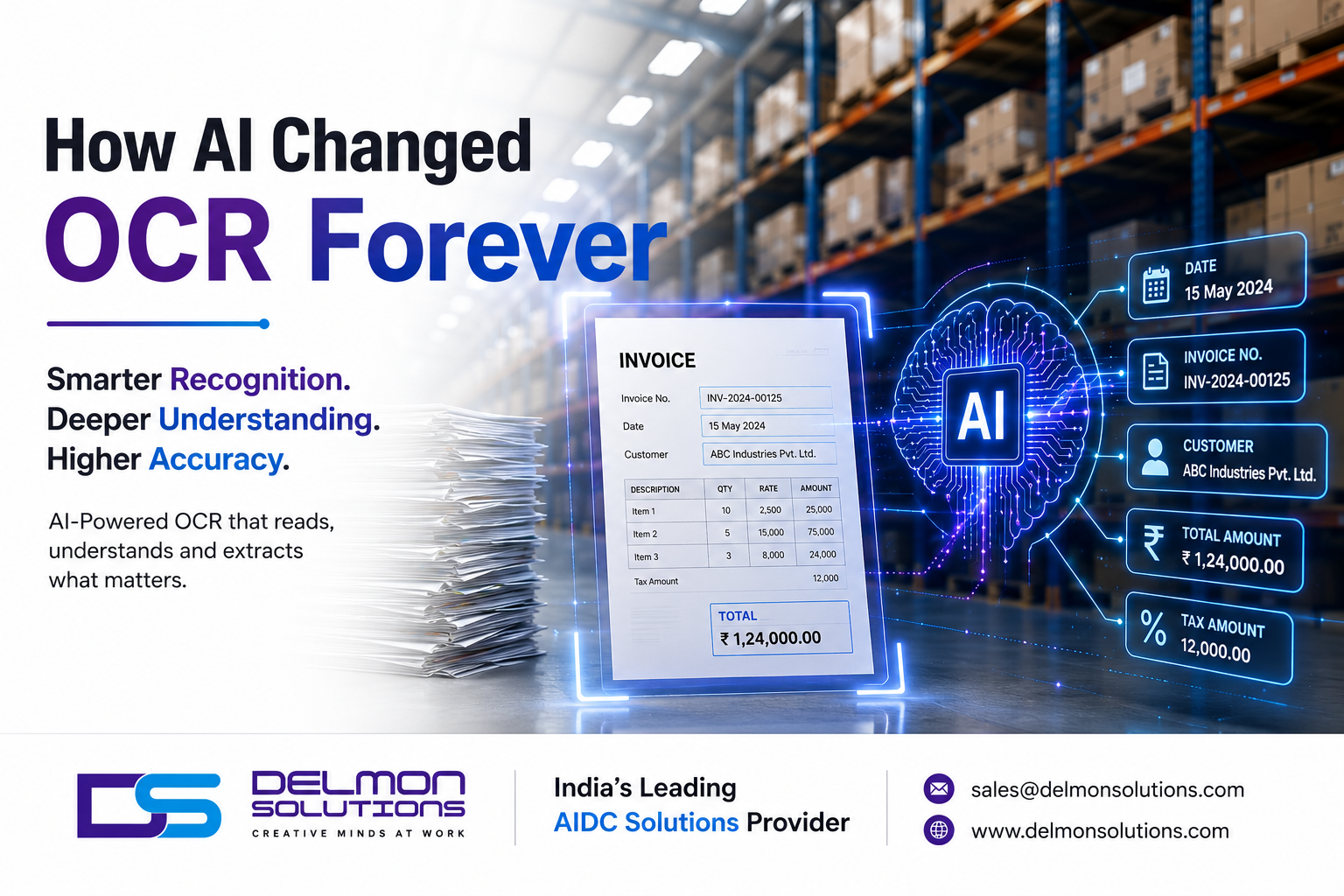
A business does not necessarily need the entire text of an invoice.
It needs:
- Vendor name
- Invoice number
- Invoice date
- Purchase order number
- Tax
- Line items
- Total amount
AI makes it possible to focus on the information that matters to the business process.
Why Traditional OCR Is Not Enough
Traditional OCR can work extremely well with clean, standardized documents.
But real business documents are messy.
They may contain:
- Different layouts
- Tables
- Handwriting
- Low-resolution scans
- Stamps
- Logos
- Multiple columns
- Mixed fonts
- Poor lighting
- Rotated pages
Traditional OCR often needs additional rules, templates or preprocessing to deal with these variations.
AI-powered approaches use computer vision and machine learning to interpret document structure and context more effectively. The evolution from traditional OCR toward intelligent document processing is one of the reasons businesses are investing in AI-driven document workflows.
The OCR Market Is Moving Quickly
The intelligent document processing market is experiencing significant growth.
Fortune Business Insights estimates the global IDP market at USD 10.41 billion in 2025, growing to approximately USD 88.91 billion by 2034, at a CAGR of 26.8%.
Mordor Intelligence also reports that OCR represented 41.55% of the intelligent document processing technology market in 2025, while cloud deployments accounted for 74.10% of revenue share.
The statistics point toward a clear trend: businesses are moving from document storage toward document intelligence and workflow automation.
Where Can Businesses Use AI OCR?
1. Invoice Processing
Finance teams receive invoices in many formats.
AI OCR can extract relevant information and structure it for downstream processing.
A typical workflow could be:
Invoice received → OCR → Field extraction → Validation → PO matching → ERP → Approval
This can significantly reduce manual data entry.
2. Purchase Orders
Purchase orders contain structured information that businesses need to enter into ERP systems.
AI OCR can extract:
- PO number
- Supplier
- Items
- Quantities
- Prices
- Delivery details
This can reduce repetitive administrative work.
3. Delivery Documents
Logistics operations often depend on documents such as delivery notes and proof-of-delivery records.
AI-powered document processing can extract relevant information and connect it to shipment or customer records.
4. Customer Onboarding
Organizations frequently need to process identity documents, applications and supporting paperwork.
OCR combined with AI can help extract information from documents and route it into onboarding workflows.
5. Contracts
Contracts contain valuable information that is difficult to manage when stored only as documents.
AI can help identify:
- Parties
- Dates
- Contract values
- Renewal periods
- Obligations
- Clauses
- Key terms
This makes document repositories more searchable and useful.
6. Manufacturing Documentation
Manufacturing businesses deal with a wide range of documents.
Examples include:
- Inspection reports
- Quality certificates
- Purchase orders
- Delivery documents
- Product labels
- Batch records
- Maintenance documentation
OCR and AI can help convert these documents into structured information.
This is particularly relevant when organizations need traceability across physical products and digital records.
OCR + AIDC: An Important Combination
OCR should not be viewed as completely separate from AIDC.
In many environments, both technologies can work together.
Consider a warehouse receiving process.
A package may contain:
Barcode: product identifier
OCR text: batch number
Printed label: expiry date
Document: delivery information
A modern data capture system could potentially combine all these sources.
This creates a richer digital representation of the physical item.
That is where OCR becomes particularly valuable for AIDC.
From Document Digitization to Intelligent Automation
There are three increasingly sophisticated levels of document processing.
Level 1: Digitization
Paper becomes a digital image.
Level 2: OCR
The image becomes machine-readable text.
Level 3: Intelligent Document Processing
The system understands the document, extracts relevant information, validates it and triggers business workflows.
This third level is where organizations can achieve the greatest operational impact.
Human-in-the-Loop Still Matters
AI document processing should not be positioned as “no humans required.”
A better model is human-in-the-loop automation.
The system handles straightforward documents automatically.
Unusual or low-confidence cases are routed to employees.
For example:
95% standard invoices → automated
5% exceptions → human review
The exact percentages will vary significantly by document quality, workflow and model performance. The principle is what matters: AI handles predictable work while people focus on exceptions and judgment.
Security Cannot Be Ignored
Document processing frequently involves sensitive business information.
An OCR AI implementation should therefore consider:
- Data encryption
- Access controls
- Data retention
- Secure APIs
- Cloud security
- Audit trails
- Role-based permissions
- Compliance requirements
Businesses should evaluate these considerations before deploying AI document processing at scale.
How to Choose an OCR AI Solution
Before purchasing a platform or device, ask:
Can it handle your documents?
Test actual documents, not only vendor samples.
Can it extract the fields you need?
Text extraction alone may not be enough.
Can it integrate with your systems?
Look for compatibility with ERP, WMS, CRM, accounting and workflow platforms.
Can it handle exceptions?
Human review should be part of the architecture.
Can it scale?
A solution that works for 1,000 documents may need a different architecture for 1 million.
Can it work with physical AIDC workflows?
For organizations operating warehouses, manufacturing facilities or field operations, integration between OCR and barcode/mobile data capture can be particularly valuable.
The Future of OCR AI
The next generation of document processing will increasingly combine:
OCR + Computer Vision + NLP + Machine Learning + Generative AI + Workflow Automation
This will allow systems to move beyond extracting individual fields.
They will increasingly be able to understand documents in context.
For example, instead of simply extracting an invoice total, an intelligent system could identify the invoice, compare it with the purchase order, detect discrepancies and route the exception to the appropriate employee.
That is a fundamentally different proposition from traditional OCR.
Frequently Asked Questions
What is OCR artificial intelligence?
OCR artificial intelligence combines optical character recognition with AI technologies such as computer vision, machine learning and NLP to extract and understand information from documents.
What is the difference between OCR and AI OCR?
Traditional OCR primarily converts images of text into machine-readable text. AI OCR can additionally interpret document structure, context and relevant information.
What is intelligent document processing?
Intelligent document processing uses AI, OCR, machine learning, NLP and workflow automation to capture, classify, extract, validate and route information from documents.
Can OCR process invoices?
Yes. OCR and AI can extract invoice information such as supplier names, invoice numbers, dates, line items, taxes and totals.
Is OCR part of AIDC?
Yes. OCR is one of the technologies used within the broader AIDC ecosystem for automatically capturing information from visual documents and text.
Can OCR AI integrate with ERP and WMS systems?
Yes. Depending on the platform, extracted information can be transmitted to ERP, WMS, CRM, accounting and other enterprise applications through APIs or integration layers.
Turn Documents Into Usable Business Data with Delmon Solutions
For organizations that still rely heavily on manual document entry, OCR and intelligent data capture can be an important step toward automation.
Delmon Solutions helps businesses evaluate AIDC hardware and data capture technologies, including barcode scanning, mobile computing and related solutions that can connect physical operations with digital workflows.
If your business is handling large volumes of labels, invoices, forms, inventory documents or operational records, the right combination of OCR, barcode scanning and enterprise integration can significantly improve how information moves through the organization.
Talk to Delmon Solutions about building a smarter document and data capture workflow for your business.