For decades, AIDC has followed a relatively predictable model. A worker finds the barcode. They aim the scanner. They capture the code. The system records the result. It works. It is reliable. It is familiar.
But it is also dependent on the worker performing a series of individual actions. Artificial intelligence is beginning to change that model.
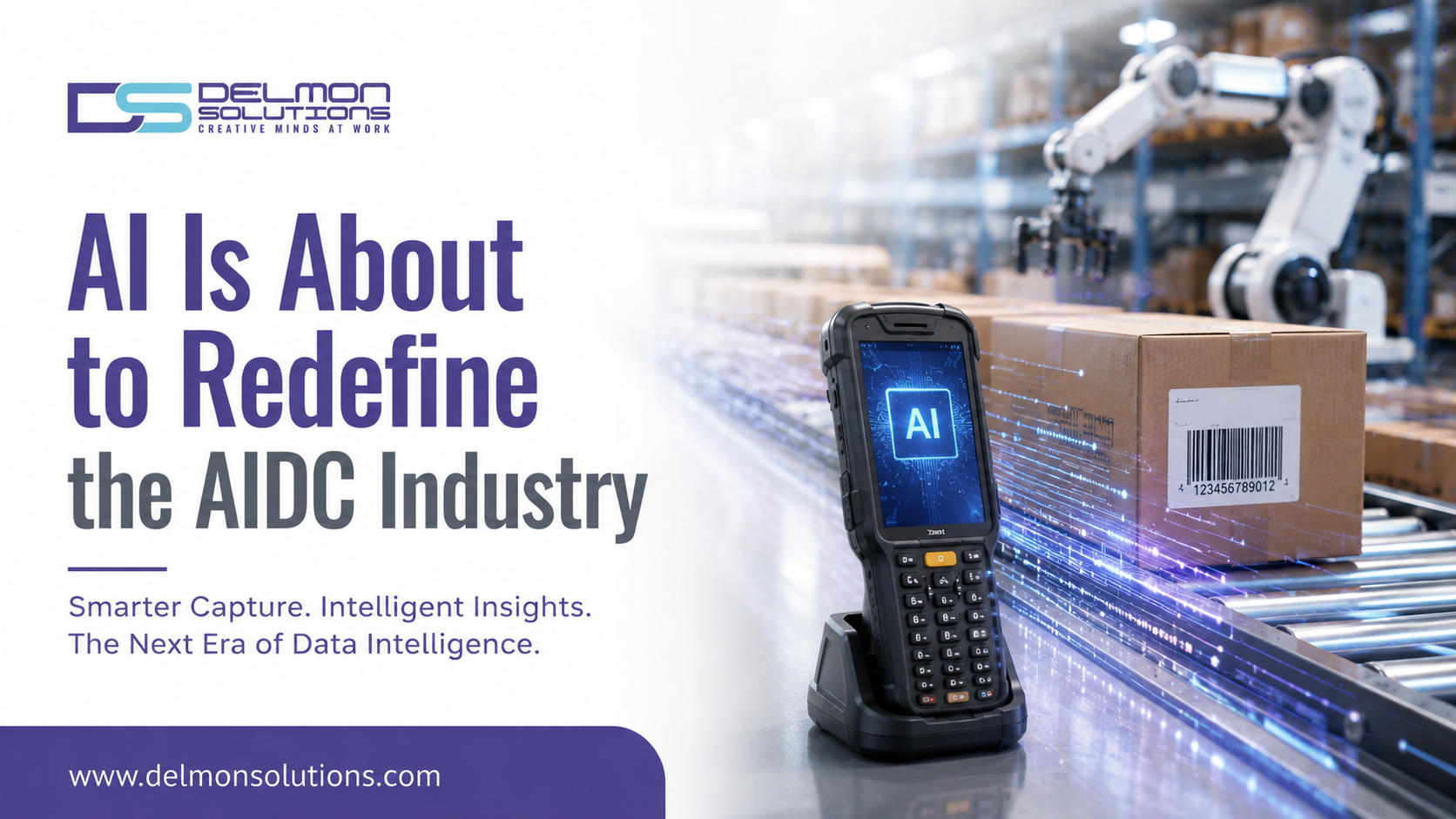
The latest generation of AI-powered AIDC technologies uses computer vision, machine learning, OCR and image recognition to interpret more information from a single visual capture.
Recent developments in AI-powered data capture demonstrate how devices can detect multiple barcodes, recognize labels and extract information from images rather than requiring every barcode to be individually targeted.
The change is subtle at first.
But strategically, it is significant.
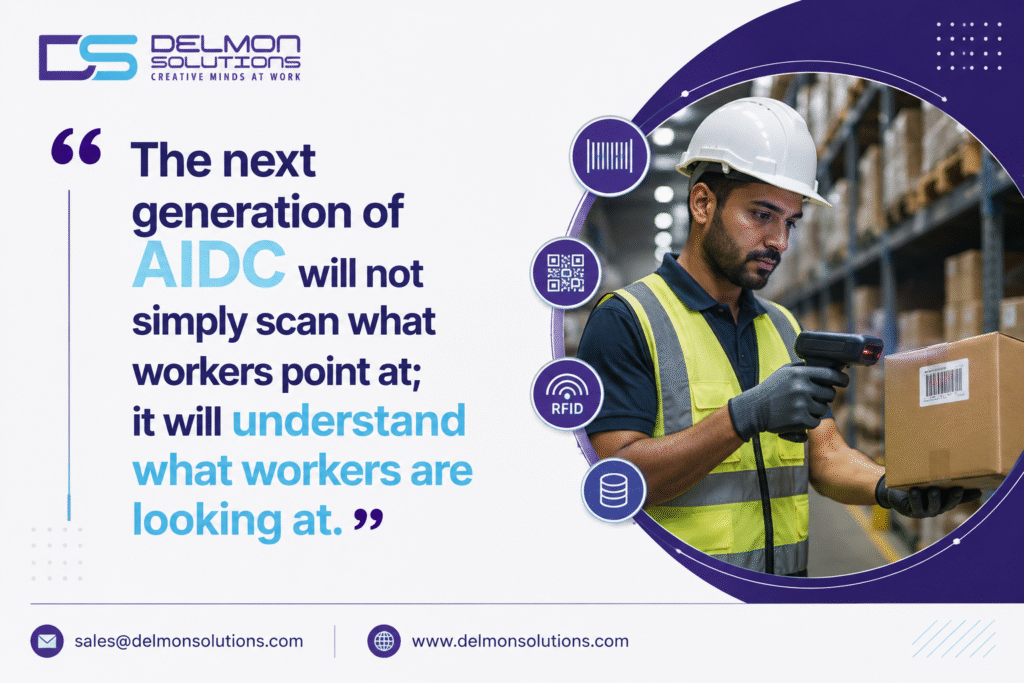
The next generation of AIDC will not simply scan what workers point at; it will understand what workers are looking at.
From Scanning to Seeing
Traditional AIDC is highly effective when the data structure is predictable.
A barcode contains a number.
The scanner reads the number.
The application looks up the corresponding record.
AI introduces a different capability.
A camera can see:
- Multiple barcodes
- Product labels
- Text
- Packaging
- Serial numbers
- Documents
- Visual anomalies
- Different object types
AI can then interpret that visual information.
This changes the fundamental interaction between worker and device.
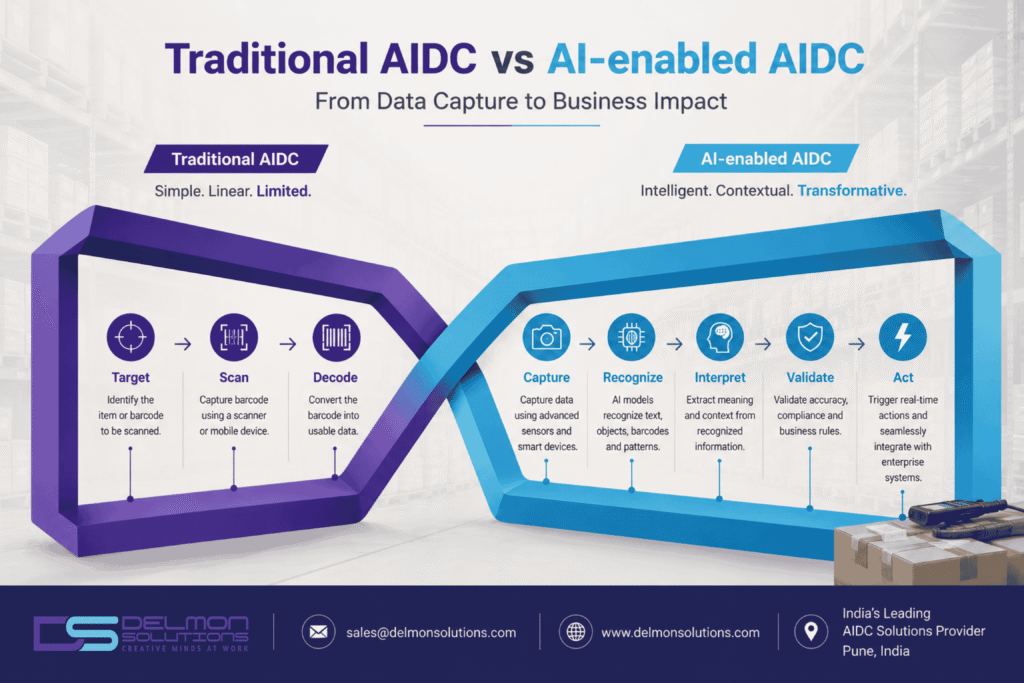
Traditional AIDC : Target → Scan → Decode
AI-enabled AIDC: Capture → Recognize → Interpret → Validate → Act
That is a much broader capability.
Why AI Matters in Warehouses
Imagine a warehouse shelf containing dozens of cartons.
A conventional workflow may require the employee to scan each barcode individually.
AI-enabled computer vision can potentially capture a wider image and identify multiple visible codes or relevant information within it. MEFERI describes this emerging model as a shift from traditional barcode scanning toward visual data capture.
The potential benefits include:
- Faster inventory verification
- Fewer individual scanning actions
- Reduced repetitive movement
- Faster exception identification
- Greater data capture density
The exact productivity improvement will depend on the environment, device, barcode quality, workflow and software integration. AI should therefore be evaluated through real operational testing rather than assumed productivity percentages.
AI Does Not Mean the End of Barcode Scanners
This is an important distinction.
AI is not necessarily replacing barcode technology.
It is augmenting it.
Barcodes remain highly efficient because they provide structured, standardized identifiers.
AI can make the capture process more flexible.
For example:
Barcode = structured identity
AI vision = contextual understanding
Together, they can be more powerful than either technology alone.
AI and OCR Are Converging
One of the biggest opportunities is combining barcode scanning with OCR.
Consider a product label containing:
- Barcode
- Serial number
- Manufacturing date
- Batch number
- Product description
A traditional scanner may capture the barcode.
An AI-enabled system could potentially capture and interpret multiple elements of the label.
This becomes particularly valuable when information is not standardized into one barcode.
The intelligent document processing market is expanding rapidly. Fortune Business Insights estimates that the global market will grow from USD 10.41 billion in 2025 to USD 88.91 billion by 2034.
This reflects the broader movement toward AI systems that can understand rather than simply digitize information.
Manufacturing Could Be a Major Beneficiary
Manufacturing environments generate enormous amounts of identification data.
Examples include:
- Components
- Work orders
- Serial numbers
- Batch numbers
- Finished products
- Quality records
- Packaging labels
AI-powered AIDC can potentially bring multiple data capture methods together.
A worker could use a mobile computer to capture an image.
Computer vision identifies the relevant elements.
OCR extracts text.
Barcode recognition captures structured identifiers.
The application validates the information.
The result is sent to the MES or ERP.
The worker receives the next instruction.
The important point is that the device becomes part of the workflow rather than merely a peripheral.
AI Can Also Help With Exceptions
AIDC systems traditionally perform well when the input is clean.
Real-world environments are rarely clean.
Barcodes can be:
- Damaged
- Obstructed
- Poorly printed
- Angled
- Dirty
- Partially visible
Labels may also contain inconsistent formatting.
AI-powered vision can potentially help interpret imperfect visual inputs and identify cases that require human intervention.
This does not mean AI will eliminate exceptions.
Instead, the objective is to reduce unnecessary manual intervention while directing genuine exceptions to employees.
The New AIDC Architecture
AI will likely change the architecture of AIDC deployments.
A simplified future workflow could look like this:
Camera / Scanner
↓
AI Vision
↓
Barcode + OCR + Object Recognition
↓
Data Validation
↓
Business Rules
↓
ERP / WMS / MES
↓
Analytics / Workflow Automation
This is substantially different from a standalone scanner connected directly to a single application.
What About 2D Barcodes?
AI’s development does not reduce the importance of barcode standards.
In fact, 2D barcodes are becoming increasingly important.
GS1 has established an industry ambition for retail POS systems to support defined GS1-compliant 2D barcodes alongside existing linear barcodes by the end of 2027.
2D codes can encode information such as:
- GTIN
- Batch or lot information
- Expiration dates
- Serial numbers
- Digital links
This means future AIDC environments will likely combine better identifiers with smarter recognition.
The Real Question for Businesses
The question is not:
“Should we replace our barcode scanners with AI?”
The better questions are:
- Where are workers spending time scanning?
- How many individual scans are performed?
- Where does manual verification occur?
- Which labels contain unstructured information?
- Where do scanning errors occur?
- Can multiple data points be captured simultaneously?
- Does the current hardware integrate with the WMS or ERP?
- Would AI reduce a meaningful operational bottleneck?
These questions lead to better technology decisions.
What Will AI-Powered AIDC Look Like in Practice?
Over the next few years, we are likely to see more enterprise devices combining:
Scanning + Camera + OCR + Computer Vision + AI + Mobile Computing
The physical device will remain important.
But the intelligence around that device will become increasingly sophisticated.
This could make AIDC less about “scanning” and more about contextual data capture.
Frequently Asked Questions
What is AI in AIDC?
AI in AIDC refers to the use of artificial intelligence, computer vision, machine learning and related technologies to make identification and data capture more intelligent.
How does AI improve barcode scanning?
AI can help identify multiple codes, recognize labels and interpret visual information, potentially reducing the need for repetitive individual scanning.
Will AI replace barcode scanners?
Not necessarily. AI is more likely to augment barcode scanning by adding computer vision, OCR and contextual interpretation.
What is AI-powered computer vision in AIDC?
It uses cameras and AI models to identify and interpret objects, barcodes, labels or text in a visual scene.
Which industries can benefit from AI-enabled AIDC?
Warehousing, manufacturing, logistics, retail, healthcare and field service are strong potential use cases.
Prepare Your AIDC Infrastructure for the AI Era
AI adoption does not mean businesses should immediately replace every device they own.
The smarter approach is to identify processes where intelligent data capture can create measurable operational value.
Delmon Solutions can help businesses evaluate barcode scanners, industrial mobile computers, wearable devices and other AIDC technologies based on the actual workflow.
Whether you are exploring AI-powered scanning or simply modernizing your existing barcode infrastructure, the right hardware is the foundation for reliable data capture.
Talk to Delmon Solutions about building an AIDC environment that is ready for the next generation of intelligent data capture.