Most warehouse leaders still diagnose inefficiencies as labor problems. In reality, the constraint sits elsewhere: how quickly and accurately decisions are made on the floor.
Picking and packing are not mechanical tasks—they are decision-heavy workflows:
- Where to go next
- What to pick
- How to verify
- How to pack
Traditional systems rely on static rules. AI introduces dynamic, context-aware decisioning—and that is where the shift happens.
What is AI-powered smart picking and packing?
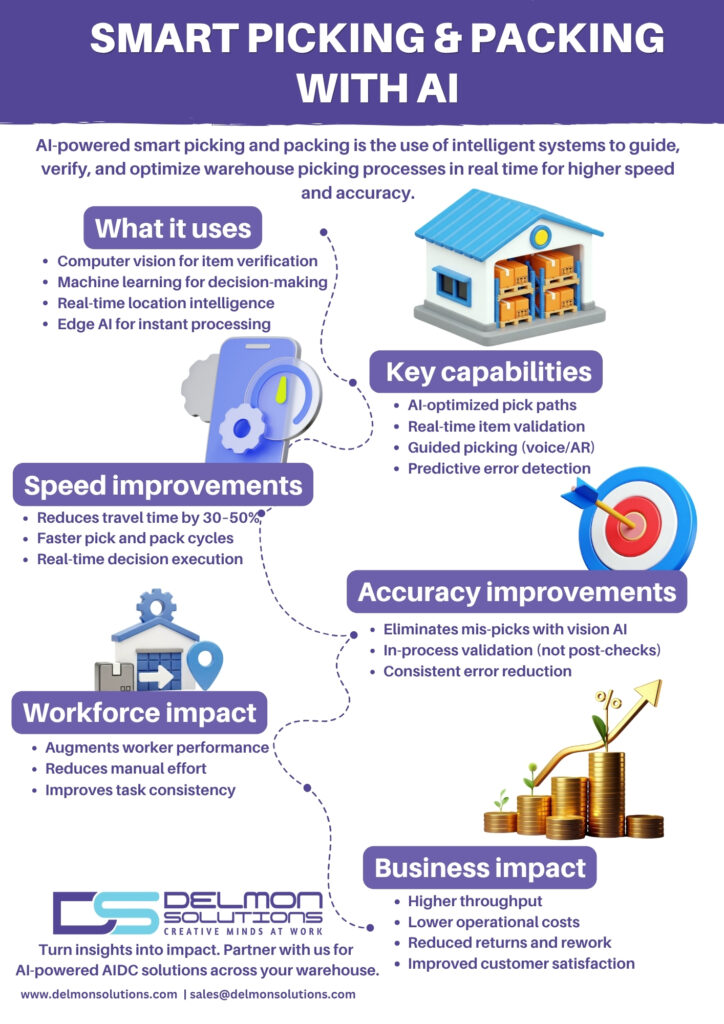
AI-powered smart picking is a warehouse execution approach that uses advanced technologies to guide and optimize the picking process in real time.
It combines:
- Computer vision for item recognition and verification
- Machine learning models for predictive decision-making
- Real-time location intelligence for optimized navigation and tracking
- Edge-enabled systems for instant, on-site processing
The outcome is not just automation, but augmented execution, where human actions are continuously guided, validated, and optimized by AI systems.
Research shows that AI-driven picking systems:
- Reduce travel time and distance significantly
- Improve task accuracy through guided decision support
More importantly, they change how work is performed, not just how fast.
How AI improves warehouse picking speed and accuracy
1. AI-driven pick path optimization (reducing travel time)
In most warehouses, walking time accounts for over 50% of picking effort.
AI systems:
- Continuously optimize routes based on real-time conditions
- Adapt to congestion, priority orders, and SKU movement
A Georgia Tech study highlights that AI-enabled picking systems can increase throughput by up to 40%
This is not incremental—it is structural improvement.
2. Vision-based verification (eliminating mis-picks)
Computer vision introduces a verification layer at the point of action:
- Confirms item selection
- Validates SKU and quantity
- Flags anomalies instantly
This is critical because mis-picks are not just errors—they cascade into:
- Returns
- Re-dispatch costs
- Customer dissatisfaction
AI reduces error probability before it becomes a downstream issue.
3. AI-assisted worker guidance (augmenting human performance)
AI does not replace workers—it guides them contextually:
- Voice-directed picking
- AR-assisted instructions
- Real-time task prioritization
According to industry analysis, AI picking assistants enhance:
- Worker efficiency
- Task accuracy
- Throughput consistency
4. Predictive error detection (before mistakes happen)
Advanced AI models:
- Identify high-risk picks
- Trigger additional validation steps
- Adjust workflows dynamically
This predictive layer transforms quality control from:
- Reactive inspection → proactive prevention
AI vs traditional picking systems: a structural comparison
| Capability | Traditional Picking Systems | AI-Powered Smart Picking |
| Decision logic | Rule-based, static | Dynamic, learning-based |
| Route optimization | Predefined paths | Real-time adaptive routing |
| Error detection | Post-pick validation | In-process predictive validation |
| Worker role | Manual executor | AI-assisted operator |
| Throughput scalability | Linear (add labor) | Non-linear (optimize system) |
| Accuracy | Dependent on human consistency | Systematically enforced |
Business impact: what actually changes
AI in picking and packing does not just improve KPIs—it redefines operational capability.
| Impact Area | Traditional Outcome | AI-Enabled Outcome |
| Order fulfillment speed | Incremental gains | Step-change improvement |
| Accuracy rates | Variable | Consistent and scalable |
| Labor dependency | High | Optimized and augmented |
| Cost structure | Labor-heavy | Efficiency-driven |
| Operational visibility | Limited | Real-time and predictive |
The broader market reflects this shift. The AI in warehousing market is projected to grow from $11.2B in 2024 to $45B by 2030, driven by demand for faster and more accurate fulfillment.
Where most AI picking implementations fail
This is where many organizations get it wrong.
They:
- Deploy isolated tools (voice, scanning, robotics)
- Expect transformation without system integration
Smart picking works only when:
- AI is embedded across workflows
- Data flows are unified
- Edge devices and systems operate cohesively
FAQs: AI in Smart Picking and Packing
1. How does AI improve picking accuracy in warehouses?
AI uses computer vision and predictive models to verify items in real time and prevent errors before they occur, significantly reducing mis-picks.
2. What is AI pick path optimization?
It is the use of machine learning to dynamically calculate the most efficient picking routes based on real-time warehouse conditions.
3. Can AI replace warehouse workers in picking operations?
No. AI augments workers by guiding decisions and improving efficiency rather than replacing human roles.
4. What technologies enable smart picking?
Key technologies include:
- Computer vision
- Edge AI devices
- Autonomous mobile robots (AMRs)
- Voice and AR-based interfaces
5. What is the ROI of AI in picking and packing?
ROI comes from:
- Reduced errors and returns
- Faster fulfillment
- Lower labor dependency
- Higher throughput
6. Is AI picking suitable for existing warehouses?
Yes. Most deployments today are retrofit-based, allowing existing warehouses to adopt AI without full infrastructure overhaul
Conclusion
Smart picking is often positioned as an efficiency upgrade. That is an understatement. It is the beginning of a broader shift from manual coordination to intelligent orchestration. And once that shift starts, it does not stop at picking.
As a leading AIDC solutions provider in India, we help businesses implement end-to-end warehousing solutions—across both hardware and software.
Contact us to streamline your warehouse operations with the right technology stack.