Manufacturing traceability depends on accurate data capture across every stage of production. In many manufacturing environments, critical information such as part numbers, batch codes, serial numbers, and inspection data is still recorded manually or stored in documents that are difficult to digitize.
Over the past few years, artificial intelligence has significantly improved how manufacturers extract and process this information. AI-powered optical character recognition (OCR) systems can now read printed text, labels, markings, and documents automatically, converting them into structured digital data that supports traceability systems.
When implemented correctly, AI-powered OCR enables manufacturers to capture production data more efficiently, reduce manual entry errors, and improve visibility across the manufacturing process.
This article explains how AI-powered OCR works and how it supports manufacturing traceability.
What is AI-Powered OCR?
Optical character recognition (OCR) is a technology that converts text from images, labels, or scanned documents into machine-readable data.
Traditional OCR systems could recognize basic printed text, but they often struggled with variations in fonts, label quality, lighting conditions, or complex industrial markings.
AI-powered OCR uses machine learning and computer vision techniques to improve recognition accuracy. These systems can interpret text from a wide range of sources, including:
- Product labels
- Component markings
- Inspection reports
- Packaging labels
- Production documents
By combining image recognition with artificial intelligence, modern OCR systems can extract information even from low-quality images or complex industrial environments.
Why Manufacturing Traceability Requires Automated Data Extraction
Manufacturing traceability systems rely on accurate data collected at multiple stages of production. This data is used to track products, identify production batches, and investigate quality issues when they occur.
However, manual data entry introduces several challenges.
Manual Data Entry Errors
Operators recording information manually can accidentally enter incorrect serial numbers, batch codes, or product identifiers.
Slow Data Collection
Manual recording processes slow down production workflows and increase administrative overhead.
Limited Visibility Across Production
If data is stored in paper records or unstructured documents, it becomes difficult to analyze production history or investigate product issues.
Automated data extraction using AI-powered OCR helps manufacturers overcome these challenges.
How AI-Powered OCR Works in Manufacturing
AI-powered OCR systems typically follow several steps to extract usable data from images or documents.
1. Image Capture
The first step involves capturing images of labels, documents, or product markings using industrial cameras, mobile devices, or scanning systems.
Examples include:
- Capturing images of product labels during packaging
- Scanning serial numbers on manufactured components
- Photographing inspection reports or quality documents
2. Image Processing and Enhancement
Before text recognition occurs, the system processes the image to improve readability.
AI algorithms adjust factors such as:
- Contrast and brightness
- Image alignment
- Noise reduction
- Text region detection
This preprocessing stage improves recognition accuracy.
3. Text Recognition
Once the image is prepared, the OCR engine identifies characters and converts them into digital text.
AI-based models can recognize:
- Serial numbers
- Batch codes
- Manufacturing dates
- Part numbers
- Supplier identifiers
Unlike traditional OCR systems, AI-driven models can adapt to different fonts, label formats, and industrial markings.
4. Data Structuring
After text is extracted, the system organizes the information into structured data fields.
For example:
- Serial number → Product identifier
- Batch code → Production batch
- Date code → Manufacturing timestamp
Structured data can then be transmitted to enterprise systems.
5. Integration with Manufacturing Systems
The extracted data is typically sent to systems such as:
- Manufacturing execution systems (MES)
- Enterprise resource planning (ERP) platforms
- Quality management systems
- Traceability databases
This integration allows manufacturers to build a digital record of each product’s production history.
Applications of AI-Powered OCR in Manufacturing Traceability
AI-driven OCR technology is increasingly used across several manufacturing environments.
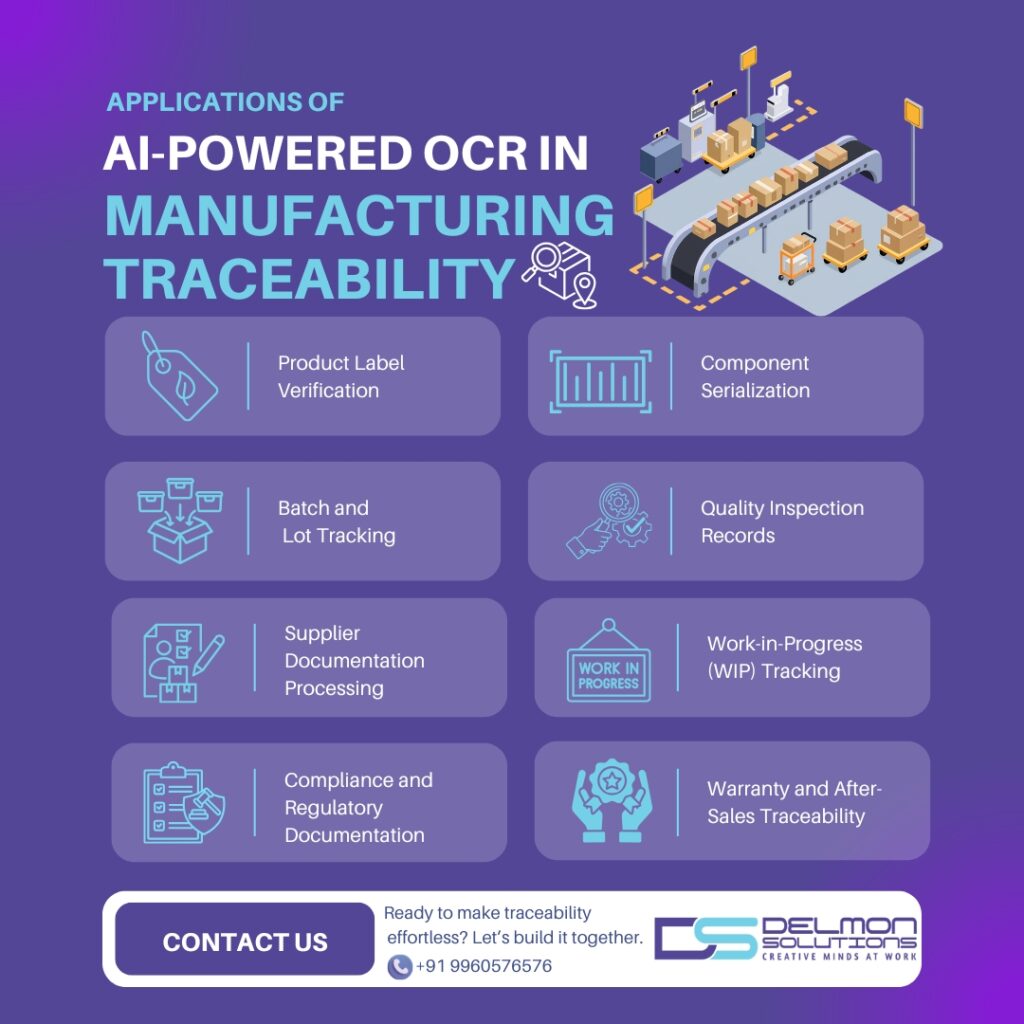
Product Label Verification
OCR systems can automatically read product labels and verify that the correct information is printed before shipment.
Component Serialization
Manufacturers can capture serial numbers from components during assembly and link them to production records.
Batch and Lot Tracking
Batch codes extracted from labels allow manufacturers to trace products back to specific production runs.
Quality Inspection Records
OCR systems can digitize inspection forms and quality documentation, making the data searchable and easier to analyze.
Supplier Documentation Processing
Manufacturers can extract information from supplier documents such as packing lists and certificates.
Work-in-Progress (WIP) Tracking
Captures identifiers from parts and subassemblies at different production stages, enabling real-time visibility into manufacturing flow and bottlenecks.
Compliance and Regulatory Documentation
Reads and verifies compliance labels, safety markings, and regulatory codes to ensure adherence to industry standards such as ISO, FDA, or CE.
Warranty and After-Sales Traceability
Extracts product identifiers from returned goods or service records, helping manufacturers trace issues back to specific batches, suppliers, or production conditions.
Benefits of AI-Powered OCR for Manufacturing
Manufacturers adopting AI-powered OCR systems often achieve several operational benefits.
Improved Traceability
Automated data capture ensures that production information is recorded consistently across manufacturing processes.
Reduced Human Error
OCR eliminates many manual data entry steps, reducing the risk of incorrect records.
Faster Data Processing
Information can be captured and processed automatically during production workflows.
Better Compliance and Reporting
Digital traceability records help manufacturers meet regulatory and quality requirements.
Key Takeaways
AI-powered OCR is transforming how manufacturers capture and manage traceability data. By extracting information from labels, documents, and product markings automatically, these systems reduce manual processes and improve the accuracy of production records.
For manufacturers that rely on detailed traceability, AI-driven OCR can play an important role in building more reliable and data-driven production systems.
Frequently Asked Questions
What is OCR in manufacturing?
OCR in manufacturing refers to the use of optical character recognition technology to extract text from product labels, documents, and component markings and convert it into digital data for production systems.
How does AI improve OCR accuracy?
AI improves OCR accuracy by using machine learning models that can recognize text under varying conditions, including different fonts, lighting environments, and label formats.
Can OCR be used for product traceability?
Yes. OCR systems can extract serial numbers, batch codes, and product identifiers, which can then be stored in traceability systems or manufacturing databases.
What systems can OCR integrate with in manufacturing?
OCR solutions commonly integrate with manufacturing execution systems (MES), enterprise resource planning (ERP) platforms, quality management systems, and traceability databases.
Manufacturers seeking better traceability often start by improving how production data is captured and recorded.
If you are exploring technologies such as AI-powered OCR, barcode systems, or automated data capture solutions for manufacturing environments, our team can help you evaluate practical approaches that align with your operational workflows.
Feel free to connect with us to discuss your requirements.