
E-commerce has matured into an arena where customer expectations evolve faster than operational capabilities. What was once considered expedited delivery has become routine, and what was once an acceptable margin of error is now commercially untenable. In this environment, fulfillment is no longer a downstream activity that merely supports sales. It has become the operational core upon which customer experience, profitability, and brand credibility depend.
Organizations that continue to view the warehouse as a cost center often discover, too late, that growth exposes structural weaknesses. Order volumes rise, yet throughput remains static. Teams work longer hours, yet dispatch windows are still missed. Errors multiply, rework increases, and margins erode quietly in the background.
The challenge is not demand. Demand is abundant. The constraint lies in the system designed to process it.
High-performing e-commerce enterprises understand a fundamental principle. e-commerce fulfillment must be engineered with the same rigor as marketing strategy or product development. It must be deliberate, resilient, and capable of scaling without proportional increases in labor or complexity.
The operational pressure of modern commerce
Today’s fulfillment centers operate under a degree of volatility that traditional warehouse models were never designed to absorb. Flash sales, seasonal peaks, marketplace integrations, and next-day delivery commitments create dramatic fluctuations in daily volumes. A facility that processes ten thousand orders on a typical day may be required to process twice that number during a promotion, without the luxury of additional space or headcount.
In such circumstances, incremental adjustments offer little relief. Adding more manual checkpoints or temporary labor often introduces further friction. What appears to be added capacity frequently becomes added confusion.
Sustainable scalability emerges not from effort, but from architecture.
When processes are structured intelligently and supported by the right operational tools, speed increases naturally, accuracy improves systematically, and growth ceases to feel disruptive.
Speed as a structural outcome
In contemporary e-commerce, speed is not a competitive advantage. It is a baseline expectation.
Customers assume that an order placed today will be dispatched within hours. Retailers and marketplaces enforce stringent service-level agreements. Delays that once seemed negligible now carry measurable financial consequences.
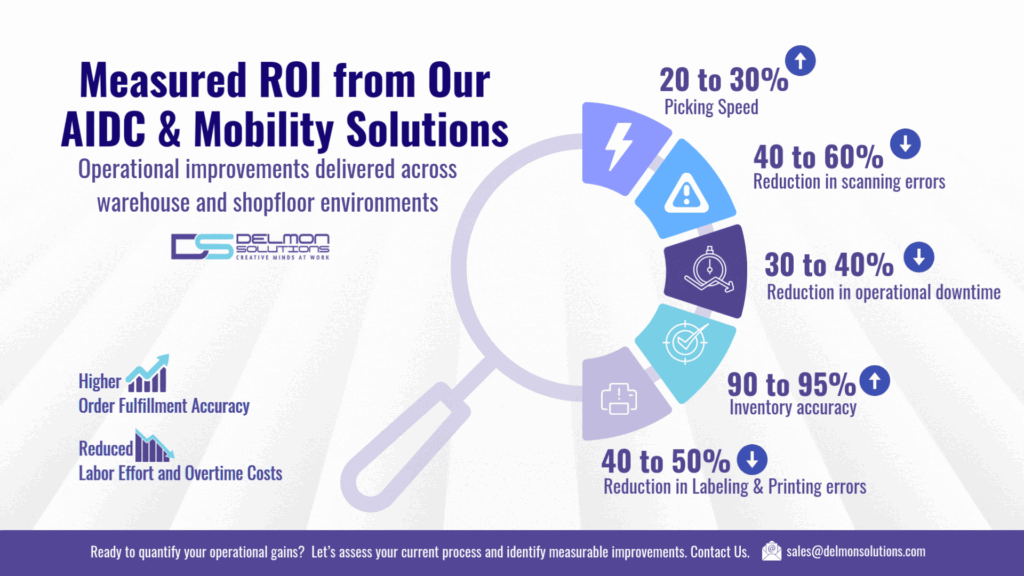
Yet delays rarely stem from a single dramatic failure. They accumulate through dozens of small inefficiencies. Labels are printed at distant stations, requiring unnecessary movement. Reprints occur because of unclear barcodes. Packing teams wait for documentation. Manual verification slows handoffs.
Each interruption appears minor. Collectively, they compromise the entire workflow.
Organizations that achieve consistent dispatch performance do so by eliminating these micro-frictions. Labels are generated at the point of activity. Identification is immediate and unambiguous. Transitions between picking, packing, and shipping occur without idle time. The result is not hurried labor, but uninterrupted flow.
Throughput improves because the system is coherent.
Accuracy as an economic necessity
While speed determines customer satisfaction, accuracy determines profitability.
A mislabeled carton or an unreadable barcode sets off a chain reaction that extends well beyond the warehouse floor. Returns, reverse logistics, customer service interventions, and replacement shipments compound the true cost of what began as a minor oversight.
At scale, even modest error rates translate into thousands of avoidable transactions. The cumulative expense is seldom captured in a single line item, yet it steadily undermines margins.
The most effective operations therefore treat accuracy not as an afterthought, but as a design principle. Clear, high-resolution labeling, dependable scanning, and consistent identification protocols reduce reliance on manual judgment. Each product movement is verified in real time, ensuring that discrepancies are addressed immediately rather than discovered downstream.
When accuracy is embedded into the process itself, rework declines, and capacity expands without additional resources.
Visibility as operational intelligence
Speed and accuracy, however, cannot be sustained without visibility.
In the absence of real-time insight, fulfillment management becomes reactive. Supervisors chase exceptions rather than preventing them. Inventory discrepancies remain hidden until they disrupt orders. Planning relies on estimates rather than evidence.
Modern fulfillment environments require a continuous stream of reliable data. Every item must be identifiable, every movement traceable, and every stage measurable.
This requirement has elevated structured identification technologies, including barcode labeling, RFID tagging, and mobile printing, from optional enhancements to foundational infrastructure. These tools create a persistent digital thread across the warehouse, enabling managers to understand precisely what is happening at any moment.
With visibility comes control. With control comes predictability. And with predictability comes the confidence to scale.
Infrastructure that supports growth rather than constrains it
As order volumes expand, the underlying tools must evolve accordingly. A fulfillment center that depends on a single shared printer or manual labeling routines will inevitably encounter bottlenecks. Conversely, an environment equipped with distributed, purpose-built systems can absorb higher loads with minimal disruption.
Compact desktop printers provide efficient support for everyday labeling tasks at packing stations. RFID-enabled systems introduce deeper traceability where asset visibility or compliance is critical. Industrial-grade printers deliver sustained performance under continuous, high-volume demand. Mobile printers extend labeling capabilities directly to receiving docks, staging areas, and dispatch points, reducing unnecessary movement and delay.
Individually, each element addresses a specific operational need. Together, they form an integrated ecosystem that aligns with the pace and complexity of modern e-commerce.
The objective is not to accumulate hardware. It is to design a coherent infrastructure in which every component contributes to speed, precision, and resilience.
A strategic rather than tactical conversation
The organizations that consistently outperform their peers have already reframed the fulfillment discussion. They no longer ask how to manage the next peak. They ask whether their current architecture can sustain the next phase of growth without compromise.
This distinction is subtle but consequential.
Tactical fixes address immediate problems. Strategic design prevents those problems from emerging in the first place.
Fulfillment, when treated as a strategic capability, transforms from a reactive necessity into a source of competitive strength. Orders move predictably. Errors decline materially. Customers receive what they expect, when they expect it.
In an industry defined by speed and choice, that reliability becomes a decisive advantage.
Connect with us
As e-commerce volumes continue to accelerate, the question facing most operations leaders is no longer whether modernization is required, but how soon it must begin.
A careful assessment of existing workflows, labeling practices, and identification systems often reveals opportunities for substantial improvement. Addressing these foundations early enables growth without strain and ensures that the warehouse keeps pace with the ambitions of the business.
If you are evaluating how to strengthen or scale your fulfillment operation, it may be time to examine whether your current infrastructure is prepared for the demands ahead.
Connect with us to explore how your fulfillment environment can be designed for measurable performance and long-term scalability.



A really good blog and me back again.
Very good i like it
wish you all the best