Electronics manufacturing requires precision, traceability, and operational efficiency. Modern production environments handle thousands of components, complex assemblies, and strict compliance requirements. Without accurate identification and tracking systems, even minor errors can disrupt production, increase costs, and affect product quality.
Barcode solutions provide a reliable way to manage materials, track production processes, and maintain traceability across the entire electronics manufacturing lifecycle. By enabling fast and accurate data capture, barcode technology has become a fundamental part of electronics manufacturing operations.
This article explains why barcode solutions in electronics manufacturing improve efficiency, traceability, and quality control.
What Is a Barcode System in Electronics Manufacturing?
A barcode system is a digital identification and tracking solution that uses printed barcodes or 2D codes on components, products, or packaging. Barcode scanners capture the encoded information and instantly transfer it into manufacturing software systems such as ERP, MES, or inventory management platforms.
In electronics manufacturing, barcode systems are commonly used to track:
- Electronic components
- Printed circuit boards (PCBs)
- Work-in-progress assemblies
- Finished products
- Inventory movement across warehouses and production lines
This automated identification process eliminates manual data entry and significantly improves accuracy.
Why Barcode Systems Are Critical for Electronics Manufacturing
Barcode systems are essential in electronics manufacturing because they enable accurate component tracking, real-time production visibility, improved inventory management, and complete product traceability. By reducing manual errors and automating data capture, barcode systems help manufacturers maintain quality control and operational efficiency across complex production environments.
Electronics production involves high component density, strict quality standards, and detailed traceability requirements. Barcode systems help manufacturers manage these complexities effectively.
1. Component Traceability and Compliance
Electronics manufacturers must maintain traceability for components and assemblies, especially in industries such as automotive electronics, aerospace, medical devices, and industrial equipment.
Barcode systems allow manufacturers to record:
- Component batch numbers
- Supplier information
- Assembly stage history
- Production timestamps
- Quality inspection results
If a defect or failure occurs, manufacturers can quickly trace affected products and identify the root cause.
This traceability capability is essential for regulatory compliance and product recalls.
2. Improved Production Accuracy
Manual tracking methods often lead to human errors, incorrect component placement, or inaccurate data recording.
Barcode scanning ensures that:
- The correct component is used at the correct workstation
- Operators follow the correct assembly sequence
- Production data is captured automatically
This reduces rework, prevents assembly mistakes, and improves overall production accuracy.
3. Real-Time Work-in-Progress Tracking
Electronics manufacturing lines typically process multiple products simultaneously. Without proper tracking, it becomes difficult to monitor production status.
Barcode scanners enable real-time visibility into work-in-progress items.
Production managers can instantly view:
- Current assembly stage
- Workstation progress
- Production bottlenecks
- Operator productivity
This visibility helps optimize production flow and improve operational efficiency.
4. Inventory Management and Component Control
Electronics manufacturing relies on thousands of components such as resistors, capacitors, semiconductors, connectors, and integrated circuits.
Barcode systems simplify inventory management by enabling:
- Accurate stock tracking
- Automated inventory updates
- Faster component picking and replenishment
- Reduced risk of component shortages
Manufacturers can maintain optimal inventory levels while minimizing excess stock.
5. Faster Data Capture and Operational Efficiency
Barcode scanning is significantly faster than manual data entry.
Operators can capture product or component information within seconds using handheld or fixed barcode scanners. This allows manufacturers to reduce administrative tasks and focus on production activities.
Faster data capture improves workflow efficiency across:
- Production lines
- Quality inspection stations
- Warehouse operations
- Shipping and logistics
6. Support for Quality Control Processes
Quality control is critical in electronics manufacturing because defective components or assemblies can cause system failures.
Barcode systems enable structured quality processes by linking inspection data with specific products or components.
Manufacturers can record:
- Inspection results
- Test data
- Quality approvals
- Rejection reports
This ensures that only verified products proceed to the next stage of production.
Types of Barcodes Used in Electronics Manufacturing
Electronics manufacturers commonly use both linear barcodes and two-dimensional codes depending on the application.
Linear Barcodes
Linear barcodes are widely used for packaging, inventory labels, and product identification.
Examples include:
- Code 128
- Code 39
- EAN or UPC
These barcodes are easy to print and scan but require more space.
2D Barcodes
Two-dimensional codes store more data in a smaller area and are ideal for electronics components.
Common examples include:
- Data Matrix
- QR Codes
- Micro QR Codes
2D codes are widely used in PCB marking and component traceability.
Barcode Applications Across Electronics Manufacturing
Barcode systems support multiple processes across the electronics manufacturing lifecycle.
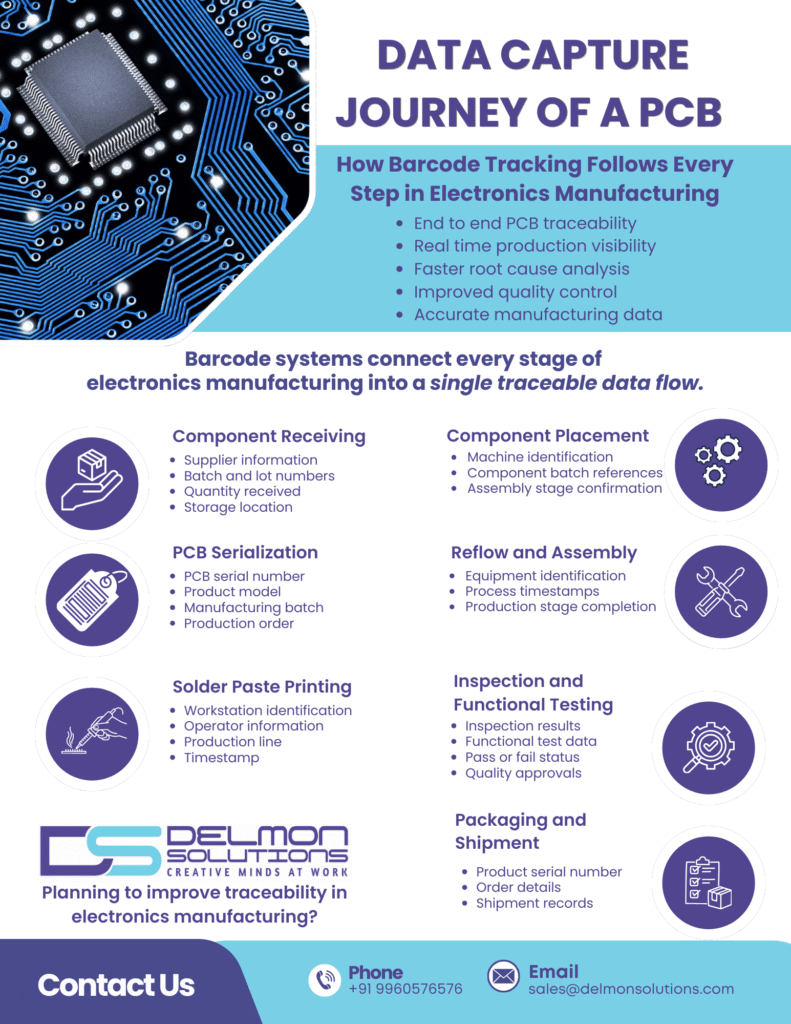
Component Receiving
When components arrive from suppliers, barcode scanning records supplier information, batch numbers, and inventory quantities.
PCB Production
Barcodes on PCBs allow manufacturers to track board movement through soldering, inspection, and assembly stages.
Assembly and Workstations
Operators scan components and assemblies to confirm correct process steps and maintain traceability.
Quality Inspection
Inspection data is linked to barcode IDs to maintain accurate product quality records.
Warehouse and Shipping
Finished products are scanned during packaging and shipping to ensure correct order fulfillment.
Benefits of Implementing Barcode Solutions in Electronics Manufacturing
Electronics manufacturers gain several operational advantages when they implement barcode tracking.
Key benefits include:
- Improved traceability across production processes
- Reduced human errors in data entry
- Faster production and inventory tracking
- Better quality control and compliance
- Increased operational visibility
These benefits help manufacturers improve productivity while maintaining high product quality standards.
Choosing the Right Barcode Solution for Electronics Manufacturing
When selecting a barcode solution, electronics manufacturers should consider several factors.
Important considerations include:
- Compatibility with ERP and MES systems
- Scanner performance for small or high-density codes
- Durability of labels in industrial environments
- Support for direct part marking on PCBs or components
- Scalability for future production growth
Selecting the right combination of barcode printers, scanners, and software ensures long-term operational efficiency.
The Role of Barcode Systems in Smart Manufacturing
Barcode technology plays an important role in modern smart factories. By capturing accurate production data, barcode systems support digital manufacturing initiatives such as Industrial IoT, automated production monitoring, and data-driven decision making.
As electronics manufacturing becomes increasingly automated, barcode systems will continue to serve as the foundation for product identification and production traceability.
Electronics manufacturing requires precise tracking, strict quality control, and efficient production processes. Barcode systems provide a reliable and scalable solution for managing these requirements.
By enabling accurate data capture, real-time production visibility, and complete component traceability, barcode systems help manufacturers improve efficiency, reduce errors, and maintain high product quality.
For electronics manufacturers aiming to scale operations and meet compliance requirements, barcode systems are not just helpful tools. They are essential infrastructure for modern manufacturing environments.
Frequently Asked Questions (FAQs)
What is a barcode system in electronics manufacturing?
A barcode system in electronics manufacturing is a tracking solution that uses barcodes or 2D codes to identify and monitor components, printed circuit boards (PCBs), and finished products throughout the production process. Barcode scanners capture the encoded data and integrate it with manufacturing systems such as ERP or MES to provide accurate, real-time production visibility.
Why are barcode systems important for electronics manufacturing?
Barcode systems are important because electronics manufacturing requires high accuracy, strict traceability, and efficient production tracking. Barcode scanning reduces manual data entry errors, improves inventory management, enables real-time work-in-progress tracking, and ensures that manufacturers can trace components and assemblies throughout the production lifecycle.
What types of barcodes are used in electronics manufacturing?
Electronics manufacturers commonly use both linear barcodes and two-dimensional codes. Linear barcodes such as Code 128 and Code 39 are typically used for packaging and inventory labels. Two-dimensional codes such as Data Matrix and QR codes are widely used for component marking and PCB traceability because they can store more information in a smaller space.
How do barcode systems improve traceability in electronics production?
Barcode systems improve traceability by linking each component, assembly, or product to a unique identifier. This identifier stores production information such as supplier details, batch numbers, assembly steps, inspection results, and production timestamps. If a defect occurs, manufacturers can quickly trace affected products and identify the root cause.
What equipment is required for a barcode system in manufacturing?
A typical barcode system in electronics manufacturing includes barcode labels or direct part markings, industrial barcode scanners, barcode printers, and integration with software systems such as ERP, MES, or inventory management platforms. Together, these tools allow manufacturers to capture and manage production data efficiently.

If you are exploring barcode solutions for electronics manufacturing or looking to improve traceability and production visibility, our team can help you identify the right barcode scanners and implementation approach for your operations. Feel free to reach out to discuss your requirements.